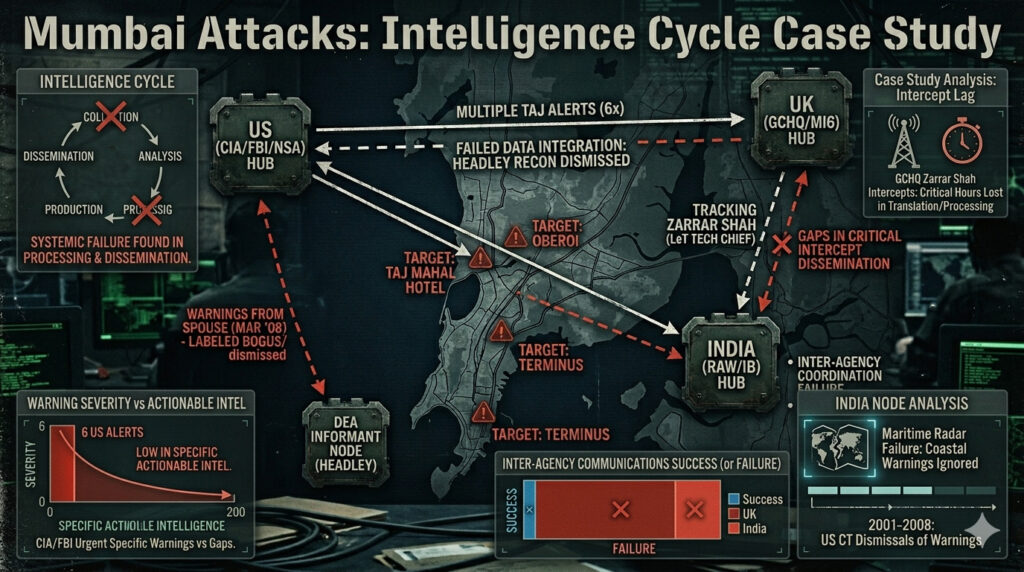

The Mumbai attacks intelligence failure remains one of the most studied examples of how fragmented data and communication gaps can lead to catastrophic security breaches.
This assessment deconstructs a “revised” report by Sebastian Rotella (ProPublica) regarding the 2008 Mumbai attacks. While the report highlights genuine, massive intelligence failures by the US, UK, and India, it appears strategically timed and sourced to malign the Pakistan Army and the ISI. By relying heavily on the testimony of David Coleman Headley – a heroin addict and DEA informant with a “too-good-to-be-true” cover – the report serves a specific political narrative aimed at sabotaging US-Pakistan defense relations and justifying international aid cutbacks.
3 Key Takeaways
- Systemic Western Failure: Authorities in the US (CIA/FBI) and UK (GCHQ) had multiple reports on David Headley and Zarrar Shah dating back to 2001, yet failed to “connect the dots” despite specific warnings about the Taj Hotel.
- Narrative Weaponization: The report’s release coincides with a $1 billion US arms sale to Pakistan, suggesting its primary function is to provide “intellectual ammunition” for lobbyists and media outlets seeking to block the deal.
- The “Headley” Contradiction: The credibility of the report rests on David Headley, whose background as a drug addict and his ease of access to top-tier militant leadership suggests either a highly flawed investigation or a manufactured intelligence persona.
BLUF (Bottom Line Up Front)
The ProPublica report is a sophisticated information operation. While it accurately exposes a global intelligence catastrophe, it selectively utilizes the testimony of a compromised asset (Headley) to link the ISI to the Mumbai plot. The ultimate goal is to paint Pakistan as a “rogue state” to influence US Congressional decisions on military aid and regional diplomacy.
Root Causes of the Intelligence Breakdown
The Credibility Gap: David Coleman Headley
The narrative surrounding Headley is riddled with inconsistencies that would fail standard intelligence vetting:
- The Asset Problem: The DEA used Headley as an informant while he was an active heroin addict. In professional law enforcement, such testimony is easily impeached.
- The Infiltration Myth: Headley’s rapid rise from a relative unknown to recruiting and fundraising for Lashkar-e-Taiba (LeT) in the US, while simultaneously meeting Hafiz Saeed and Ilyas Kashmiri, is statistically improbable for a standard operative.
- The “Invisible” Man: Despite being reported to the US Embassy in Islamabad three times in 2008 as a “terrorist, drug dealer, and spy” by his own wife, he remained free to scout targets.
Intelligence Breakdown vs. Complicity
The report details a “comedy of errors” across four nations:
- GCHQ/RAW: Tracked LeT technology chief Zarrar Shah in 2008 but failed to identify the specific threat.
- US Authorities: Claim to have warned India six times specifically about the Taj Hotel but failed to monitor their own asset (Headley) who was providing the coordinates.
- The Outcome: As stated by Shivshankar Menon, no one put the picture together until the shooting started.
Institutional Bias: Who is ProPublica?
To understand the article, one must look at the funding and pedigree of the publisher:
- Founders: Veterans of the Wall Street Journal and New York Times, outlets traditionally critical of the Pakistani military.
- Funding: Primarily the Sandler Foundation, which supports the Center for American Progress—a heavily left-leaning Democratic party lobbyist organization.
- The Agenda: This suggests the report is not just journalism, but a policy tool designed to shift the Democratic party’s stance on South Asian military aid.
Potential Threat Assessment
If this narrative gains traction in the US House and Senate, CommandEleven anticipates the following risks:
- Legislative Blocks: Usage of this data to halt the $1 billion weapons sale to Pakistan.
- Diplomatic Coercion: Increased pressure on the Government of Pakistan to “rein in” the ISI based on claims of rogue elements.
- International Isolation: Justification for EU and other allies to cut aid, painting Pakistan’s nuclear program as “out of control” compared to India’s “peaceful” status.
Timeline of Failure
- 2001–2008: US authorities ignore multiple warnings about Headley.
- Dec 2007–Apr 2008: Headley’s wife provides specific warnings to the US Embassy; they are dismissed as “bogus allegations from an angry spouse.”
- Sept 2008: Headley’s Chicago-based wife praises his “graduation” (reconnaissance completion) in coded emails.
- Oct 2009: FBI finally arrests Headley at O’Hare Airport, but only after a second recon mission to Denmark.