| Foresight Audit: Tracking the Predictive Lead |
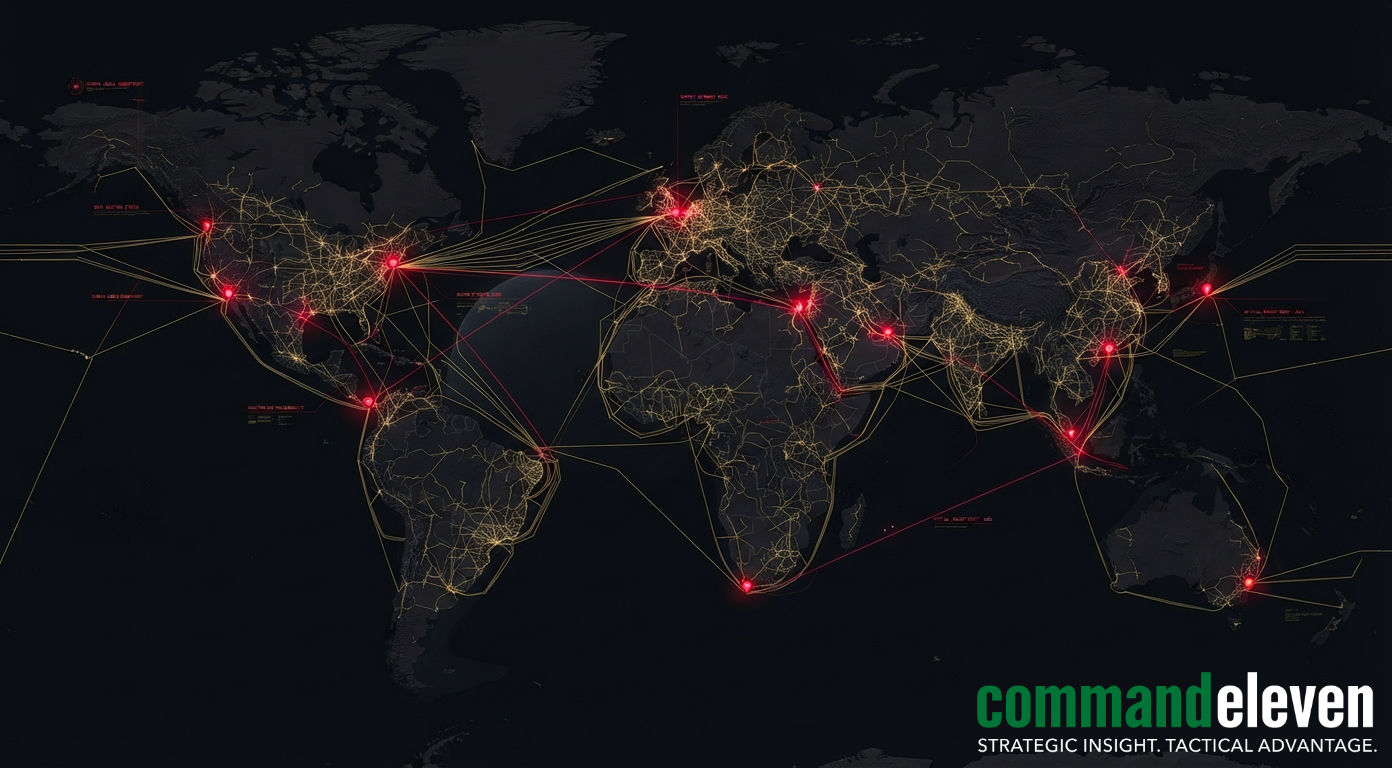
| CommandEleven Assessment [August 2022 / August 2023]: Technical audits on critical infrastructure and regional security frameworks documented that data routing controls and state-level structural vulnerabilities were not passive nodes, but operational assets being mapped for systemic population-scale profiling and targeted intervention. |
| On-Ground Manifestation [First Half 2026]: The convergence of conventional border shocks with aggressive routing manipulation, algorithmic containment, and localized narrative isolation confirms that infrastructure control is the primary mechanism driving cognitive dominance in modern warfare. |
Key Takeaways
- The Materiality of Cognitive Domain Control: Cognitive warfare cannot execute at scale without physical subversion of the transport layer. Control over subsea fiber splitters, LEO satellite routing protocols, and 5G cellular gateways dictates what data substrates reach the target audience.
- The Proximity of Interception Vectors: The decentralization of 5G architecture through Multi-access Edge Computing (MEC) shifts the vulnerability vector to the local perimeter. Adversaries exploiting edge nodes can run automated injection loops to alter localized trends and news feeds within minutes.
- Enforcement of Structural Truth: National-level narrative isolation exploits the illusory truth effect by systematically severing access to external data streams. When a population is confined to state-scrubbed channels via inverted BGP routing, the repeated exposure to the remaining data pool fabricates compliance.
Executive Summary
Modern cognitive warfare depends fundamentally on the physical transport layer. Hostile information operations cannot achieve strategic scale without exploiting the material pathways that route global data. This dossier examines how adversaries use subsea fiber-optic cables, low-Earth orbit (LEO) satellite constellations, and 5G cellular gateways as physical levers to manipulate information. By controlling these chokepoints, hostile actors can isolate target populations, degrade executive decision-making, and create state-level narrative monopolies. The physical network is not merely standard utilities infrastructure; it is the core delivery system for modern cognitive weapons.
Subsea Fiber-Optic Cables and Landing Site Vulnerabilities
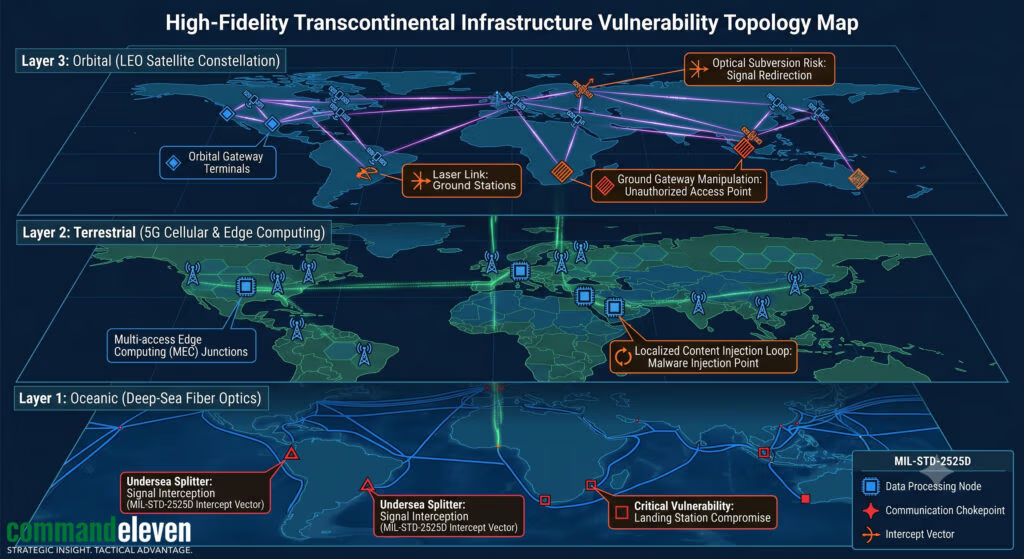
Subsea fiber-optic cables carry over 95 percent of all transcontinental data traffic. This massive concentration creates a highly centralized architecture vulnerable to hostile interception and physical subversion. Adversaries target these systems well below the surface or at localized landing stations where marine cables transition into terrestrial networks.
Deep-Sea Interception and Signal Splitting
Specialized naval assets manipulate undersea cables by installing non-invasive optical splitters. These devices divert a percentage of the light signal without disrupting the physical cable or triggering automated network loss alarms. This harvested data stream flows directly into high-speed computing facilities. There, machine-learning models sort the raw data to extract detailed psychographic profiles of the target populations.
Terminal Landing Station Vulnerabilities
Landing stations are high-value, centralized facilities where subsea networks link into domestic infrastructure. These nodes are exceptionally vulnerable to covert kinetic operations or insider subversion. By compromising a single landing station, an adversary can deploy deep-packet inspection (DPI) arrays to monitor, delay, or manipulate all incoming traffic. This allows operators to run targeted information filtering before data ever reaches domestic consumers.
Satellite Routing Constellations and Extraterrestrial Chokepoints
The rapid expansion of commercial and state-managed low-Earth orbit (LEO) satellite networks has shifted critical parts of the transport layer into space. While these systems offer crucial redundancy when terrestrial fiber networks fail, they introduce severe systemic vulnerabilities at the orbital routing level.
Optical Inter-Satellite Link (OISL) Subversion
Modern LEO networks use laser-driven Optical Inter-Satellite Links (OISLs) to route data directly through space, bypassing terrestrial borders. This creates a highly secure environment, but it concentrates immense control within the satellite network’s routing software. If an adversary compromises the orbital command-and-control software, they can alter routing protocols to selectively drop, delay, or modify data packets. This creates an invisible, space-based informational block.
Ground Gateway Interdiction
Satellites must communicate with terrestrial environments through localized downlinks and ground stations. These facilities are bound to specific legal and physical jurisdictions. Hostile states use regulatory pressure or kinetic threats to force satellite operators to route traffic through state-controlled ground gateways. This exposes formerly secure satellite data to direct government filtering, content injection, and surveillance networks.
5G Gateways and Edge-Computing Manipulation
The transition to 5G network architectures alters how data flows by shifting processing power away from central servers down to the edge of the network. This distributed framework expands the available surface area for sophisticated cognitive operations.
User Plane Function (UPF) Subversion
The User Plane Function (UPF) is the primary routing core of a 5G gateway, managing the delivery of data packets to individual devices. If an operator or adversary compromises the UPF, they can dynamically alter the content delivered to specific users. This enables hyper-targeted micro-targeting, allowing operators to manipulate localized information feeds based on real-time cell-tower location data.
Edge-Computing Injection Loops
5G networks use Multi-access Edge Computing (MEC) to process data closer to the end-user, reducing latency down to fractional levels. This low latency is essential for complex applications, but it creates a localized vector for narrative injection. By deploying malware to compromised edge nodes, adversaries can run automated injection loops that alter localized search results, social media trends, and news feeds within minutes. This occurs long before centralized security filters can detect the anomaly.
National-Level Narrative Isolation Vectors
By coordinating interventions across subsea cables, satellite downlinks, and 5G gateways, a state can execute national-level narrative isolation. This strategy cuts off a target population from external data while flooding domestic networks with state-approved information.
Algorithmic Borders and Inverted Routing
During geopolitical crises, a state can alter national Border Gateway Protocol (BGP) routing tables to force all domestic traffic through government-managed data scrubbing centers. This inverted routing allows state agencies to suppress foreign perspectives, eliminate independent reporting, and enforce a unified narrative monopoly across the population substrate.
Cognitive Echo Chambers at National Scale
Total narrative isolation exploits a psychological vulnerability known as the illusory truth effect: repeated exposure to information increases the likelihood that individuals will accept it as factual truth. When an adversary cuts off external counter-narratives, the isolated population has no choice but to process the state’s manufactured reality. This structural isolation erodes public trust in independent institutions, damages social cohesion, and builds collective compliance across the target nation.
Infrastructure-to-Cognitive Mapping Matrix
| Infrastructure Vector | Technical Chokepoint | Cognitive Vulnerability | Strategic Impact |
| Subsea Fiber Cables | Landing Stations / Optical Splitters | Data Stream Exposure & Profiling | Enables population-scale psychographic mapping. |
| LEO Satellite Arrays | OISL Routing Software / Downlinks | Selective Data Dropping & Delays | Creates invisible, space-based informational blocks. |
| 5G Cellular Gateways | User Plane Function (UPF) Nodes | Hyper-Targeted Feed Manipulation | Drives localized micro-targeting at machine speed. |
| BGP Routing Arrays | Border Routing / Core Gateways | The Illusory Truth Effect | Enforces complete, national-level narrative isolation. |
Strategic Conclusion and Analytical Outlook
The physical components of global networks are not passive conduits; they are active levers used to achieve cognitive dominance. Defensive doctrines must move past treating information operations as purely digital content threats. True cognitive defense requires hardening physical infrastructure: securing subsea cable landing stations, building independent orbital routing networks, and implementing strict integrity audits across 5G gateway architectures. If a state fails to protect the physical transport layer, it cedes control of its national consciousness to its adversaries.