Summary
By February 2026, the long-simmering tension between Islamabad and the Islamic Emirate of Afghanistan (IEA), the Taliban, transitioned from “shadow war” to “open confrontation.” Following the collapse of the Qatar-mediated ceasefire, Pakistan launched Operation Ghazab Lil Haq (Righteous Fury), striking targets in Kabul, Nangarhar, Khost, and Kandahar. However, the true casualty of this escalation was not just military infrastructure; it was the final death of the “Strategic Depth” doctrine.
While Pakistan maintains conventional military superiority, it is currently losing the Narrative War. The Taliban have successfully reframed themselves from a “client state” to a “defiant sovereign,” leveraging a decentralized digital ecosystem that moves faster than Pakistan’s institutional communication. To win, Pakistan must shift from a reactive, military-led messaging model to a proactive, multi-dimensional cognitive strategy.
Key Takeaways
- The Cyber-Physical Nexus: Modern conflict in this region is no longer purely kinetic. Military operations are now synchronized with cyber-attacks on surveillance infrastructure and real-time disinformation campaigns. Success is defined by the “Digital Ambush Vector,” where the first narrative to reach the public screen,regardless of factual accuracy,becomes the established truth.
- The “Taliban Paradox” and Narrative Asymmetry: The Taliban and TTP have successfully reframed the conflict as a defense of sovereignty and “One Jihad,” effectively dissolving the distinction between the two groups in the cognitive domain. Pakistan struggles to counter this because its current anti-terror narrative contradicts its historical endorsement of the Taliban, leading to a loss of credibility in tribal border regions.
- Institutional Obsolescence of the ISPR: The centralized “Command-and-Control” model of Pakistan’s media wing is failing in a decentralized era. By the time official statements are vetted and released, the adversary has already “meme-ified” the event. To regain the initiative, the text argues for a “5-R Approach”: decentralizing narrative authority to local voices, reducing response times to 15 minutes, and shifting from military-led messaging to civilian-led “democratic legitimacy.”
The security architecture of South Asia, long defined by porous borders and kinetic engagements, has reached a critical inflection point. As we navigate the complex, multi-polar landscape of 2026, the Pakistan-Afghanistan “Conflict Cluster” is no longer a localized border dispute, but a sophisticated laboratory for hybrid warfare. We are witnessing a fundamental shift, where the physical struggle for control along the Pakistan-Afghanistan border is matched by an equally potent, and arguably more disruptive, invisible battle occurring in the digital and psychological domains.
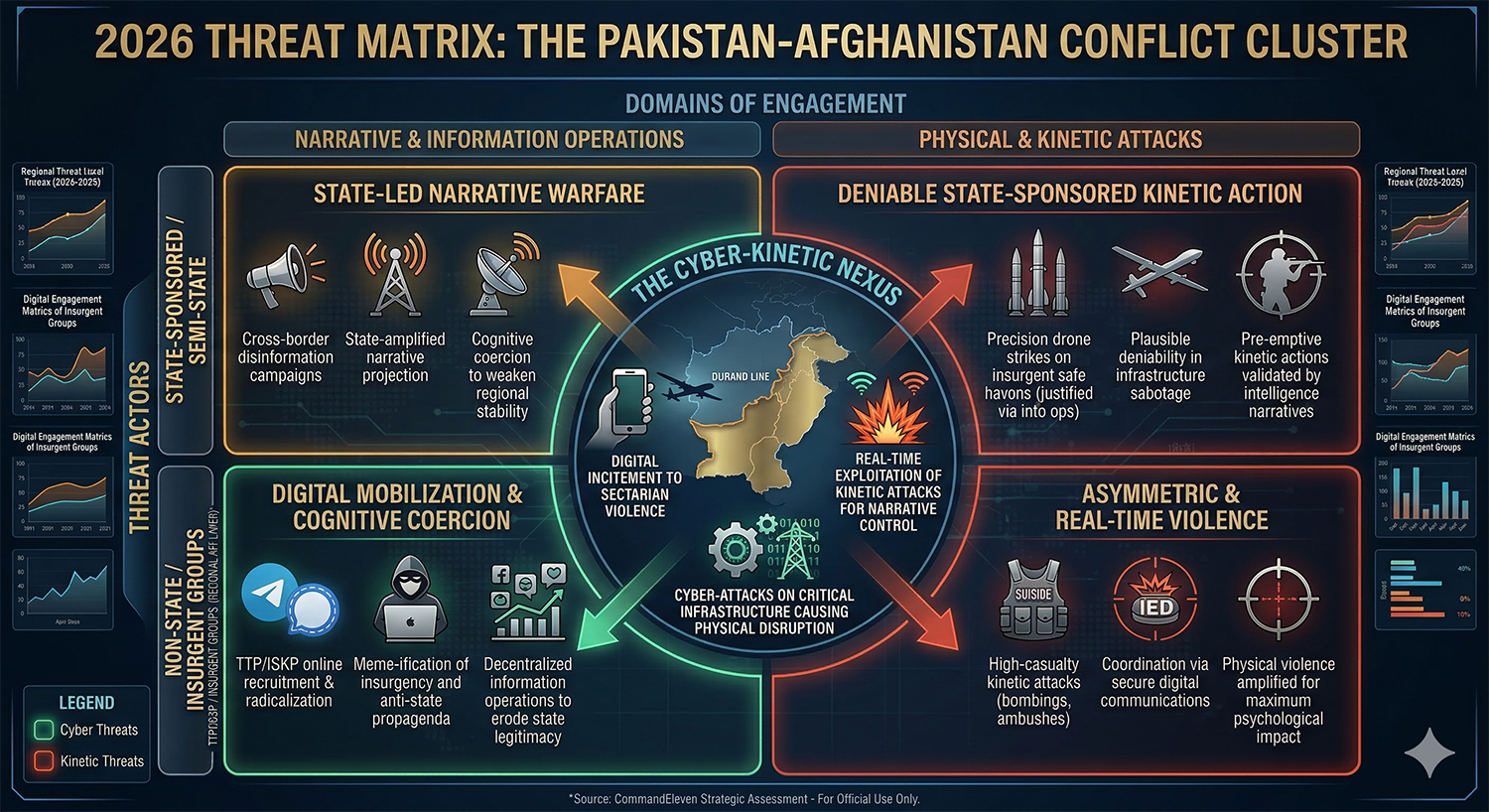
This is the era of the Cyber-Kinetic Model. Where an improvised explosive device (IED) attack in Khyber Pakhtunkhwa is coordinated and celebrated across encrypted networks, amplified by disinformation campaigns, and potentially synchronized with a cyber strike against regional data centers. Security agencies, risk consultants, and corporate entities operating in this sphere can no longer analyze threats in isolation. To fail to recognize the interdependence of cyber capabilities and ground reality is to accept an intelligence gap that our adversaries exploit with devastating precision.
The Pakistan-Afghanistan border, always a point of contention for Afghan Pashtuns, has evolved into the central nexus of this hybrid conflict. It is a line where kinetic action meets information control, where non-state actors leverage digital asymmetry, and where regional powers, including India and China, employ disruptive intelligence to reshape the strategic balance.
This Strategic Assessment is a framework to understand this new operational reality.
This is not just an academic exercise; it is an analytical imperative.
We must unpack how the “Old Wars” of territory and insurgency have grown into the “New Wars” of digital authority, infrastructure disruption, and cognitive manipulation.
Pillar I: Strategic & Regional Overwatch
Assessing Regional Security Intelligence and Geopolitical Risk
Effective strategy begins with an unimpeded view. Regional Security Overwatch is the cornerstone of CommandEleven’s methodology, providing the necessary distance to recognize that localized skirmishes are often manifestations of larger, coordinated campaigns. In 2026, maintaining this oversight along the Pakistan-Afghanistan axis requires deciphering a layered, three-dimensional threat matrix.
The Hybrid Consolidation of Non-State Actors: TTP and ISKP
The operational landscape has been dominated by the adaptive strategies of the Tehreek-e-Taliban Pakistan (TTP) and Islamic State – Khorasan Province (ISKP). Both organizations have moved beyond traditional guerrilla warfare, integrating cyber-kinetic capabilities to enhance their reach and lethality.
- TTP’s Decentralized Digital Command: The TTP has successfully exploited the vacuum of governance on both sides of the border. They have integrated sophisticated communication tools to synchronize operations, using end-to-end encrypted messaging platforms for command and control (C2) and propaganda dissemination. Their hybrid model allows them to maintain a decentralized structure, making it difficult for kinetic strikes to neutralize leadership, while simultaneously projecting an image of unified force.
- ISKP’s Information Dominance Strategy: ISKP, though often competing with the TTP, excels in the psychological dimension. Their propaganda is a strategic asset, designed not just for recruitment but to cause political destabilization. By controlling narratives on social media and creating digital echo chambers, they foster regional fractures, targeting ethnic and sectarian minorities to incite violence. This digital agitation directly correlates to an increase in kinetic activity on the ground.
Our Overwatch confirms that these groups are now employing “A/B Testing” of their propaganda messaging and leveraging data analysis to identify optimal targets for both physical and digital disruption. They are not merely utilizing technology; they have weaponized the information environment to create what CommandEleven terms a Digital Ambush Vector.
The Pakistan-Afghanistan Border: A Cyber-Physical Nexus of Vulnerability
The physical border, always porous, is now mirrored by a digital border that is equally difficult to secure. CommandEleven has identified key “Conflict Clusters” along the Pakistan-Afghanistan border where hybrid warfare techniques are intersecting:
- Infiltration vs. Surveillance Integration: While kinetic efforts focus on fencing and personnel deployment, non-state actors use disruptive cyber tactics to interfere with electronic surveillance systems and communication infrastructure. A synchronized physical crossing often follows a coordinated (and often unattributed) electronic attack to blind forward operating bases.
- Narrative Displacement of Sovereignty: Through information operations, non-state groups create parallel governance narratives. ISKP and TTP both utilize digital platforms to claim territorial control and present themselves as the “legitimate authority,” directly challenging the state’s narrative of sovereignty. This erosion of psychological authority precedes the physical contest for control.
Geopolitical Dimensions of Hybrid Warfare
The regional dynamics in 2026 cannot be separated from the geopolitical competition. Our Overwatch recognizes a clear escalation in “Disruptive Intelligence” from external state and semi-state actors.
The Pakistan-Afghanistan conflict cluster serves as a proxy battlefield where external powers, including India, China, and Russia, employ non-kinetic means to secure strategic interests:
- Narrative Amplification (Information Operations): State-sponsored or state-aligned digital campaigns amplify TTP and ISKP propaganda to increase internal pressure on the Pakistani state, manipulating international perception to isolate Islamabad.
- Infrastructure as a Strategic Target: CommandEleven predicts a marked increase in deniable cyber operations targeting critical infrastructure, energy grids, and communication lines, synchronized with geopolitical tension. These acts are designed to create panic, degrade military readiness, and weaken the state’s resolve, all while maintaining plausible deniability.
This is the complexity that standard security models fail to capture. The Conflict Cluster is not static; it is a high-speed, data-driven theater of war where physical movement on the ground is merely the visible manifestation of a conflict that began, and continues to be fought, in the digital and cognitive realms.
Pillar I (Narrative Focus): The Asymmetry of Storytelling
Why the Taliban is Winning the Digital Front
In the current conflict, the Taliban are not just fighting with captured US hardware; they are fighting with Narratives of Resistance. Despite a floundering economy and international isolation, they have maintained a superior “Battle of the Story” for three primary reasons:
Speed over Verification: The “Meme-ification” of Conflict
The Taliban’s information machinery, led by figures like Zabihullah Mujahid, has evolved into a distributed, fluid network. During the February 2026 airstrikes, Afghan digital accounts were circulating manufactured images of “civilian casualties” and “downed drones” within minutes of the first explosions.
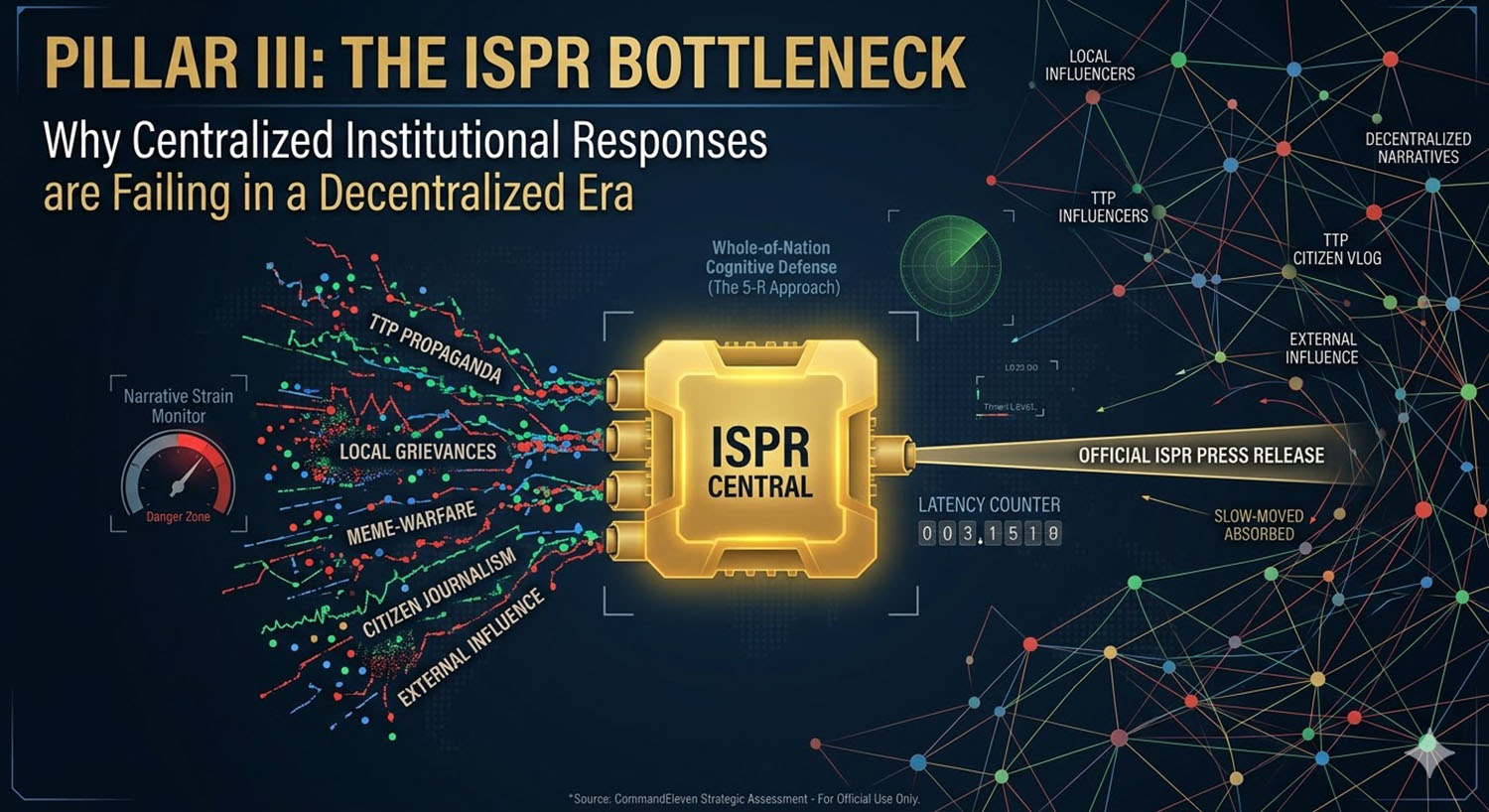
In contrast, Pakistan’s Inter-Services Public Relations (ISPR) remains tethered to a centralized, institutional verification process. While this ensures higher factual accuracy, it creates a Narrative Vacuum. By the time an official ISPR press release is issued, the “Afghan victimhood” narrative has already been “meme-ified,” translated into multiple languages, and solidified in the regional consciousness.
In cognitive warfare, the first story to reach the screen often becomes the “truth.”
The “Sovereignty” vs. “Intervention” Frame
The Taliban have successfully flipped the script on Pakistan’s historical role. They portray Pakistan not as a former patron, but as a “subservient agent of external powers” or an “aggressor” violating Afghan soil. This resonates deeply with Afghan Pashtun nationalism. Even Afghan Pashtuns, who loathe the Taliban’s social policies, find themselves “rallying around the flag” when the narrative is framed as a defense of the homeland against Pakistani airstrikes.
Pakistan, conversely, struggles to frame its actions. Is it a counter-terrorism operation against the TTP? Or an “Open War” against the IEA? This ambiguity allows the Taliban to paint Pakistan as confused and strategically desperate.
Ideological Consistency vs. Strategic Paradox
The Taliban’s narrative is simple and consistent: Jihad, Sovereignty, and Islamic Identity. They do not need to explain away 30 years of complex proxy history.
Pakistan, however, faces a “Taliban Paradox.”
For decades, the state narrative legitimized the Taliban as “freedom fighters” against foreign occupation. Now, the state must characterize the same ideological DNA,as manifested in the TTP,as “terrorist.” This cognitive dissonance creates a “Legitimacy Deficit” within Pakistan’s own borders, particularly in the tribal belts, where the TTP exploits this confusion to justify their own “Jihad” against the Pakistani state.
Pillar II: The TTP-Kabul Nexus
Ideological vs. Transactional Narratives
In the strategic geography of 2026, the boundary between the Tehreek-e-Taliban Pakistan (TTP) and the Afghan Taliban (IEA) has effectively dissolved in the cognitive domain. While Islamabad attempts to treat them as distinct entities, one a “terrorist insurgent” and the other a “neighboring government,” the TTP and Kabul have successfully projected a narrative of Inseparable Brotherhood.
This nexus is built on two competing narrative pillars: the Ideological Bond (for the masses) and the Transactional Leverage (for the bargaining table).
The “One Jihad” Doctrine
The TTP’s most potent narrative tool is the claim of ideological continuity. They frame their campaign against the Pakistani state not as a localized insurgency, but as the “natural extension” of the Afghan Taliban’s “victory” over the United States.
- The Bay’ah (Oath of Allegiance): The TTP leadership consistently reaffirms its loyalty to the Afghan Taliban’s Supreme Leader, Hibatullah Akhundzada. This creates a “Sanctuary of Legitimacy.” By positioning themselves as soldiers of the same Emirate, the TTP makes it religiously and politically impossible for Kabul to fully “crack down” on them without appearing to betray their own creed.
- The Narrative of “Incomplete Shariah”: The TTP argues that while Afghanistan is liberated, Pakistan remains a “security state” under Western-derived legal systems. This resonates with the ultra-conservative segments of the Pashtun belt, effectively painting the Pakistani military as an “occupying force” similar to the former NATO presence in Kabul.
Kabul’s Transactional Ambiguity
The Afghan Taliban use the TTP as a Strategic Counter-Weight. Their narrative toward Pakistan is one of “principled neutrality” mixed with “deniable irritation.”
- The “Internal Problem” Frame: Whenever Pakistan presents evidence of TTP sanctuaries in Kunar or Paktika, Kabul’s response is a masterpiece of narrative deflection: “The TTP is a product of Pakistan’s own internal failures; do not export your security crises to Afghan soil.” This shifts the burden of proof and the blame for violence entirely onto Islamabad’s doorstep.
- Leverage in Trade and Transit: Kabul subtly links the security of the TTP to broader bilateral issues, such as the APTTA (Afghan-Pakistan Transit Trade Agreement) and the treatment of Afghan refugees. The implied narrative is: If you pressure us on the TTP, we will make your Western trade routes and border stability untenable.
Dismantling the Border: The “Pakistan-Afghanistan border is a Line in the Sand”
The TTP and Kabul have aligned on a powerful nationalist narrative: the rejection of the Pakistan-Afghanistan border. By framing the border as an “artificial colonial imposition,” they provide a moral justification for the TTP’s cross-border movement.
When Pakistan reinforces the border fence, the Taliban narrative isn’t about security; it’s about “Dividing the Ummah” and “separating families.” This turns a technical security measure into a grievance that fuels recruitment.
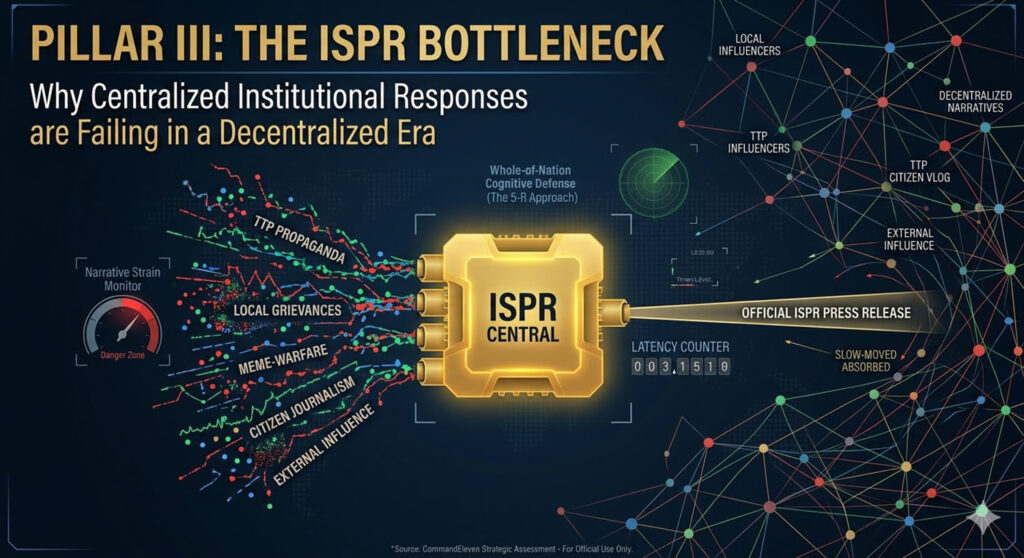
Pillar III: The ISPR Bottleneck
Why Centralized Institutions are Failing in a Decentralized Era
For decades, the Pakistan Army’s Inter-Services Public Relations (ISPR) was the undisputed master of the national narrative. However, in the hyper-decentralized environment of 2026, the “Single Source of Truth” model is becoming a strategic liability.
The Speed-Credibility Gap
The TTP’s media wing, Umar Media, operates like a guerrilla newsroom. They release raw, unedited footage of attacks or “governance” in tribal areas almost instantly.
The ISPR, by contrast, operates on a Command-and-Control model. Information must be vetted, cleared by multiple tiers of leadership, and packaged into high-production videos or formal tweets. This delay creates a “Golden Hour” where the adversary’s version of events, no matter how false, dominates the global and local news cycle.
In the time it takes for a colonel to approve a press release, a TTP TikTok has already reached 2 million views.
The “Institutional Tone” Problem
State messaging often sounds like a lecture. It is formal, patriotic, and defensive. In the 2026 information war, the target audience (disenchanted youth in border regions) responds more to authenticity and emotion than to institutional authority.
- The Taliban’s “Poetic” Narrative: The Taliban use Pashto poetry, religious hymns (nasheeds), and “vlog-style” content that feels personal and grassroots.
- The State’s “Bureaucratic” Narrative: Pakistan’s response often relies on heavy-handed nationalism that can feel disconnected from the daily hardships of people living in conflict zones. This “Tone Deafness” allows the TTP to position themselves as the “voice of the oppressed.”
The Over-Reliance on “Fifth Generation Warfare” Rhetoric
By constantly labeling all domestic dissent or regional criticism as “Fifth Generation Warfare” (5GW), the state has inadvertently diluted its own message. When every critical tweet is framed as a foreign conspiracy, the public becomes desensitized. This “crying wolf” effect makes it harder for the state to mobilize the public when a genuine foreign-funded information operation occurs.
The Selection of Media Proxies and Blue-Eyed Boys
The Pakistan Army has long suffered from the problem of attempting to pick nobodies from the populace and turn them into superstars defending the ISPR crafted narrative. In the current digital environment, the model has been significantly deteriorated with companies, X handles and YouTube channels being launched with wholly patriotic sounding names, which are actually run directly from ISPR Headquarters in Rawalpindi. From writing the tweets to stealing ideas from others, an ecosystem has been built to support useful idiots that do more damage to Pakistan’s narrative credibility than enhance or support it, for the simple reason they don’t have a clue what they are talking about. There is no internal cognitive process to what’s being put out publicly for consumption. Boosted engagement delivers bigger paychecks from the khaki supporters, intelligence and competence does not.
Strategic Intelligence: Building the 5-R Approach
To regain the initiative, Pakistan must move toward a “Whole-of-Nation” Cognitive Defense:
- Revisit the Doctrine: Move away from the “Strategic Depth” ghost. Explicitly separate the Afghan state from the Afghan people in all messaging to avoid “rally around the flag” effects in Kabul.
- Reach Out (Localize): Shift narrative power from Rawalpindi to Peshawar and Quetta. Allow regional voices,journalists, scholars, and tribal leaders,to lead the counter-narrative in their own dialects and styles. A story told by a local tribal elder against TTP violence is 10x more effective than a graphic from a government office.
- Reduce Response Time: Create “Rapid Narrative Cells” that have the authority to release raw, factual information within 15 minutes of an incident, bypassing the long approval chain. Weaponize transparency by sharing verifiable, high-definition intelligence in real-time.
- Reinforce Civilian Institutions: The lead on narrative warfare should shift from the military (ISPR) to civilian platforms like NACTA and the Ministry of Information. This lends the message “democratic legitimacy” rather than “martial authority.”
- Reintegrate and Rehabilitate: The narrative must offer a “Way Out.” Instead of just “annihilating terrorists,” the state must broadcast the successes of those who have left the TTP, highlighting the failures of the “Jihad” and the benefits of returning to the national fold.