Executive Summary
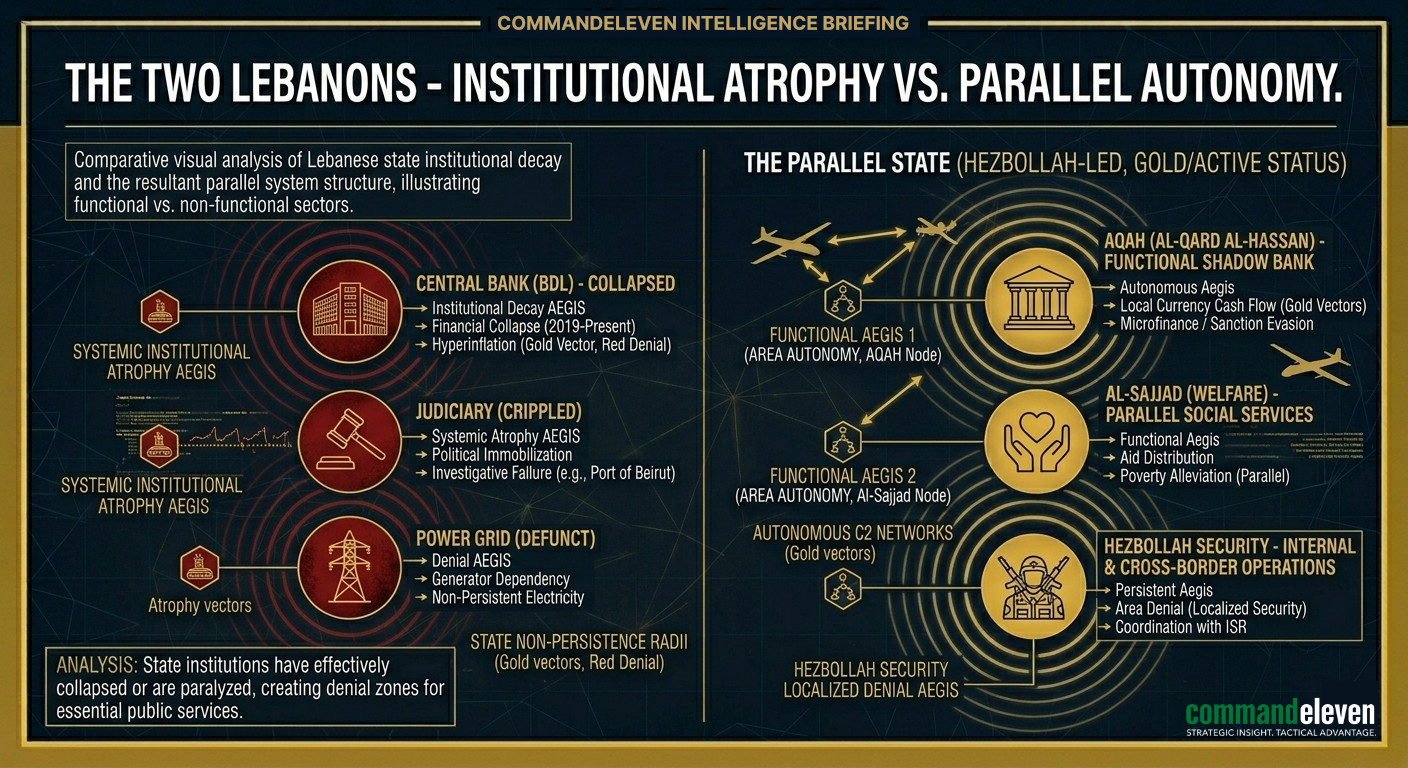
The Lebanese Republic is currently traversing the terminal phase of institutional atrophy. Since the financial collapse of 2019, the state’s ability to provide basic services, maintain a monopoly on violence, or regulate its monetary system has largely evaporated. This vacuum has been systematically filled by Hezbollah, which has utilized the crisis to expand its parallel socio-economic and security ecosystem. As of May 2026, Lebanon exists as a “hollow state,” where formal institutions serve as a facade for a non-state actor that manages its own banking, logistics, and welfare networks.
3 Key Takeaways
- State Irrelevance: Formal Lebanese institutions are no longer the primary movers of the economy or security; they have been superseded by a non-state “Resistance” infrastructure.
- The Hard Currency Edge: Hezbollah’s access to USD and an informal cash economy has made it the most stable employer and social provider in the country, incentivizing public alignment with the party.
- Irreversible Atrophy: The depth of judicial and financial decay suggests that a return to a centralized, sovereign Lebanese state is improbable without a total overhaul of the post-Taif political settlement.
The Mechanics of State Dissolution
The decay of the Lebanese state is not a passive byproduct of neglect but a consequence of systemic “elite capture” and the deliberate paralysis of regulatory bodies.
- Monetary Suicide: The Lebanese Lira (LBP) has ceased to function as a store of value. The banking sector’s de facto insolvency has locked depositors out of their life savings, forcing the economy into a primitive, cash-only state. This environment favors actors with access to external hard currency (USD) and illicit regional trade flows.
- Judicial Paralysis: The investigation into the 2020 Beirut Port explosion remains the definitive case study of institutional decay. Persistent political interference and the intimidation of judges have rendered the judiciary incapable of holding the ruling elite or paramilitary groups accountable, signaling a total collapse of the rule of law.
- Public Service Vacuum: State-provided electricity and water are virtually non-existent in many regions. The National Social Security Fund (NSSF) is bankrupt, leaving the majority of the population without a healthcare safety net.
Hezbollah’s Parallel State: The Al-Sajjad Ecosystem
As the formal state retracted, Hezbollah deployed a sophisticated, self-sufficient infrastructure to maintain its constituency and project power beyond its traditional base.
Financial Sovereignty: Al-Qard al-Hassan (AQAH)
The AQAH association now functions as Lebanon’s primary “shadow bank.”
- Infrastructure: Operating through over 30 branches and specialized ATMs, it provides interest-free micro-loans and gold-backed credit.
- Resilience: Because it operates entirely outside the SWIFT system and the Banque du Liban’s oversight, it is insulated from both domestic collapse and international sanctions. It has effectively become the central bank of the “Resistance Economy.”
Logistical and Consumer Control
- The Al-Sajjad Cards: Hezbollah has issued subsidized “Al-Sajjad” loyalty cards to thousands of families. These cards provide access to a network of co-operative supermarkets stocked with Iranian and Syrian goods, bypassed by state customs.
- Energy and Fuel: When state fuel supplies collapsed, Hezbollah organized the direct import of Iranian diesel via the Syrian border, distributing it through its own networks to hospitals and private generators, further undermining the Ministry of Energy’s relevance.
The Erosion of Security Sovereignty
The Lebanese Armed Forces (LAF), once viewed as the sole unifying national institution, is struggling to maintain operational readiness as soldier salaries have lost nearly 90% of their purchasing power.
- Security Substitution: In the South, the Beqaa, and the Southern Suburbs of Beirut, Hezbollah’s security apparatus manages checkpoints, local intelligence, and conflict resolution.
- Intelligence Primacy: Hezbollah’s signals intelligence (SIGINT) and fiber-optic communication networks are more resilient and technologically advanced than the state’s legacy systems, allowing for total domain awareness in contested areas.
Geopolitical Implications: The “Iranian Land Bridge” Terminal
Lebanese institutional decay serves a strategic purpose for regional actors. A weakened state ensures that Lebanon remains a friction-less transit point for the “Axis of Resistance.”
- Border Porosity: The lack of state control over the Port of Beirut and the land crossings to Syria facilitates the unhindered transfer of precision-guided munition (PGM) components and dual-use technology.
- Sovereignty for Sale: The paralysis of the Lebanese presidency (vacant or contested) ensures that no sovereign decision can be made that contradicts Hezbollah’s strategic requirements, effectively tethering Lebanese foreign policy to Tehran’s regional objectives.