Executive Summary
As of May 2026, the Mekong sub-region has emerged as a high-risk theater for cyber-kinetic convergence, where digital intrusions are specifically engineered to trigger catastrophic physical failures in critical infrastructure. This technical assessment identifies a systemic vulnerability within regional energy grids, hydroelectric management, and industrial control systems (ICS) across Thailand, Vietnam, and Cambodia. The integration of insecure legacy SCADA protocols with modern, internet-facing “Smart City” networks has expanded the attack surface for state-sponsored Advanced Persistent Threats (APTs). These actors have transitioned from traditional espionage to the “pre-positioning” of autonomous malware designed to disable mechanical safety protocols. CommandEleven Intelligence warns that the window for human intervention is closing, necessitating a shift toward hard air-gapping, mechanical redundancies, and AI-driven active defense to prevent regional grid collapse or weaponized water deprivation.
3 Key Takeaways
- Industrialization of Cyber-Sabotage: Regional APTs have evolved from data theft to “logic-bomb” exploits, targeting Programmable Logic Controllers (PLCs) to override physical safety limits and induce hardware destruction.
- Weaponization of the Water-Energy Nexus: The Mekong’s hydroelectric infrastructure is a primary kinetic target; unauthorized digital control over sluice gates presents a non-linear threat of artificial flooding or downstream water deprivation.
- Obsolescence of Traditional Defense: The emergence of AI-driven, autonomous malware and the weaponization of the Industrial Internet of Things (IIoT) render reactive, human-speed patching ineffective, requiring a move toward “zero-trust” hardware and analog failsafes.
SCADA and ICS Vulnerability Audit
The industrial landscape of the Mekong region relies on a heterogeneous mix of legacy hardware and modern internet-connected sensors. This hybrid architecture has created a “vulnerability bridge,” where security flaws in decades-old protocols are now exposed to the global threat landscape.
Legacy Systems Integration and Protocol Insecurity
Supervisory Control and Data Acquisition (SCADA) systems in the regional power and water sectors frequently utilize protocols such as Modbus or DNP3. These protocols were originally designed for isolated serial networks and lack native encryption or authentication mechanisms.
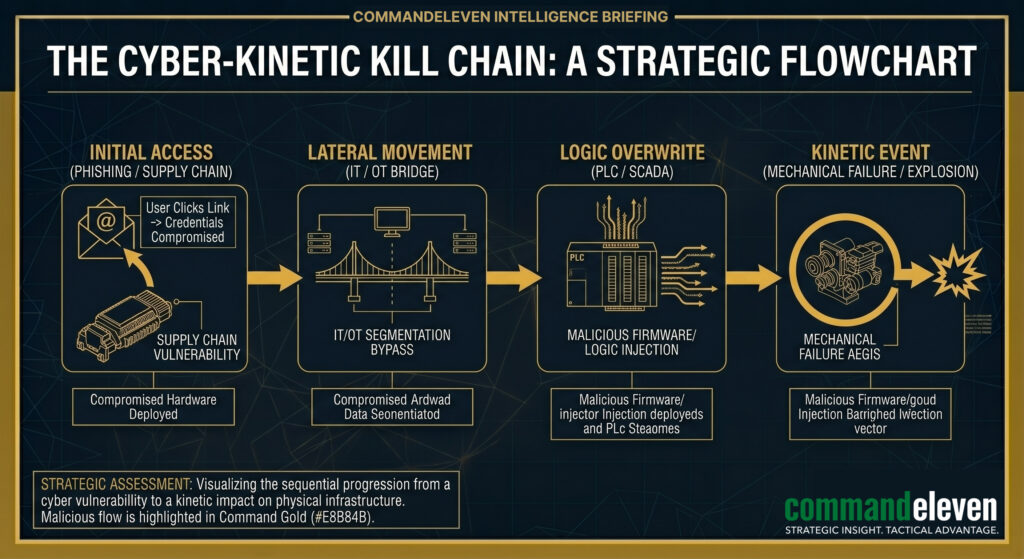
- The IT/OT Convergence Risk: As utilities in Thailand and Vietnam integrate operational technology (OT) with corporate IT networks for data analytics, these insecure protocols become accessible to remote attackers. A compromised workstation in a corporate office can serve as a pivot point to inject malicious commands directly into the SCADA master station.
- Cleartext Vulnerabilities: Because these protocols transmit data in cleartext, an adversary with “man-in-the-middle” access can intercept sensor readings and inject false data, leading operators to take corrective actions for non-existent problems – a tactic known as “deceptive data injection.”
PLC Exploitation and Safety Instrumentation Systems (SIS)
The core of cyber-kinetic warfare lies in the manipulation of Programmable Logic Controllers (PLCs) that manage the physical parameters of machinery.
- Logic Overwrites: Technical analysis of 2026-era APT (Advanced Persistent Threat) signatures indicates a shift toward “logic-bomb” exploits. Attackers do not merely shut down a PLC; they overwrite its control logic to disable mechanical safety limits. For instance, by overriding pressure relief valves in a thermal power plant, an attacker can induce a catastrophic boiler explosion.
- Targeting the SIS: The most sophisticated threats target the Safety Instrumentation Systems (SIS) – the “last line of defense.” By neutralizing the SIS, an attacker ensures that physical failsafes will not trigger when the primary control system is driven into a hazardous state.
Supply Chain Contamination
The hardware supply chain for the Mekong’s digital infrastructure is a primary vector for state-sponsored infiltration.
- Embedded Malware: CommandEleven has identified instances of “pre-compromised” hardware, including industrial gateways and network switches, entering the regional market. These devices contain hardcoded backdoors or dormant malware at the firmware level, allowing for persistent access that survives traditional software wipes.
- Component Origin Risks: The lack of a unified “trusted vendor” framework in the Mekong sub-region allows for the procurement of critical components from high-risk manufacturers, increasing the probability of “kill-switches” being embedded within the regional power grid.
Strategic Targets: The Energy-Water Nexus
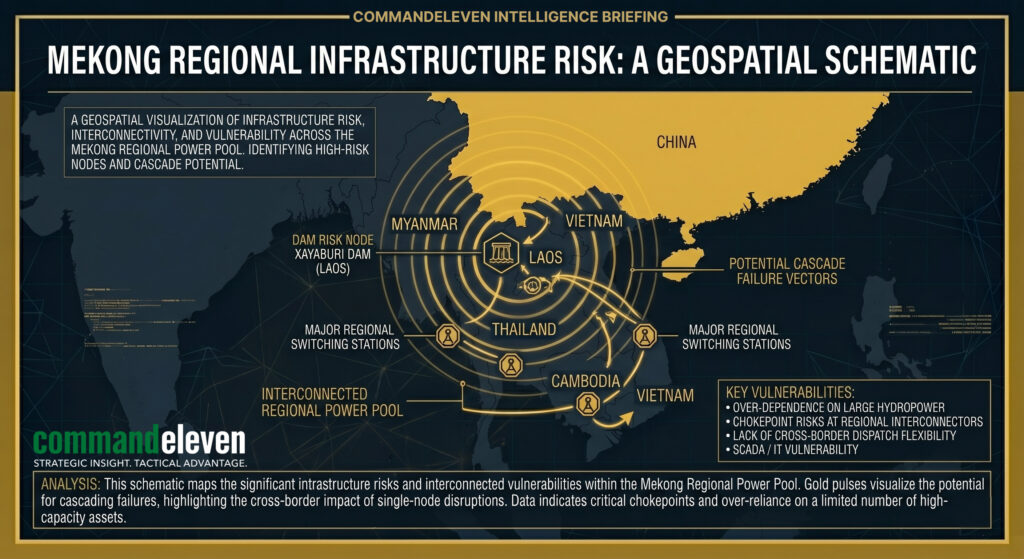
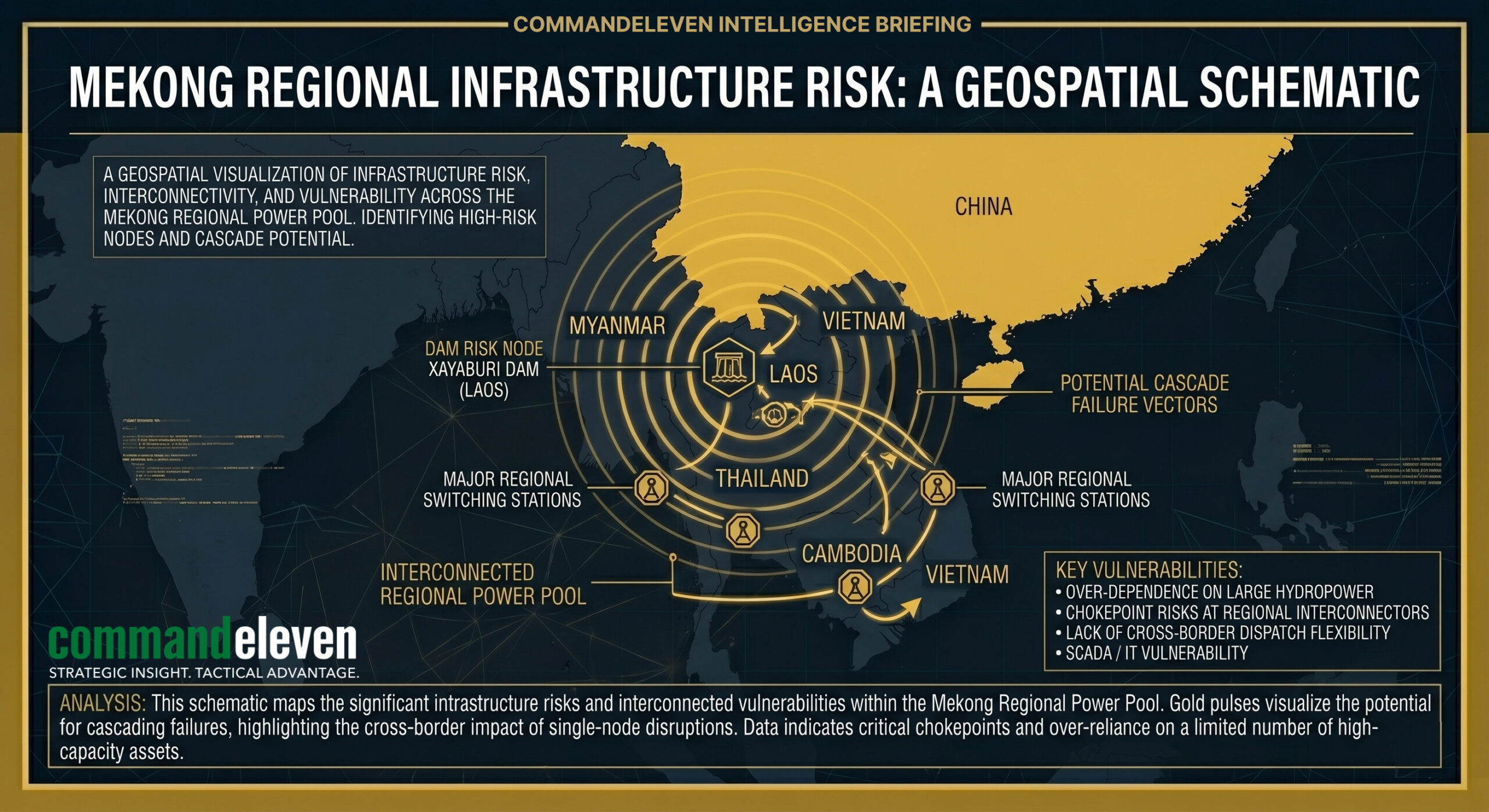
The Mekong region’s economic stability is tethered to the “Energy-Water Nexus.” The interconnected nature of hydroelectric dams and the regional power pool means that a localized cyber-kinetic strike can have non-linear, trans-border consequences.
Smart Grid Vulnerabilities and the Attack Surface
The rapid adoption of “Smart City” initiatives in Bangkok, Ho Chi Minh City, and Da Nang has exponentially expanded the regional attack surface.
- AMI Exploitation: Advanced Metering Infrastructure (AMI) – the smart meters installed in millions of homes – serves as a distributed entry point. A coordinated hack of these endpoints can be used to simulate a massive surge or drop in demand, potentially tripping regional substations and inducing a black-start scenario.
- Distributed Energy Resources (DER): The integration of solar and wind farms into the main grid introduces thousands of new, often poorly secured, digital interfaces. Exploiting the inverters of these DERs allows attackers to manipulate frequency and voltage, destabilizing the grid’s synchronization.
Hydroelectric Sabotage: The “Water Weapon”
The Mekong River’s dam infrastructure is perhaps the most sensitive kinetic target in the sub-region.
- Digital Dam Management: Modern dams utilize automated systems to manage sluice gates and turbine flows based on water levels. A cyber-kinetic intrusion into these management consoles can trigger unauthorized water releases.
- Kinetic Impact: In a coordinated strike, an attacker could trigger “cascading releases” from upstream dams in Laos or China, causing flash flooding in downstream Cambodian or Vietnamese agricultural heartlands. Conversely, the digital locking of gates during a drought can be used to weaponize water deprivation against downstream populations.
Trans-Border Cascading Failures
The Mekong power pool is an increasingly integrated network, where energy is traded across borders in real-time.
- The Domino Effect: Analysis indicates that the regional grid lacks sufficient “cyber-firewalls” between national dispatch centers. A successful cyber-kinetic strike on a major switching station in Vietnam could cause a frequency imbalance that propagates into the Cambodian and Thai grids.
- Interdependence Vulnerability: As regional states become more dependent on imported power, the ability of a hostile actor to trigger a “coordinated regional blackout” via a single digital vector becomes a potent tool for strategic coercion.
Actor Profiles and Digital Espionage Vectors
The Mekong sub-region serves as a primary laboratory for state-sponsored Advanced Persistent Threats (APTs) to refine cyber-kinetic doctrines. In 2026, the distinction between traditional espionage and pre-kinetic preparation has effectively vanished.
State-Sponsored APT Profiles
Regional intelligence identifies several sophisticated actors – predominantly extra-regional powers – utilizing the Mekong’s infrastructure as a “proof-of-concept” for broader geopolitical objectives.
- The “Living off the Land” (LotL) Specialists: Certain APT groups have transitioned from deploying custom malware to utilizing legitimate administrative tools already present in utility networks (e.g., PowerShell, WMI). This LotL strategy allows them to maintain persistence within Thai and Vietnamese energy grids for months without triggering traditional signature-based antivirus alerts.
- The “Pre-Positioning” Doctrine: Analysis of dormant code discovered in Cambodian water management systems suggests that the primary goal of these actors is not immediate disruption, but “pre-positioning.” They establish access to critical kill-switches, ensuring that in the event of a regional kinetic conflict, they can paralyze the adversary’s internal logistics through digital sabotage.
The Grey Zone Shift: Deniable Sabotage
Cyber-kinetic operations have fundamentally altered the risk-reward calculus of regional sabotage.
- Attribution Ambiguity: Unlike a missile strike or a physical bombing, a cyber-induced turbine failure in a Lao hydroelectric plant can be attributed to equipment age, maintenance negligence, or software glitches. This “Grey Zone” ambiguity allows hostile actors to degrade a nation’s industrial capacity without crossing the threshold that would trigger a formal military response.
- Strategic Coercion: Digital intrusions into the automated logistics hubs of Vietnam’s maritime ports have been utilized as a form of non-kinetic signaling. By causing temporary, inexplicable “glitches” in container tracking systems, hostile actors demonstrate their capability to cripple a nation’s export economy at will.
Advanced Phishing and Credential Harvesting
Despite the high-tech nature of the exploits, the initial entry point remains overwhelmingly human-centric.
- Spear-Phishing Utility Engineers: Targeted campaigns in 2026 utilize AI-generated “deepfake” audio and text to impersonate senior technicians or government regulators. These communications are designed to lure engineering staff into revealing VPN credentials or installing “security updates” that contain embedded RATs (Remote Access Trojans).
- The “Watering Hole” Tactic: Attackers compromise regional professional forums or industrial equipment supplier websites. When employees of utility companies visit these sites, their browsers are silently exploited, allowing the attacker to leapfrog into the corporate network.
Counter-Measures and Resilience Standards
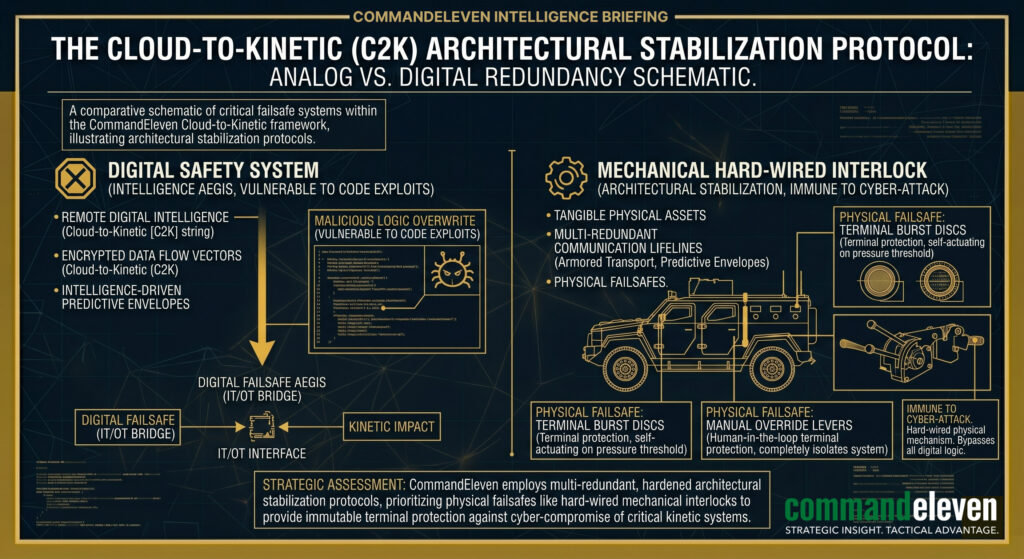
As the threat of cyber-kinetic convergence intensifies, CommandEleven advocates for a “Defense-in-Depth” strategy that prioritizes physical redundancy over digital complexity.
Hard Air-Gapping and Unidirectional Gateways
The most effective defense against a remote kinetic strike is the absolute physical isolation of Operational Technology (OT) from the Public Internet.
- Total Air-Gapping: Critical PLC networks in nuclear or large-scale hydroelectric facilities must be strictly air-gapped. Any data transfer between IT and OT networks should occur via physical “data-diodes” – unidirectional gateways that allow data to flow out for monitoring but physically prevent any signal from flowing in to the control network.
- Removable Media Quarantine: The implementation of rigorous “Sheep Dip” stations – dedicated, isolated machines used to scan and scrub any USB drive or external device before it is permitted near a SCADA terminal.
Cyber-Physical Redundancy and Mechanical Failsafes
Resilience must be built into the physical layer of the infrastructure, ensuring that a digital compromise cannot lead to a catastrophic physical event.
- Analog Backups: CommandEleven recommends the reintegration of analog gauges and manual override levers for critical valves and circuit breakers. These mechanical systems must be designed to override any digital command, providing human operators with the ability to “hard-kill” a runaway system.
- Hard-Wired Interlocks: Physical safety interlocks – such as pressure-sensitive burst discs – must be used in place of digital safety instrumentation systems (SIS) where possible. These components rely on the laws of physics rather than lines of code to prevent hardware destruction.
Regional Intelligence Sharing: The Mekong Cyber-Defense Framework
The interconnected nature of the Mekong grid necessitates a unified regional response.
- Unified Threat Telemetry: The establishment of a sub-regional “Cyber-SOC” (Security Operations Center) where Thailand, Vietnam, and Cambodia share real-time telemetry on APT activity. This allows for “herd immunity,” where an attack detected in one nation’s grid triggers immediate defensive updates across the entire Mekong power pool.
- Incident Response Maneuvers: Regular, joint “Cyber-Kinetic War Games” where regional utility operators practice manual recovery procedures and cross-border energy load-balancing in the event of a successful digital strike on a major regional node.
Intelligence Assessment & Forecasting (2026–2030)
The trajectory of cyber-kinetic convergence in the Mekong sub-region indicates a shift from human-coordinated intrusions to autonomous, machine-speed warfare. CommandEleven Intelligence assesses that the 2026–2030 period will be defined by the “Automation of Sabotage,” where the window for human intervention in infrastructure defense will effectively close.
AI-Driven Automated Exploits and Autonomous Malware
The most significant technological shift in the next four years will be the deployment of Autonomous Cyber-Kinetic Weapons (ACKW).
- Self-Mapping Malware: Future APT strains will be equipped with on-board AI capable of mapping a SCADA network in seconds rather than months. These agents will autonomously identify the specific PLC models and firmware versions governing a turbine or a substation, selecting the most lethal exploit payload without requiring instructions from a remote command-and-control (C2) server.
- The Zero-Day Factory: We forecast the rise of AI systems designed specifically to discover and weaponize zero-day vulnerabilities in industrial hardware at an industrialized scale. This will render current signature-based defenses obsolete, as the variety and frequency of exploits will outpace the ability of human engineers to issue patches.
The Weaponization of the Industrial Internet of Things (IIoT)
As the Mekong region accelerates its “Industry 4.0” integration, the sheer density of connected sensors will create a pervasive “Digital Flank” for attackers.
- Botnet-Driven Physical Stress: Hostile actors will increasingly utilize massive botnets comprised of insecure IoT devices to launch coordinated Distributed Denial of Service (DDoS) attacks against the internal processing units of power plants. By overwhelming the internal network traffic of a facility, attackers can induce a “communication blackout” between sensors and controllers, triggering automated safety shutdowns or preventing operators from seeing a brewing mechanical failure.
- Edge Computing Infiltration: The move toward “Edge Computing” – processing data closer to the sensors – introduces thousands of localized entry points. CommandEleven assesses that regional ports and smart-logistics hubs in Vietnam and Thailand will be the primary targets for “Edge-level” sabotage, where localized digital disruptions are used to create systemic delays in regional supply chains.
The Rise of “Digital Mercenaries” and Asymmetric Proxy Warfare
The 2026–2030 period will see a proliferation of non-state “Digital Mercenaries” offering cyber-kinetic services to the highest bidder.
- Deniable Proxy Attacks: State actors will increasingly utilize these third-party groups to conduct infrastructure sabotage, providing a layer of “absolute deniability.” This complicates the regional security architecture, as the victim state may find it impossible to identify a sovereign aggressor, thereby neutralizing the deterrent effect of traditional military alliances.
- Industrial Extortion: We forecast a shift from simple data-encryption ransomware to “Kinetic Ransomware.” Attackers will seize control of a critical asset – such as a city’s water treatment plant – and threaten to trigger a physical failure (e.g., a chemical spill or pipe burst) unless a ransom is paid. This introduces a lethal dimension to digital crime that regional law enforcement is currently ill-equipped to handle.
Final Intelligence Forecast
The Mekong sub-region has become the premier global theater for cyber-kinetic testing and escalation. CommandEleven warns that the “security through obscurity” model previously relied upon by regional utilities is officially dead. The integration of AI into both offensive and defensive workflows is now a mechanical necessity. Regional stability in the late 2020s will depend entirely on the ability of states to implement Active Cyber-Defense – a posture that does not merely wait for an intrusion but utilizes AI-driven telemetry to hunt and neutralize threats within the network before they can cross the kinetic threshold.