The shift in CommandEleven Intelligence’s publication model, analytical tone, and structural format over recent months has been noted across our network of subscribers, institutional partners, and defense professionals. This evolution is neither accidental nor a mere stylistic preference. It represents a deliberate milestone in our institutional maturity – the formal transition from a geopolitical commentary website to a capability-driven intelligence platform.
Commentary processes what has already happened; CommandEleven Intelligence’s structured briefs are built to maintain the exact analytical edge demonstrated by our historical track record and recent audits.
The complexity of contemporary warfare – defined by gray-zone conflicts, decentralized asymmetric networks, and cyber-kinetic convergence – demands an analytical framework that prioritizes high-density, actionable intelligence over narrative prose.
The Principle of Institutional Maturity
Institutional maturity requires an organization to evolve alongside the threat landscapes it monitors. In our foundational phase, long-form commentary served its purpose to establish our baseline perspectives. However, as localized flashpoints increasingly trigger macro security crises, the mechanisms used to analyze them must become more rigorous, standardized, and detached from public sentiment.
Our transition to a clinical, structured intelligence format is built on four core principles:
- Analytical Detachment: Eliminating speculative or opinion-driven rhetoric to deliver objective, threat-centric analysis.
- Structural Standardization: Utilizing uniform templates designed for rapid executive consumption and strategic decision-making.
- Continuous Monitoring: Shifting from reactive news coverage to predictable, programmatic regional surveillance cycles.
- Predictive Lead Time: Ensuring our outputs focus entirely on identifying vulnerabilities and trajectories before they solidify into public consensus.
Verifying the Engine: The Predictive Audit Ledger
True intelligence is validated solely by the delta between its publication and its subsequent realization by the broader public and traditional institutional bureaucracies. The recent validation of our assessments regarding Iranian asymmetric operations highlights this exact dynamic.
While yesterday’s public news cycle scrambled to analyze a “leaked intelligence document” detailing the tactical expansion of Iranian sleeper cells, their coordination within the Gulf, and the evolution of proxies applying lessons from the historic failed plot against the Saudi Ambassador, CommandEleven Intelligence had already systemized these vectors into active threat models. The leaked material merely confirmed what our platform had processed months prior.
The following ledger deconstructs five core operational hypotheses, checking our original tracking parameters against live frontend field validation events to demonstrate our systemic Lead Advantage.
Hypothesis 1: The Afghan State Collapse & Militia Defection Model
- Original Projection (January 2018): CommandEleven Intelligence identified that Western military intelligence infrastructure was operating under obsolete troop strength and stability indicators. The firm projected that the rapid rise of the Islamic State Khorasan Province (ISKP), combined with targeted CIA-led high-value decapitation tactics, would fracture the Taliban’s internal cohesion. It explicitly warned that regional command defection arrays (e.g., Qari Hekmat’s infrastructure in Jawzjan) would lead to the systematic transfer of armed personnel, weapons caches, and localized territory directly into more radical transnational syndicates, while pro-government local militias raised by Kabul would rapidly collapse or switch sides.
- Field Validation Event (August 2021): The total structural collapse of the 350,000-strong Afghan National Army (ANA) and associated provincial militias occurred within a 72-hour window during the US withdrawal, precisely validating the baseline hypothesis that local security architecture lacked systemic institutional loyalty and local writ.
- CommandEleven Intelligence Lead Advantage: 42 Months Ahead of Global Policy Consensus.
Hypothesis 2: The Indo-US Containment Axis & SAARC Fragmentation
- Original Projection (November 2018): CommandEleven Intelligence forecasted that India’s deep state would intentionally weaponize bilateral friction points to permanently sabotage the multilateral SAARC framework in order to block full organizational membership for Beijing. The analysis warned that this short-sighted containment strategy would severely backfire, creating an immediate financing and infrastructure vacuum that China would exploit via rapid, massive bilateral capital injections to economically detach New Delhi’s closest regional allies.
- Field Validation Event (2017–2018): India officially boycotted the 19th Summit in Islamabad, effectively terminating SAARC’s functional relevance. Beijing immediately counter-stepped by dropping a massive $24 billion direct financial and transport infrastructure package into Dhaka, successfully shifting Bangladesh out of India’s exclusive commercial orbit.
- CommandEleven Intelligence Lead Advantage: 12 Months Ahead of Trans-Regional Trade Reality.
Hypothesis 3: The Multi-Polar CENTO / South Eurasian Rimland Realignment
- Original Projection (February 2017): CommandEleven Intelligence formulated the unique “South Eurasian Belt” (SEB) geopolitical doctrine, projecting that Turkey, Iran, and Pakistan would structurally converge into a cohesive, non-Western alignment. The firm projected that these three civilizations would completely invert the pro-Western containment objectives of the legacy Cold War-era CENTO framework, transforming the geographic rimland into an integrated transit shield that secures Chinese BRI corridors and Russian energy integration loops.
- Field Validation Event (2020–2022): The formal admission of Pakistan and Iran into the Shanghai Cooperation Organization (SCO), combined with the trilateral synchronization of regional customs frameworks and the operational launch of northern transit railway corridors (PAKAFUZ), locked this continental alignment into active state policy.
- CommandEleven Intelligence Lead Advantage: 36 Months Ahead of Global Diplomatic Realignment.
Hypothesis 4: The Infiltration of Telecom Switching & Identity Databases (NADRAGate)
- Original Projection (June 2017): CommandEleven Intelligence released a highly technical counter-espionage forensic audit revealing that Western signals intelligence agencies (NSA and GCHQ) had deep, persistent access inside Pakistan’s core internet backbones and PTCL routers. The audit proved that loose API connections and unauthorized backdoors built under foreign-designed border management programs allowed hostile operators to transition from read-only data harvesting to achieving active write-access permissions natively within the national citizen identity registry.
- Field Validation Event (2020–2023): Multiple catastrophic federal identity data exposures culminated in the public monetization of over 115 million unique citizen mobile records and Computerized National Identity Cards (CNICs) across dark-web trading blocks, tracing back precisely to misconfigured provincial software connections and un-audited state databases.
- CommandEleven Intelligence Lead Advantage: 36 Months Ahead of Technical Forensic Confirmation.
Hypothesis 5: Cyber-Kinetic Convergence Doctrine
- Original Projection (April 2025): CommandEleven Intelligence published a specialized infrastructure security assessment system-mapping the vulnerabilities of Western critical infrastructure. The assessment warned that advanced non-state cyber syndicates and state-sponsored threat actors had permanently moved past standard information harvesting, engineering malware campaigns explicitly designed to target legacy medical operating systems, open RDP ports, and misconfigured public utility SCADA lines to translate digital database compromises into active, real-world kinetic threats to human life.
- Field Validation Event (March 2026): A destructive wave of synchronized cyber-attacks – flagshipped by the Medusa ransomware grid paralyzing the internal operating databases of major US medical centers – forced widespread system collapses and immediate federal alerts, validating the dynamic warning curve.
- CommandEleven Intelligence Lead Advantage: 11 Months Ahead of Sovereign Systemic Shock.
The Connective Tissue: The 2026 Global Counter-Terrorism Assessment
The definitive proof of concept for our current architecture is the 2026 Global Counter-Terrorism Assessment (GCTA). The fatal flaw within traditional defense and intelligence apparatuses is siloed analysis – bureaucracies track individual tactical events but fail to connect them to broader, coordinated operational doctrines.
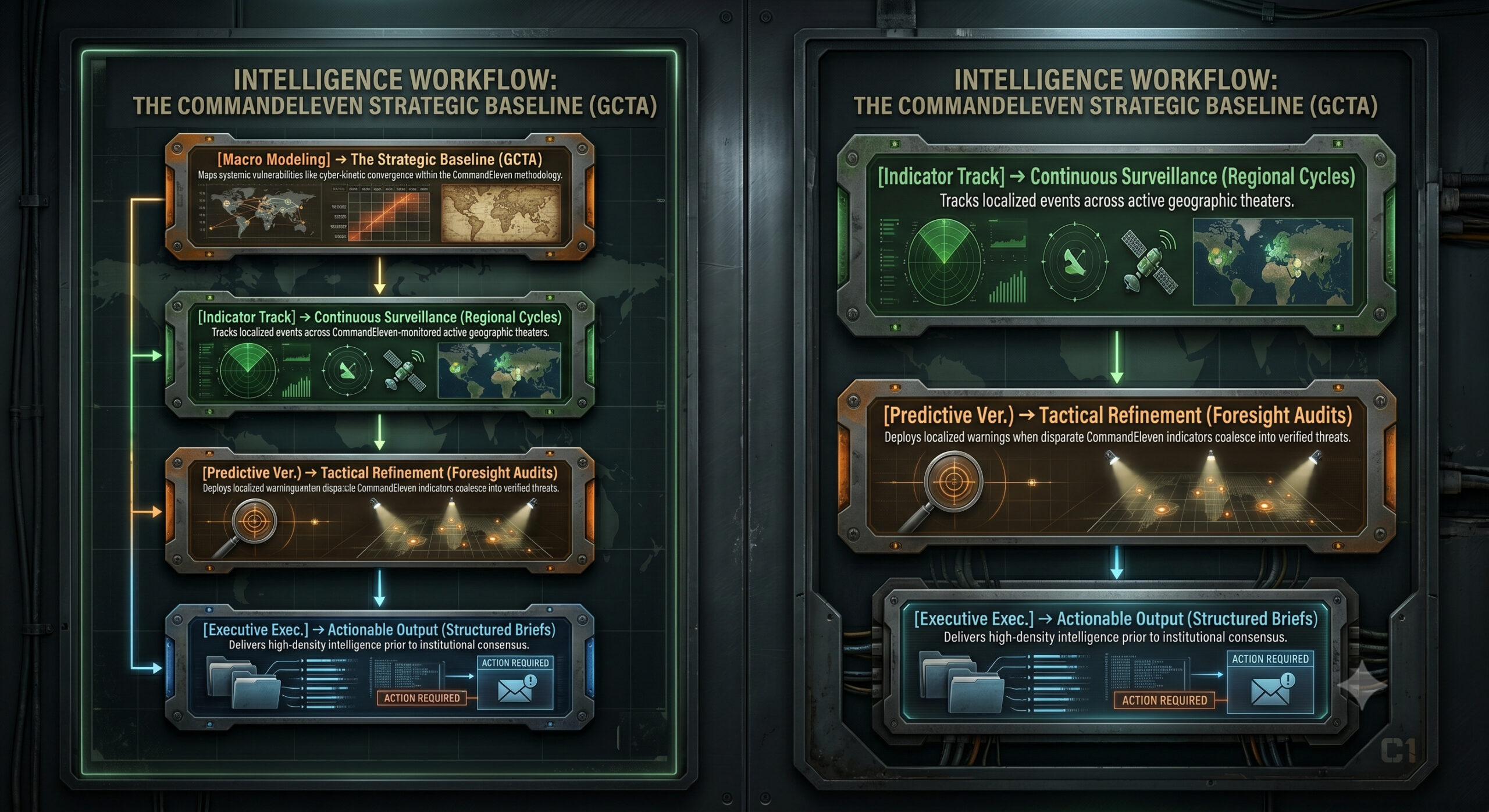
The GCTA was built to solve this structural failure. It acts as our foundational doctrine, synthesized through four systematic layers:
- [Macro Modeling] –> The Strategic Baseline (GCTA) to map systemic vulnerabilities like cyber-kinetic convergence.
- [Indicator Modeling] –> Continuous Surveillance (Regional Cycles) to track localized events across active geopolitical theaters.
- [Predictive Visioning] –> Tactical Refinement (Foresight Audits) to deploy localized warnings when disparate indicators coalesce.
- [Executive Execution] –> Actionable Output (Structured Briefs) to deliver high-density intelligence prior to institutional consensus.
Our recent Foresight Audits regarding unmanned aircraft systems (UAS) over domestic military bases (e.g., Barksdale AFB) and the security layout for the 2026 World Cup are direct tactical applications of the GCTA framework. While public agencies react post-facto with last-minute airspace lockdowns and National Guard deployment requests due to personnel shortages, our systemic methodology mapped these exact defensive gaps well in advance.
- The Strategic Baseline (GCTA): Establishes the macro threat models, detailing how decentralized networks leverage dual-use commercial technologies and cross-border gray zones.
- Continuous Surveillance (Regional Cycles): Daily regional monitoring feeds into the GCTA baseline, capturing localized indicators before they disrupt the wider operational environment.
- Tactical Refinement (Foresight Audits): When disparate indicators coalesce into an active, unrecognized threat – such as the domestic UAS capabilities targeting critical installations – the platform issues a Foresight Audit.
- Actionable Output (Structured Briefs): The final intelligence is delivered directly to policymakers and risk managers, maximizing their decision-making window.
The Architecture of the CommandEleven Intelligence Platform
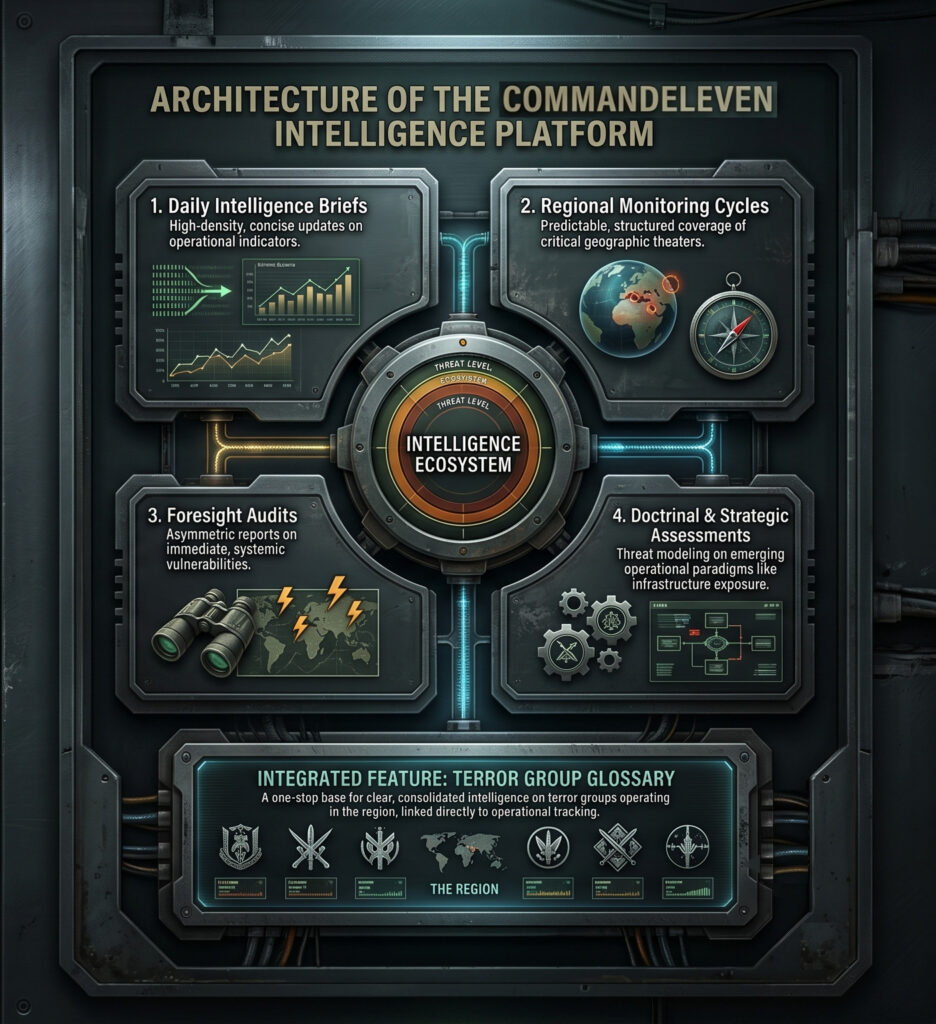
Moving forward, all outputs published on the platform adhere strictly to this operational architecture. Casual commentary has been permanently retired. In its place, our subscribers and partners can access targeted intelligence across four primary pillars:
- Daily Intelligence Briefs (subscription-based): High-density, concise updates prioritizing actionable risk assessments and operational indicators over long-form narrative prose.
- Regional Monitoring Cycles: Predictable, structured coverage spanning critical geographic theaters on specific days of the week:
- Monday: The Levant
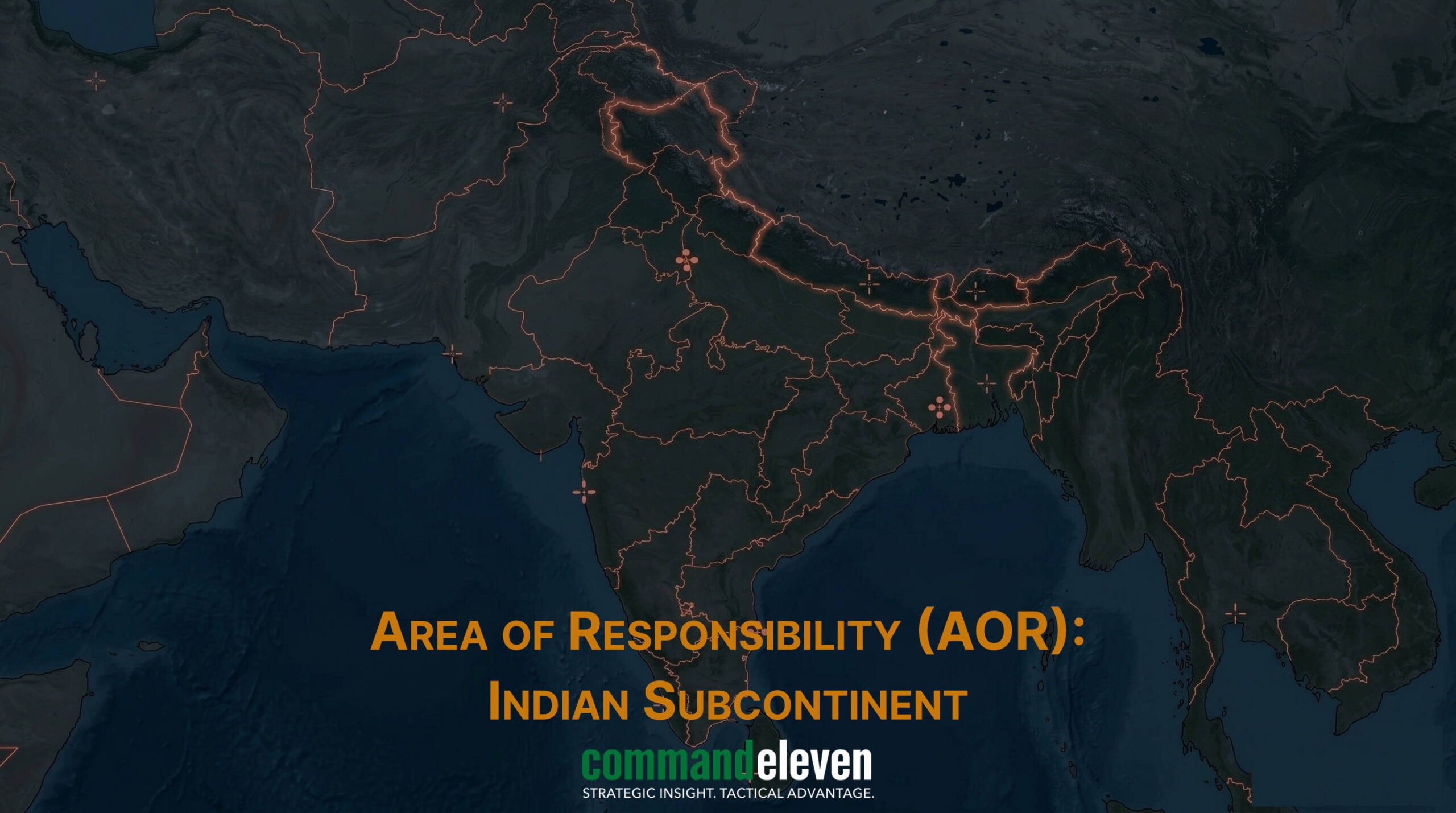
- Tuesday: Indian Subcontinent
- Wednesday: Southeast Asia
- Thursday: The Sahel
- Friday: Global Geopolitics & Macro Trends
- Foresight Audits: Asymmetric, ad-hoc reports triggered when localized or non-obvious threat indicators mature into an immediate, systemic vulnerability.
- Doctrinal & Strategic Assessments: Deep-dive threat modeling focused on emerging operational paradigms, critical infrastructure exposure, and the long-term updates to our annual Global Counter-Terrorism Assessment.
CommandEleven Intelligence has always functioned as an intelligence enterprise; our new platform architecture simply optimizes the delivery system to match the rigor of our methodology. We welcome our institutional clients and dedicated readers into this next phase of our operational capability.