Executive Summary & Macro-Financial Context
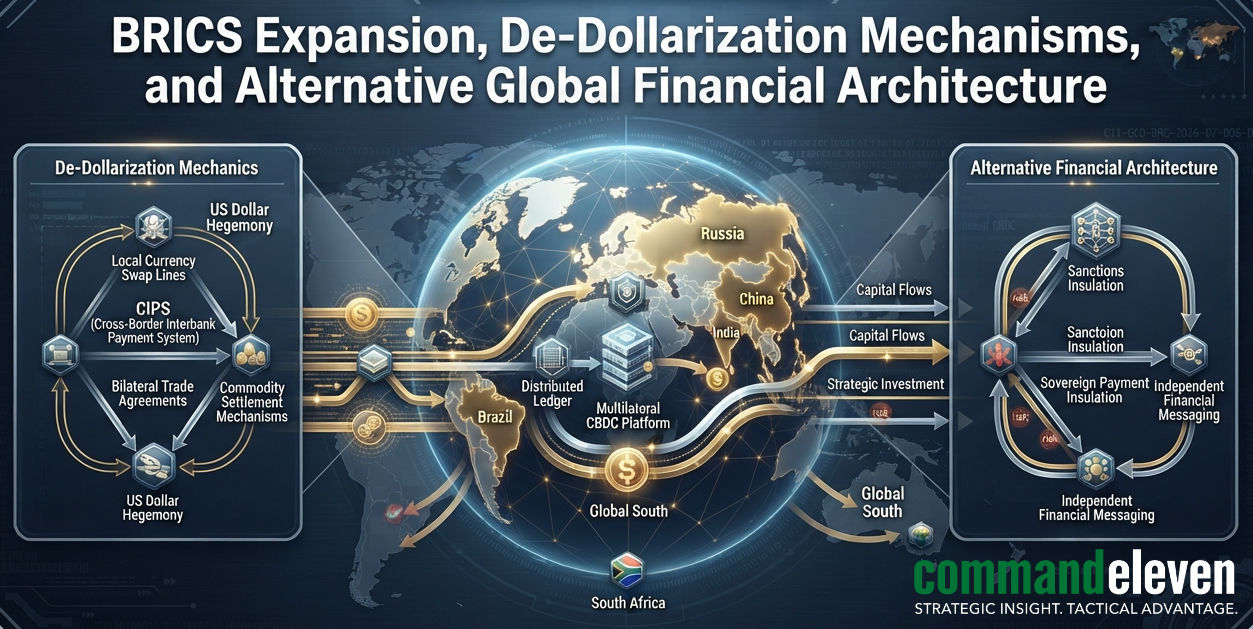
As of July 2026, the expanded BRICS coalition operates as the primary institutional vehicle driving the structural fragmentation of the post-WWII Western-centric financial order. What originated as a diplomatic forum has materialized into a geoeconomic bloc wielding significant control over global commodities, energy production, and maritime supply routes. The integration of full member states,including key energy producers in the Middle East and strategic hubs in North Africa and Southeast Asia,has fundamentally altered global trade settlement dynamics.
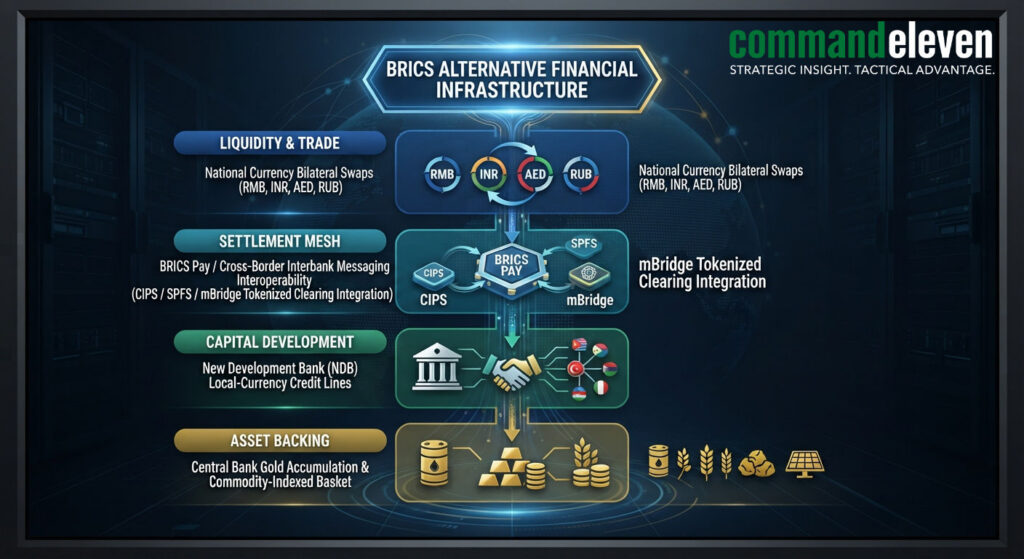
The bloc’s strategic objective is not the immediate, total replacement of the US Dollar (USD) as the global reserve currency,an objective constrained by capital controls and internal political divergences,but rather the construction of a multi-tiered, friction-resistant financial bypass. By deploying non-dollar bilateral settlement channels, distributed ledger clearing frameworks, and expanded local-currency development lending, BRICS effectively insulates its member states from G7 unilateral sanction regimes, secondary financial pressures, and Western banking chokepoints like SWIFT.
Institutional Mechanics of Expansion & Geoeconomic Integration
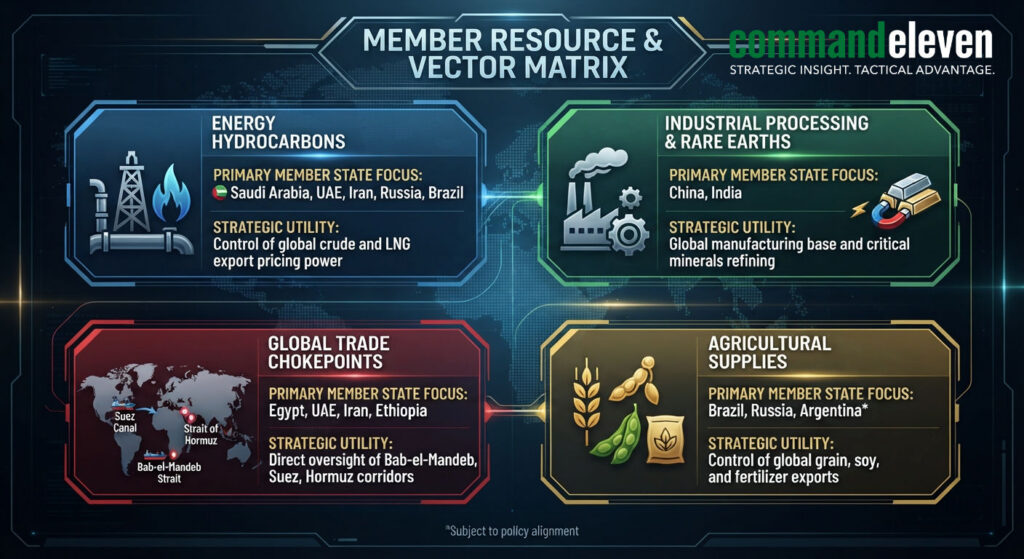
The structural footprint of the enlarged BRICS bloc reflects a deliberate strategy to control critical nodes of the global primary resource and logistics supply chain.
Energy Grid Consolidation
The absorption of major Gulf energy exporters into the BRICS economic orbit has severed the exclusive link between global oil transactions and the US Dollar (the petrodollar framework):
- Non-Dollar Hydrocarbon Invoicing: A substantial percentage of crude oil and natural gas trades between BRICS members (e.g., Russian crude to India and China, UAE and Saudi deliveries to Asian markets) are now invoiced and settled directly in Chinese Yuan (RMB), Indian Rupees (INR), or UAE Dirhams (AED).
- OPEC+ Alignment: The structural overlap between BRICS member states and OPEC+ decision-making bodies coordinates global oil production quotas directly with non-Western demand hubs, minimizing Western influence over global energy market stabilization.
Geostrategic Chokepoint Coverage
The expansion secures physical control over pivotal maritime trade nodes:
- Red Sea and Persian Gulf Corridors: With Egypt, Ethiopia, Iran, and the UAE within the institutional fold, BRICS states flank both sides of the Bab-el-Mandeb Strait, the Suez Canal, and the Strait of Hormuz. This geographic alignment enables coordinated infrastructure investment and maritime security arrangements independent of Western naval coalitions.
Financial Infrastructure, Payment Architecture, and De-Dollarization
To insulate cross-border trade from external interdiction, BRICS has deployed a redundant network of financial messaging, clearing, and asset-transfer mechanisms.
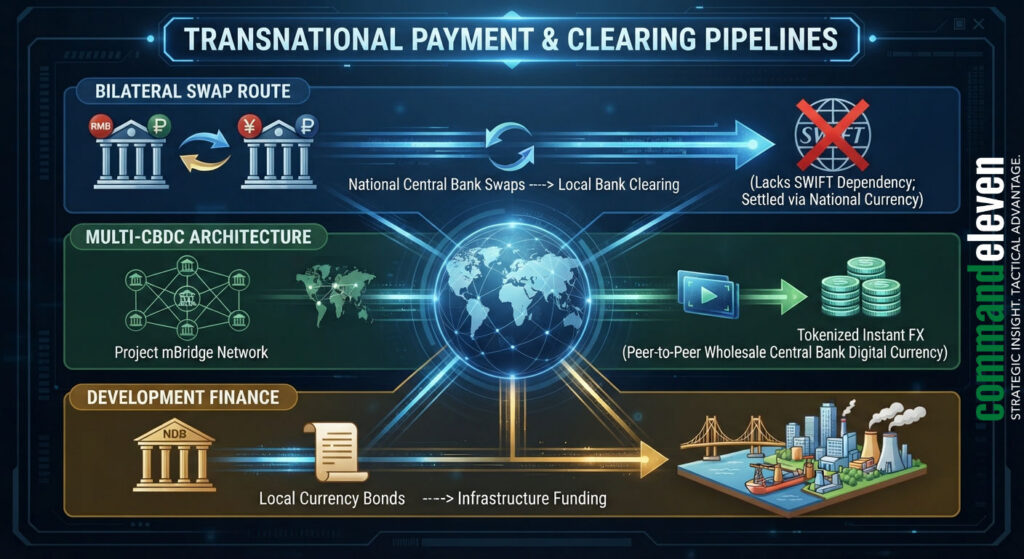
Cross-Border Payment Messaging Interoperability
BRICS states have mitigated SWIFT exclusion risks by interconnecting domestic financial messaging platforms:
- Interoperable Messaging: China’s Cross-Border Interbank Payment System (CIPS), Russia’s System for Transfer of Financial Messages (SPFS), and India’s Structured Financial Messaging System (SFMS) operate integrated gateway protocols. This allows commercial banks within member countries to execute cross-border transfers directly without routing instructions through Western correspondent banks.
- Project mBridge and Digital Assets: The deployment of multi-CBDC platforms,such as Project mBridge,enables direct, peer-to-peer wholesale clearing of cross-border transactions using tokenized central bank digital currencies. This platform eliminates the need for intermediate USD conversion, reduces transaction latency to seconds, and bypasses Western clearinghouses (e.g., CHIPS).
The New Development Bank (NDB) and Local-Currency Debt
Under its revised long-term strategy, the New Development Bank (headquartered in Shanghai) systematically scales down its USD-denominated debt exposure:
- Local Currency Issuance: The NDB aims to issue over $30%$ of its development loans in local member currencies (e.g., Panda bonds in China, Rupee-denominated bonds in India). This protects borrowing developing nations from foreign exchange mismatch risks and USD interest rate volatility dictated by the US Federal Reserve.
Reserve Diversification, Commodity Baskets, and Asset Backing
The structural vulnerabilities exposed by the freeze of Russian sovereign foreign exchange reserves have accelerated central bank reserve reallocation across the expanded bloc.
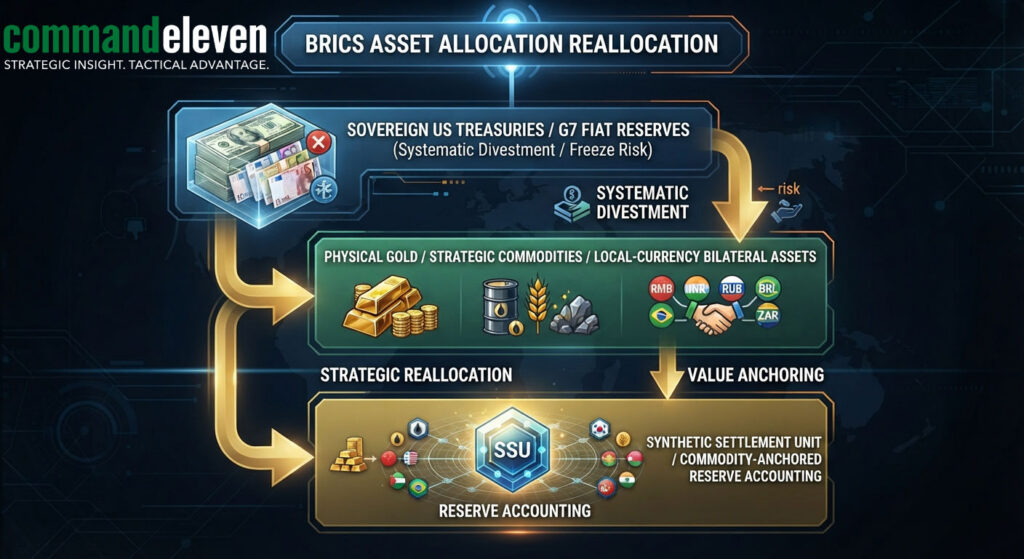
- Sovereign Gold Accumulation: BRICS central banks,specifically China, Russia, India, and Middle Eastern members,have engaged in sustained, high-volume net purchases of physical gold. Unencumbered physical gold stored within domestic vaults serves as the primary tier-one sovereign reserve asset free from counterparty risk or foreign freeze orders.
- Commodity-Backed Trade Unit Concepts: While a single unified BRICS physical currency remains constrained by member economic divergence, the bloc utilizes a synthetic accounting unit anchored to a weighted basket of member currencies and physical commodities (gold, crude oil, rare earth elements, wheat). This accounting unit serves as a benchmark for settling trade imbalances without relying on Western exchange rates.
Western Countermeasures, Fragmentation Risks, and Internal Friction
The expansion and financial engineering of BRICS encounter structural friction, both from internal member divergence and external Western policy responses.
Internal Divergences and Heterogeneity
- Sino-Indian Strategic Competition: Tensions between New Delhi and Beijing impede total institutional integration. India resists transforming BRICS into an explicitly anti-Western geopolitical alliance, prioritizing a “non-aligned” economic multi-polar approach while maintaining deep security ties with Western partners (e.g., QUAD).
- Economic Asymmetry: China’s gross domestic product (GDP) dwarfs the combined economic output of all other member states. Smaller economies express apprehension over transitioning from a Western-dominated financial system to one overwhelmingly dictated by Beijing’s economic leverage and the RMB.
Western Regulatory and Sanctions Counter-Pressure
- Secondary Sanctions Enforcement: G7 economies utilize targeted secondary sanctions against non-Western financial institutions attempting to interface with sanctioned Russian or Iranian entities. This exerts significant compliance pressure on commercial banks within Brazil, India, and the UAE, restricting the execution of illicit clearing mechanisms.
- G7 Competitiveness Initiatives: Western nations attempt to counter BRICS infrastructure influence through competitive development finance initiatives, such as the G7 India-Middle East-Europe Economic Corridor (IMEC) and the Partnership for Global Infrastructure and Investment (PGII).
Strategic Forecasting & Baseline Indicators (H2 2026 – 2027)
The structural momentum of BRICS financial bypass mechanisms will persist through the secondary half of 2026. Key monitoring indicators for intelligence tracking include:
- mBridge Commercial Scaling: The volume of energy contracts settled via the mBridge multi-CBDC platform, specifically tracking Gulf exporter involvement with Asian import terminals.
- NDB Local-Currency Ratio: The percentage share of non-G7 currency issuances within the NDB’s total active loan portfolio for Q3/Q4 2026.
- Non-Dollar Hydrocarbon Invoicing Metrics: The net shift in global petrostates’ foreign currency reserves from US Dollar Treasuries into physical gold and non-G7 sovereign assets.