
Executive Summary
As of May 2026, the Line of Control (LoC) has transitioned from a static-kinetic front into a high-intensity electromagnetic battlefield. Driven by the 2024–2030 Electronic Warfare Modernization Plan, regional actors have shifted their focus toward Spectrum Dominance. This technical audit explores the convergence of SIGINT and Electronic Attack (EA) into portable, AI-driven manpack units that enable real-time “Detection-to-Disruption” loops. Furthermore, the analysis evaluates the rise of GPS-denied environments through targeted GNSS spoofing and the tactical necessity of signature management, where any radio-frequency emission now serves as a primary trigger for precision-guided kinetic strikes.
3 Key Takeaways
- Spectrum as a Kinetic Vector: On the LoC, the electromagnetic spectrum is now a primary battlefield. AI-driven geolocation ensures that any detectable RF signature can be translated into a precision-guided artillery strike within minutes.
- Decentralized Electronic Warfare: The shift from vehicle-mounted arrays to converged SIGINT/EW manpacks has granted tactical infantry units the power of a strategic intelligence platform, allowing for localized “spot jamming” and autonomous frequency-hopping counters.
- The Rise of Aerospace Denial: The proliferation of C-UAS (Counter-Unmanned Aerial Systems) utilizing GPS spoofing and “meaconing” has rendered legacy drone surveillance obsolete, forcing a move toward hardened, non-GNSS navigation systems.
SIGINT/EW Manpack Convergence: The SDR Revolution
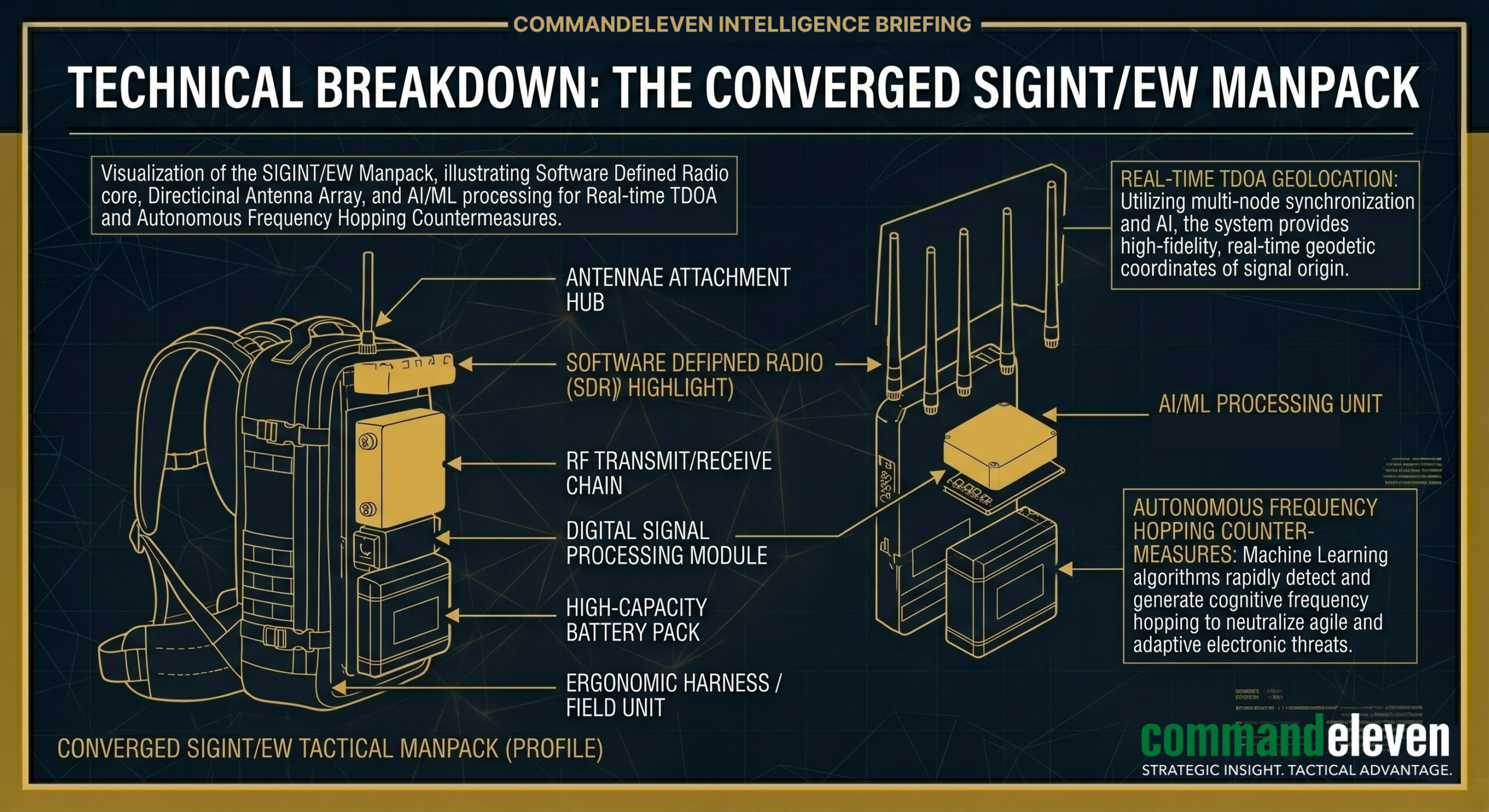
The tactical landscape of the Line of Control (LoC) has moved beyond the reliance on bulky, vehicle-mounted jamming arrays. The current phase of the 2024–2030 Electronic Warfare Modernization Plan focuses on the “democratization” of EW capabilities through the deployment of converged SIGINT/EW Manpacks. These units, carried by individual tactical teams, have fundamentally altered the “Detection-to-Disruption” timeline.
The Software Defined Radio (SDR) Architecture
The core of this convergence is the transition from hardware-fixed circuitry to Software Defined Radio (SDR).
- Broadband Agility: Unlike legacy systems limited to specific VHF/UHF bands, modern SDR manpacks can monitor and attack a massive frequency range,from 30 MHz to 6 GHz,within a single, lightweight unit.
- Waveform Reconfigurability: Tactical units can now “download” new jamming waveforms in the field to counter specific adversary radio upgrades, ensuring the equipment remains lethal against evolving encryption and frequency-hopping standards.
The “Detection-to-Disruption” Loop
In the high-altitude environment of the LoC, speed of action is the primary determinant of survival. Converged manpacks allow for a seamless transition between passive collection and active interference.
- Real-Time Geolocation: These units utilize Time Difference of Arrival (TDOA) and Angle of Arrival (AoA) algorithms to triangulate the position of an adversary emitter within seconds of the first transmission.
- Surgical Jamming: Once an emitter is geolocated, the operator can initiate a “spot jam” or “follower jam” that specifically targets the adversary’s frequency while leaving adjacent friendly channels open. This minimizes “electromagnetic fratricide” and allows for a localized offensive advantage.
Cognitive EW and Machine Learning (ML)
As of May 2026, the LoC has become a testing ground for Cognitive Electronic Warfare.
- Autonomous Signal Identification: ML algorithms embedded in the manpack’s processor can autonomously recognize “Low Probability of Intercept” (LPI) signals,burst transmissions designed to hide beneath the noise floor.
- Dynamic Response: Cognitive systems do not require operator input to counter frequency-hopping radios. They analyze the hopping pattern in real-time and predict the “next hop,” placing a jamming signal on the frequency before the adversary’s radio even arrives there.
C-UAS and the GPS-Denied Frontier
The proliferation of commercial-off-the-shelf (COTS) drones for reconnaissance and “kamikaze” strikes has necessitated the creation of an electronic “Iron Dome” across the LoC. The focus has shifted from kinetic interception to Aerospace Denial through GNSS (Global Navigation Satellite System) interference.
Targeted GNSS Interference: The “Denial Bubble”
Counter-Unmanned Aerial System (C-UAS) units on the LoC are now primarily calibrated to strike the “heart” of drone navigation: the GPS/GLONASS signals.
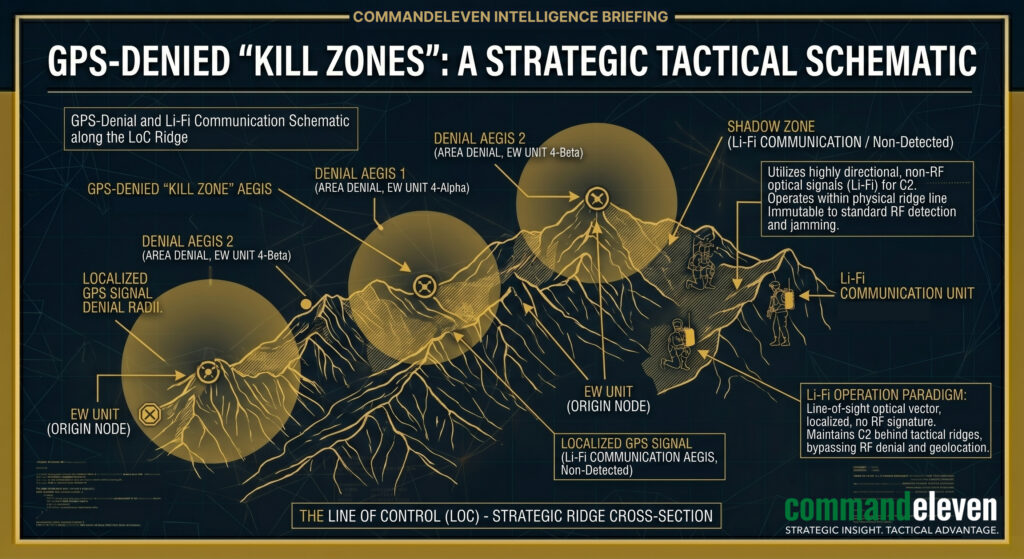
- L-Band Saturation: By flooding the GPS L1 (1.575 GHz) and L2/L5 bands with localized noise, EW units create “GPS-denied zones.” When a drone enters this “bubble,” its flight controller loses its spatial orientation and its ability to execute programmed waypoints.
- Meaconing and Spoofing: Advanced C-UAS units don’t just jam; they “spoof.” By broadcasting fake GNSS signals that are stronger than the legitimate satellite data, the EW unit can trick a drone into “thinking” it is several kilometers away, causing it to crash or execute a “Return to Base” (RTB) protocol that leads it directly into friendly territory for capture and forensic analysis.
The Challenge of Frequency Deconfliction
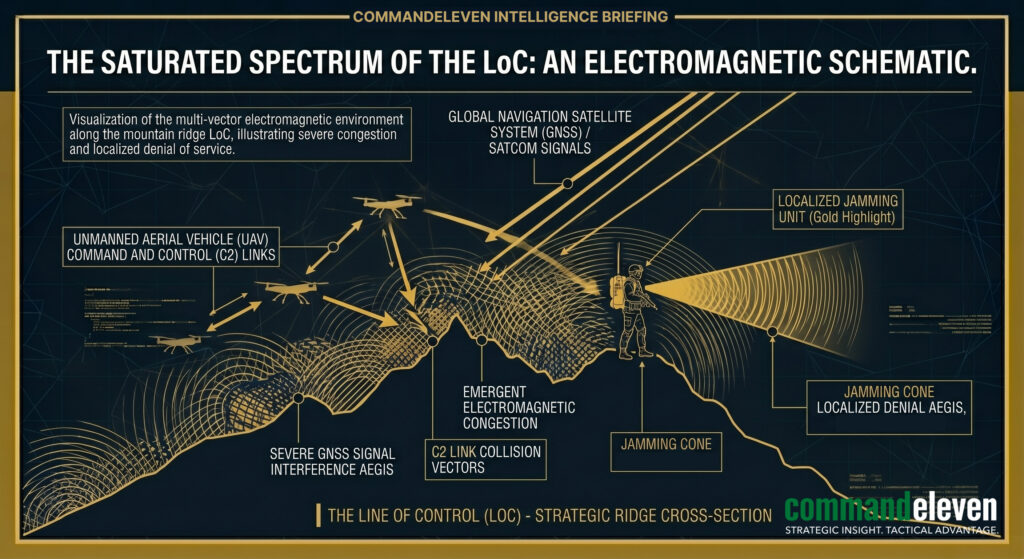
The massive scale of jamming on the LoC has created a “congested spectrum” problem where friendly assets are frequently neutralized by their own EW units.
- Blue-on-Blue Interference: The broadband nature of “noise jamming” can inadvertently drop friendly drone links or scramble tactical C2 (Command and Control) channels.
- Sectorized Shielding: To mitigate this, 2026-generation C-UAS systems utilize Directional Beamforming. Instead of a 360-degree “bubble,” they project a “cone of silence” toward the adversary ridge, allowing friendly drones to operate safely in the “shadow” behind the jamming unit.
Impact on Asymmetric Loitering Munitions
The integration of EW on the LoC has forced a redesign of loitering munitions.
- Anti-Jamming Resilience: Both state and non-state actors are now deploying munitions with CRPA (Controlled Reception Pattern Antennas) and high-grade Inertial Navigation Systems (INS). These assets are designed to “ignore” electronic interference, maintaining their mission profile even in a total GPS-blackout environment.
- The “Home-on-Jam” Threat: A critical technical risk in 2026 is the “Home-on-Jam” seeker. Modern loitering munitions can be programmed to treat a jamming signal as a target beacon, effectively turning the defender’s EW unit into a high-priority target.
Hardened Communications & Signature Management
As the LoC transitions into a high-intensity Electronic Warfare theater, the ability to maintain “Electromagnetic Silence” has become as critical as physical camouflage. The 2026 tactical environment dictates that any Radio Frequency (RF) emission is a potential target acquisition trigger.
Counter-SIGINT and the Decline of Legacy RF
Traditional VHF/UHF radio communication is now viewed as a liability. Tactical units operating in the NMDs and LoC proximity are transitioning to “Low-Observable” communication technologies to bypass AI-driven geolocation.
- Millimeter Wave (mmWave) Communication: By utilizing frequencies in the 30–300 GHz range, units can achieve high-bandwidth communication with a highly localized footprint. Because these waves are easily absorbed by atmospheric oxygen and have limited range, they are significantly harder for distant adversary SIGINT arrays to detect.
- Directional Laser (Li-Fi) and Free-Space Optics (FSO): For static outposts and “line-of-sight” communication between ridges, directional laser links offer near-total immunity to jamming and interception. These “point-to-point” beams do not radiate a detectable RF signature, making the communication link invisible to electronic reconnaissance.
Emission Control (EMCON) and AI Geolocation
The integration of AI into adversary signals intelligence means that even a two-second radio burst can be geolocated with meter-level accuracy.
- The Kinetic-EW Loop: A new doctrine has emerged where EW units act as “spotters” for precision-guided artillery. Once a specific RF signature is geolocated, the coordinates are automatically fed into a loitering munition or a PGM-enabled battery, resulting in a kinetic strike within minutes of the transmission.
- Electronic Signature Decoys: To counter this, tactical teams are deploying “RF Decoys”,small, expendable emitters that mimic the signal characteristics of a command post or a troop concentration. These decoys draw adversary fire and EW resources away from actual operational units.
Strategic Implications for CommandEleven Assets
For CommandEleven personnel – including intelligence analysts, executive protection teams, and field observers – the EW saturation on the LoC necessitates a fundamental overhaul of standard operating procedures (SOPs).
The Vulnerability of COTS and Satellite Comms
Standard Commercial-Off-The-Shelf (COTS) equipment, such as satellite phones (Thuraya, Iridium) and standard encrypted messaging apps, are highly vulnerable in this theater.
- Uplink Interception: Satellite uplinks create a “vertical signature” that is easily detectable by airborne SIGINT platforms (UAVs and ELINT aircraft). In a contested environment, the use of a satellite phone can inadvertently “paint” the user’s location for a kinetic strike.
- The “Encryption Fallacy”: While the content of a message may be encrypted, the metadata (location, time, and frequency) is sufficient for an adversary to identify the presence of high-value personnel.
Executive Protection (EP) in GPS-Denied Zones
EP teams must now prepare for “Total Electronic Blackout” scenarios when operating near the LoC or in the NMDs.
- Hardened Navigation: Vehicles must be equipped with non-GNSS navigation systems, such as Visual Odometry or high-precision Inertial Measurement Units (IMUs), to maintain orientation when GPS spoofing or jamming occurs.
- RF-Shielded Kits: Personnel are required to utilize signal-blocking pouches (Faraday bags) for all non-essential electronics to prevent passive tracking via Wi-Fi or Bluetooth “handshakes” that occur even when devices are ostensibly off.
Operational Requirement: The “Stealth Field Kit”
Future deployments for CommandEleven assets will require the “Stealth Field Kit,” which includes:
- SDR-based Burst Transmitters: Devices that compress data into micro-second bursts, minimizing the window for detection.
- Frequency-Hopping Li-Fi Links: For secure, high-speed data transfer between field units and mobile command nodes without utilizing the RF spectrum.
Intelligence Assessment & Forecasting (2026–2030)
The trajectory of Electronic Warfare on the Line of Control suggests a rapid transition from human-operated systems to Autonomous Electromagnetic Combat. CommandEleven assesses that the next 48 months will be defined by the “Ghost Spectrum” phase, where combat is conducted by machines in frequencies invisible to traditional surveillance.
Autonomous EW Swarms and Loitering Jammers
By 2027, the deployment of dedicated “EW Swarms” will become standard operational procedure for high-altitude infantry advances.
- The “Forward Jammer” Doctrine: Rather than relying on rear-echelon jamming, tactical units will deploy swarms of small, low-cost UAVs that precede an advance. These drones will be programmed to identify and “blanket” specific enemy communication nodes, creating a “dead zone” that moves in tandem with friendly troops.
- Persistent Loitering Jammers: We anticipate the rise of solar-powered or high-endurance tethered drones that can remain in a GPS-spoofing orbit for days. These “Electronic Sentinels” will provide permanent protection for strategic ridges, effectively rendering them invisible to adversary drone reconnaissance.
The Quantum Race: Post-Quantum Cryptography (PQC)
As computational power increases, the encryption standards currently protecting tactical Command and Control (C2) links are approaching obsolescence.
- Quantum-Resilient Links: By 2028, the primary competition on the LoC will be the implementation of Post-Quantum Cryptography (PQC). The first actor to secure their tactical comms against quantum-based decryption will possess an overwhelming advantage in “Information Sovereignty.”
- The Decryption Deadline: Intelligence indicates that regional state actors are currently “harvesting” encrypted adversary transmissions, storing them with the intent to decrypt them once quantum computing reaches the required threshold. For CommandEleven, this necessitates an immediate shift to PQC standards for all long-term strategic archives.
Directed Energy Integration
The integration of Directed Energy Weapons (DEW) into the EW architecture is the inevitable final step in spectrum dominance.
- High-Power Microwave (HPM) “Frontiers”: By 2029, we forecast the deployment of vehicle-mounted HPM systems designed to physically fry the circuitry of incoming PGM swarms and loitering munitions. This represents a shift from “soft-kill” (jamming) to “hard-kill” (electronic destruction).
- Spectrum Scarcity: As more systems move to the electromagnetic domain, the LoC will face “Spectrum Scarcity.” The resulting interference will make communication nearly impossible for any actor without advanced AI-driven frequency management tools.
Final Assessment
The LoC has entered a state of Permanent Electromagnetic Friction. For CommandEleven assets, the baseline assumption for any future deployment must be that the theater is GPS-denied, RF-saturated, and AI-monitored. Success will depend on the ability to operate within the “shadows” of the spectrum,utilizing directional laser links and burst-transmissions to maintain C2 while the primary RF bands are rendered useless by autonomous jamming.