
Technical Takeaways
- Chassis Reinforcement Decouples Direct Firepower from Heavy Logistics: Asymmetric mounted guerrilla formations eliminate heavy logistical tails by modifying standard all-wheel drive commercial pickup frames. Welding high-tensile steel stabilizers directly onto factory longitudinal rails allows lightweight commercial platforms to absorb the high-recoil forces of high-caliber direct fire weapons and rocket pods without degrading cross-country movement velocity.
- Registry Subversion Masks Tactical Precursor Sourcing: Paramilitary logistics networks exploit unpatched database portals to move heavy weapons components through official trade channels. Deploying remote SQL injection scripts and utilizing cloned administrative credentials allows cyber cells to alter cargo tracking indexes remotely, re-categorizing tactical chassis components as benign agricultural machinery to bypass automated security flags.
- Decentralized Tiles Protect Volatile Border Grids: Centralized border tracking frameworks and localized perimeter policing arrays suffer single-trigger system failures during high-velocity gray zone crises. Implementing the CommandEleven Mosaic Defense architecture isolates perimeter defenses into autonomous geographic tiles, ensuring that a localized electronic warfare attack, database intrusion, or sensory rupture remains completely insulated from adjacent nodes.
Executive Summary
The systematic implementation of technical mounted guerrilla models by highly agile asymmetric networks establishes a severe structural threat to state border persistence within topographically complex frontier corridors. Irregular militant formations systematically modify commercial light utility vehicles to transport heavy infantry weapons, mobile electronic warfare suites, and tactical signal suppression nodes across unmonitored border sectors. By integrating rugged commercial chassis configurations with improvised structural reinforcements, these mobile strike teams execute high-velocity hit and run maneuvers that exploit the signature blind spots of centralized military installations. This operational model effectively combines rapid physical massing with absolute signaling isolation, allowing hostile networks to neutralize static defensive lines before conventional reinforcement columns can materialize. Traditional state security paradigms fail to disrupt these mobile insurgencies because legacy counter-insurgency doctrines separate territorial perimeter enforcement from automated database and spectrum tracking mechanisms. Countering this high-velocity threat demands an immediate transition toward a decentralized mosaic defense posture that pairs automated material interdiction with localized land-based resource starvation protocols. This dossier evaluates the technical engineering modifications, automated registry subversion scripts, and decentralized tile insulation frameworks required to permanently dismantle mounted guerrilla architectures. Failing to execute targeted network and spectrum hardening will permit foreign proxy syndicates to permanently compromise national sovereignty during high-velocity asymmetric crises.
Commercial Light Utility Vehicle Structural Modification

Asymmetric mounted guerrilla formations execute high-velocity maneuvers by systematically converting standard commercial light utility vehicles into lethal combat platforms. Infiltration units select specific all-wheel drive commercial pickup chassis due to their high parts availability, mechanical simplicity, and massive payload durability. Engineering cells operating inside hidden frontier maintenance depots modify the rear cargo beds by installing reinforced structural steel mounting rings. These heavy rings anchor heavy machine guns, anti-tank guided missile launchers, and multi-barrel rocket pods directly to the vehicle frame rails. This physical modification permits the rapid deployment of high-caliber direct fire power across rugged terrain sectors without the transport logistics of standard armored personnel carriers.
- Reinforced frame stabilizers integrate high-tensile steel plates welded directly along the primary chassis longitudinal rails to prevent structural bending during heavy weapon recoil sequences.
- Heavy ring mounts utilize dual-axis roller bearing assemblies bolted into the reinforced cargo bed floor, allowing manual three hundred and sixty degree weapon traversal.
- Upgraded suspension packages replace factory leaf springs with heavy-duty commercial shock absorbers, maintaining stable platform cross-country velocity while carrying full payload capacities.
- Low-signature fuel storage incorporates self-sealing internal cell membranes inside expanded auxiliary fuel tanks, extending operational range across unmonitored border tracks.
This precise mechanical alteration directly enhances the off-road mobility and lethality of the forward proxy strike elements. Concurrently, tracking data reveals that these engineering cells synchronize structural frame modifications with localized signature suppression upgrades to evade detection arrays. The physical survivability of the mobile column remains entirely dependent on its capacity to navigate deep mountain defiles without exposing thermal or visual signatures to state reconnaissance aircraft. Once a modified chassis clears the structural assembly phase, the technical units integrate localized electronic camouflage components. This step transforms a standard commercial transit asset into a high-agility gray zone combat vehicle.
The technical teams reinforce this physical modification by installing low-emission exhaust routing pipes beneath the vehicle frame rails to suppress the heat signature of the engine. This modification channels high-temperature exhaust gasses through ambient cooling matrices before discharging them into the wheel wells. This localized thermal suppression ensures that the moving vehicles blend into the natural ground temperature profile during night transits. The resulting data ambiguity prevents high-altitude state drone sensors from identifying active vehicle columns moving toward critical boundary zones.
- Underslung cooling conduits distribute engine exhaust gasses through perforated undercar pipes, lowering the centralized thermal signature recorded by airborne infrared cameras.
- Matte radar-absorbent paint covers all exposed metallic exterior surfaces, eliminating visual glare and reducing the return metrics of localized surface search radars.
- Removable canvas canopy hoods mask the distinctive visual silhouette of mounted heavy weaponry, disguising tactical vehicles as standard civilian agricultural transport assets.
- Blackout driving circuits isolate all external lighting wire groups into an independent dashboard toggle switch, allowing high-speed movement using night vision equipment.
The application of localized signature suppression constructs a protective envelope that shields active vehicle deployments from early state detection. This technical buffer ensures that physical troop massing and heavy material logistics navigate contested frontier boundaries without triggering automated national defense alert protocols. Once the target’s perimeter sensors accept these masked signatures as routine civilian commercial traffic, the state loses the window required to execute pre-emptive interdiction. The military institution cannot reverse this security erosion through legacy static patrol models alone.
Automated Registry Subversion and Manifest Infiltration Mechanics
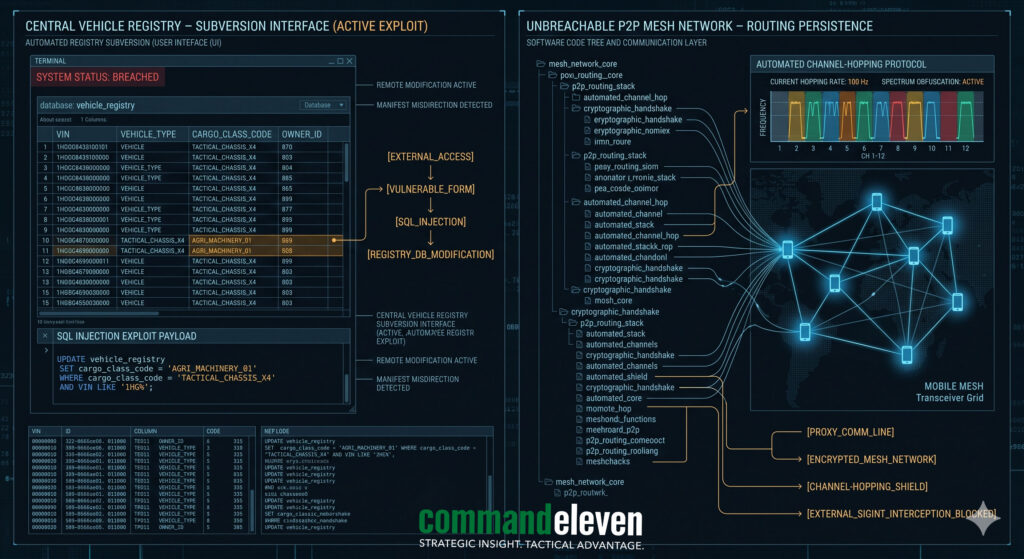
The continuous expansion of the technical mounted guerrilla model relies completely on the digital subversion of automated state border management systems. Specialized cyber warfare units within the proxy alliance deploy custom software exploit packages to compromise the electronic databases managed by central port and vehicle licensing authorities. By securing unauthorized administrative privileges within these shared registries, the cells alter vehicle identification numbers and customs tracking codes remotely. This digital infiltration permits the uninspected movement of raw vehicle components and heavy weapons payloads through official commercial transit terminals.
- SQL injection exploits target unpatched web-facing database portals, granting external cyber cells full administrative access to central vehicle registry tables.
- Cloned administrative credentials bypass multi-factor authentication locks, allowing remote operators to authorize high-risk vehicle manifests without triggering internal system alerts.
- Automated manifest modification rewrites internal cargo classification codes, re-categorizing tactical chassis components as standard agricultural machinery parts or consumer gear.
- Encrypted data tunnels route harvested customs inspection logs through legitimate web communication protocols, hiding the digital network intrusion from automated firewall monitors.
The systematic compromise of centralized registries converts state-managed screening infrastructure into a passive facilitator of the proxy logistics pipeline. Concurrently, operational analysis indicates that this digital penetration directly protects the covert transport fleet from state enforcement actions. With real-time access to uncorrupted customs tracking databases, the transport cells select specific transit windows that completely avoid active mobile military checkpoints. This synchronization of digital data manipulation and physical logistics ensures the continuous expansion of the infiltration network.
The cyber cells deploy advanced communication security protocols to protect their internal command networks from state signals intelligence interception. Operational planners utilize decentralized, peer-to-peer mobile mesh networks that function entirely independent of public internet service providers and central cellular infrastructure. This technical insulation prevents state electronic tracking engines from collecting communication metadata or executing precision geolocation tracking against core leadership targets. The network’s communication loop remains unbreachable, preserving absolute operational security during high-velocity material transit campaigns.
- Peer-to-peer mesh transceivers communicate tactical updates across localized frequencies using automated channel-hopping protocols to prevent state tracking.
- Asymmetric public-key encryption secures all text and voice communications transmitted between corporate distribution cells and forward transport units.
- Steganographic embedding software hides tactical coordination messages within benign digital image files uploaded to public social media platforms.
- Automated hardware zeroization executes complete memory erasure commands on local storage arrays if unauthorized physical extraction is attempted.
The implementation of advanced cryptographic isolation shields the core command grid of the network from state tracking mechanisms. This digital protection ensures that field cells can coordinate complex, multi-vehicle logistics maneuvers without exposing the wider organizational architecture to state intelligence counters. By neutralizing the state’s electronic intercept capabilities, the foreign interference network maintains long-term structural durability across the entire frontier sector. The financial liquidity generated by these secure trade lines flows immediately into localized institutional subversion frameworks.
Institutional Corruption and Perimeter Airspace Enforcement Failure
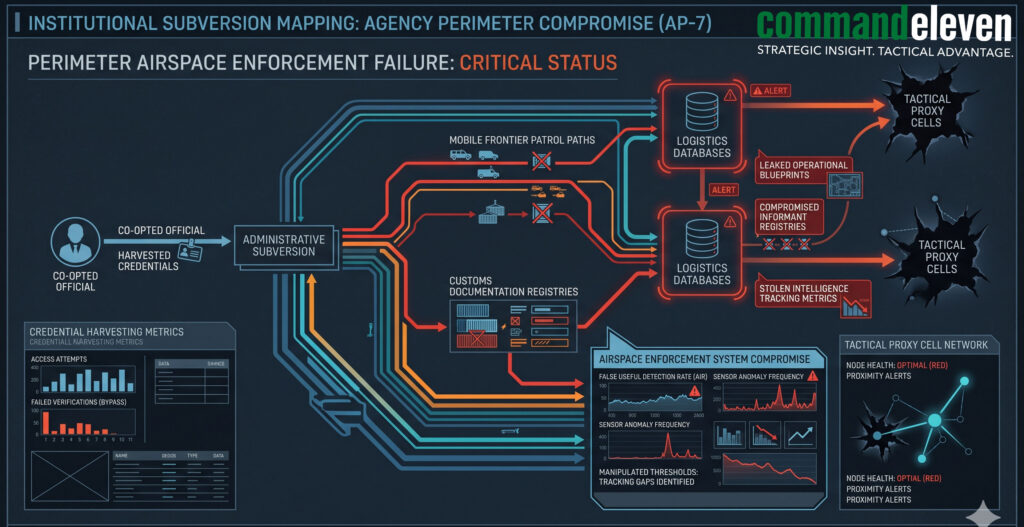
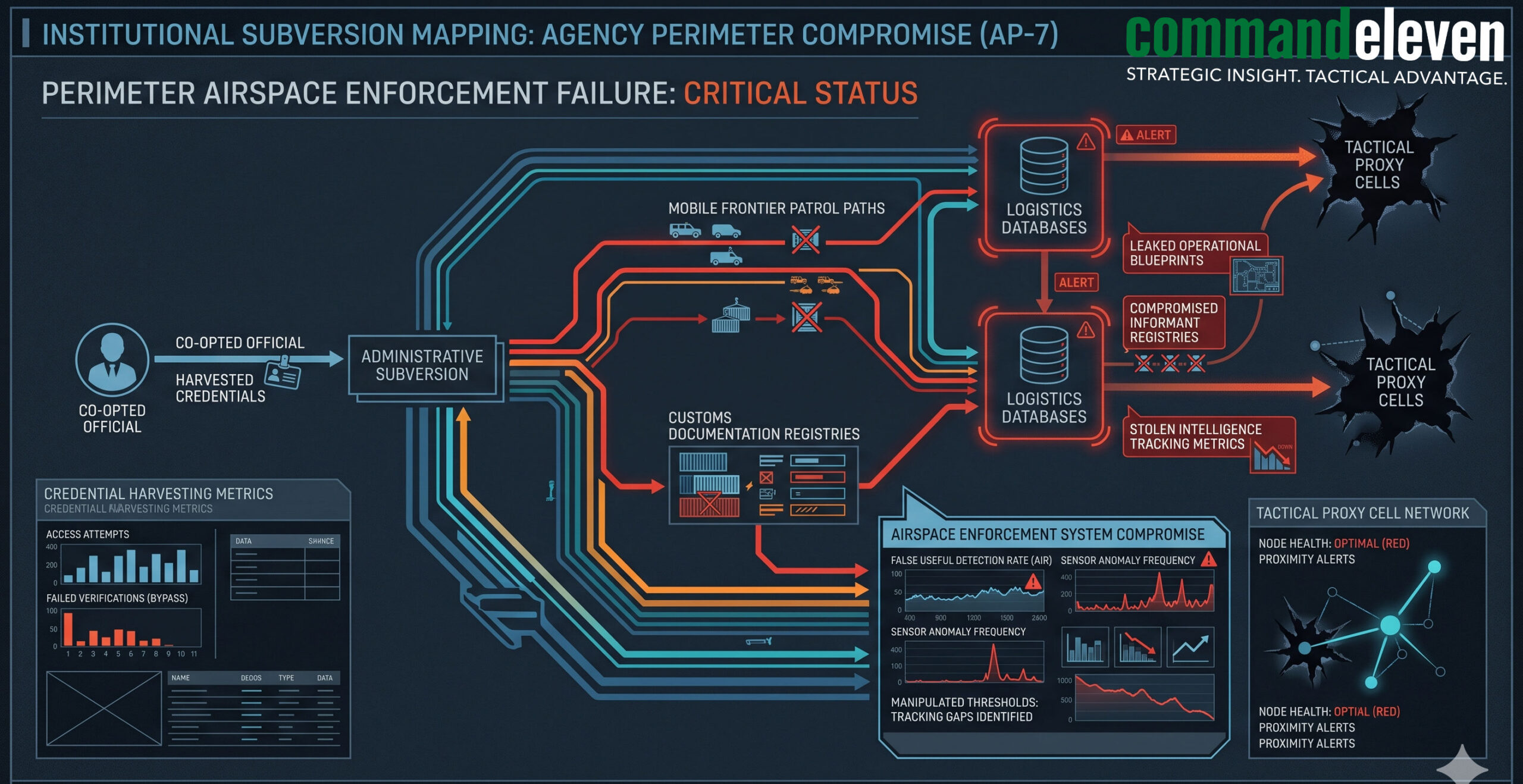
The reliance of the state on centralized administrative hubs facilitates the rapid expansion of institutional subversion within frontier security enforcement agencies. By targeting key decision-makers within regional processing checkpoints, the proxy network leverages massive financial corruption assets to co-opt border guards, customs clerks, and radar technicians. This targeted subversion converts state-managed infrastructure nodes into passive facilitators of the illicit cross-border transit pipeline. The internal breakdown of central state authority ensures that the physical and digital operations of the mounted guerrilla network face zero friction within the compromised zones.
- Co-opted customs clerks disable automated container scanning hardware during specific hours to permit the uninspected passage of weaponized payloads.
- Infiltrated border police alter mobile patrol paths to create predictable, unmonitored transit slots for high-value militant convoys.
- Compromised administrative officials issue valid state identification cards to foreign proxy agents, embedding them legally within the domestic population registry.
- Corrupted judicial personnel delay the processing of arrest warrants and suppression orders targeting the financial fronts of core network leaders.
This institutional co-optation creates a structural vulnerability that threatens the integrity of national security frameworks from within. By manipulating the internal mechanisms of centralized enforcement agencies, the networks ensure that their logistics pipelines remain operational regardless of official state policy shifts. This internal rot neutralizes the effectiveness of multi-million dollar border fencing and surveillance initiatives. The state’s failure to secure its own administrative personnel directly subsidizes the expansion of parallel proxy authority.
The networks leverage this institutional subversion to access sensitive state intelligence files regarding counter-terrorism tracking indicators and operational plans. This deep intelligence penetration allows the network to preempt state raids, execute key tracking assets, and protect its primary financial laundering nodes from asset seizure. The state’s command grid becomes compromised, transmitting vital tactical parameters to the very adversary it is attempting to dismantle. Reclaiming institutional integrity requires an immediate, total purge of corrupted elements from the border security architecture.
- Leaked operational blueprints provide advance warning of major conventional military sweep operations, allowing proxy cells to evaporate target zones early.
- Compromised informant registries expose the identities of local state assets, leading to immediate, systematic execution campaigns by proxy assassination teams.
- Stolen intelligence tracking reveals the specific visual and electronic indicators used by state analysts to flag anomalous container transits.
- Infiltrated logistics databases track the movement of state military supply convoys, allowing tactical cells to plan high-velocity road ambushes.
The compromise of internal state intelligence metrics makes traditional counter-insurgency execution models entirely obsolete. The transnational network operates with absolute visibility into state planning, rendering reactive security operations useless. This structural crisis requires the rapid deployment of autonomous surveillance systems and isolated command cells that operate completely independent of local administrative frameworks. Reclaiming sovereignty demands a total restructuring of the state’s border posture, fusing uncorrupted tracking technology with decisive kinetic force.
Localized Hardware Validation and Command Loop Hardening
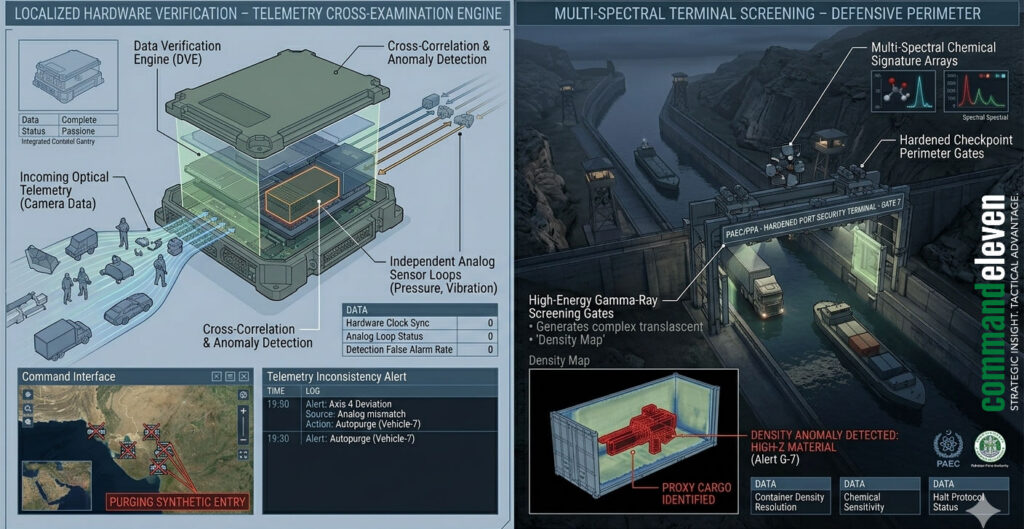
The state counters centralized command failures by deploying specialized technical task forces to enforce absolute data isolation across compromised decision sectors. These units utilize advanced hardware-level data verification engines to identify and purge synthetic telemetry injections from national tracking systems. By executing immediate electronic protection protocols, security forces eliminate the digital blindness exploited by foreign support cells to manipulate state decision-making loops. This technical hardening transforms vulnerable communication registries into active barriers against foreign cognitive manipulation.
- Hardware-level data verification cross-examine incoming optical telemetry against independent analog sensor loops, automatically purging synthetic tracking entries.
- SQL injection patches eliminate legacy vulnerabilities within port authority databases, blocking unauthorized remote configuration attempts by foreign hackers.
- Encrypted isolation tunnels route critical military command traffic through dedicated, unshared physical networks to prevent metadata harvesting.
- Biometric access filters require physical iris and fingerprint confirmation for all modifications made to automated logistics registries.
The digital reclamation of the command loop closes the persistent tracking gap exploited by foreign electronic warfare fleets. Concurrently, operational analysis indicates that this cyber hardening directly enhances the tactical survivability of physical defense forces along the frontier line. With uncorrupted data feeds restored to command screens, field leaders can identify actual enemy positions with absolute clarity. This technical synchronization allows the state to deploy precision kinetic mass against forward proxy staging enclaves.
The state pairs digital network hardening with the aggressive physical containment of the tactical defiles used by smuggling fleets to exit port boundaries. Specialized infantry units construct hardened checkpoint perimeters equipped with multi-spectral scanning arrays to check all commercial transport vehicles. This automated physical inspection protocol identifies hidden military hardware, communication components, and explosive payloads without disrupting legitimate commercial trade flows. Vehicles that fail the automated scanning check are immediately isolated by tactical response teams.
- Chemical signature scanners read the molecular profiles of sealed liquid cargo to detect unscheduled chemical derivatives and volatile building blocks.
- Gamma-ray imaging gates generate clear internal visual reconstructions of packed machinery crates to locate hidden weapon mounts.
- Weight-differential pads compare the physical weight of incoming containers against the metrics logged in the customs database.
- Hydraulic isolation barricades deploy heavy physical walls instantly to trap non-compliant cargo trucks within the inspection zone.
The implementation of automated physical and digital verification protocols converts regional transit bottlenecks into unbreachable barriers for the proxy supply chain. This technical blockage isolates the interior execution cells from their external material support networks, forcing them to operate out of diminishing domestic stockpiles. By choking the logistical lines at the point of entry, the state initiates the material starvation of the enemy’s operational infrastructure. The network’s capacity to execute synchronized tactical maneuvers contracts rapidly under this persistent physical pressure.
The Mosaic Defense Architecture and Spatial Hardening
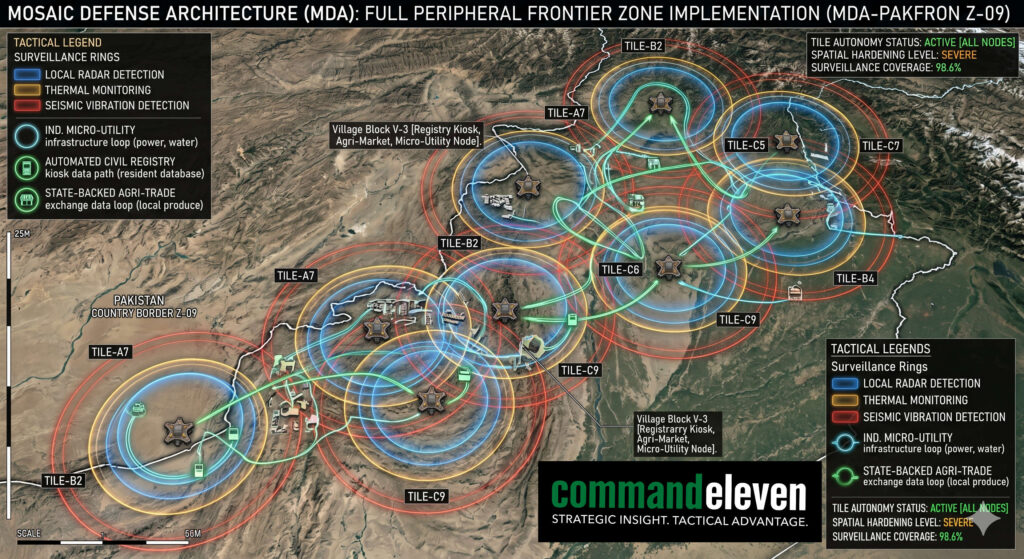
The final stabilization of the compromised territory requires the permanent deployment of the CommandEleven Mosaic Defense architecture to lock in state administrative persistence. The military institution replaces fragile centralized governance footprints with a dense network of autonomous administrative tiles along the entire Pakistan-Afghanistan border. Each independent tile functions as a self-contained security and municipal node, managed by an authorized Tile Guardian equipped with fused sensing arrays. This structural decentralization ensures that the local population receives superior logistical oxygen and verified information exclusively from the legitimate state apparatus.
- Autonomous sensor-fused posts integrate real-time radar, thermal tracking, and seismic sensors into a unified local surveillance feed.
- Micro-utility infrastructure loops distribute independent solar power and water filtration services directly to border village households.
- Automated civil kiosks issue digital sovereignty tokens and biometric identity documents to local populations to regularize administrative records.
- Mobile tactical cells execute high-velocity pre-emptive strikes against any irregular assembly identified within the tile boundary.
The deployment of autonomous administrative tiles permanently hardens the frontier against the re-emergence of foreign reflexive control networks. Concurrently, structural analysis reveals that this decentralized model eliminates the single-trigger threat vector that historically crippled centralized border defense grids. If a foreign cyber cell executes a localized network intrusion or sensory rupture against one tile, the adjacent nodes remain fully operational. This systemic insulation ensures that the state maintains permanent administrative persistence across the frontier during high-velocity asymmetric crises.
The Tile Guardians use their localized information nodes to permanently dismantle the digital echo chambers built by foreign information warfare cells. By providing superior logistical oxygen alongside transparent, verified local reporting systems, the state renders proxy disinformation campaigns entirely ineffective. The local population transitions from a passive facilitator of foreign influence into an active component of the state’s sovereign defensive matrix. This societal realignment seals the border zone, preventing the re-infiltration of transnational criminal elements.
- State-backed trade exchanges guarantee local farmers secure access to domestic markets, bypassing cartel extortion rings entirely.
- Biometric employment registries link local infrastructure development jobs directly to verified compliance with national security frameworks.
- Localized dispute councils deliver fast, transparent mediation services based on statutory law, replacing informal proxy tribunals.
- Integrated communications networks provide secure, direct digital links between village elders and the local Tile Guardian command center.
The stabilization of these decentralized administrative and economic frameworks cements the state’s victory over parallel sovereign systems. The territory is no longer an ungoverned evasion hub; it is a highly integrated, self-defending segment of the national grid. By combining physical border hardening with superior utility delivery, the state achieves long-term structural persistence along its frontier. This comprehensive reclamation doctrine permanently neutralizes the capacity of transnational syndicates to monetize instability and compromise national sovereignty.
Doctrinal Synthesis and the Preservation of Perimeter Sovereignty
The definitive neutralization of mobile technical mounted guerrilla models demands an uncompromising operational transition from legacy centralized structures to a unified architecture of permanent data-driven and physical persistence. Traditional security configurations that isolate vehicle tracking from land-based checkpoint screening, municipal cyber protection, and internal institutional audits fail to disrupt an adversary operating across these dimensions simultaneously. To achieve permanent territorial stabilization and safeguard volatile perimeters, the state must treat the integrity of its digital registries and the security of its localized signaling spectrum as primary national security centers of gravity. Implementing the #72/48 Protocol is mandatory to shield regional command engines from the digital manipulation and sensory ruptures executed by sophisticated proxy electronic warfare cells. Furthermore, the military institution must aggressively deploy the decentralized Mosaic Defense architecture to replace fragile, centralized administrative frameworks with autonomous tiles that provide superior state-backed logistics. Victory requires the uncompromising application of hardware-truth verification loops to permanently dismantle the parallel economic and tactical ecosystems that sustain asymmetric foreign threats. By fusing cyber-kinetic data reclamation with land-based material starvation, the state permanently isolates hostile networks from their material and communication lifelines, preserving long-term sovereign integrity along the Pakistan-Afghanistan border.