CommandEleven Intelligence · Iran Desk. Flash Assessment, status as of October 29, 2026. Companion to The Strike Clock.
Bottom Line Up Front
On October 23, Tom Barrack, the US ambassador to Türkiye and the administration’s special envoy for Syria, told interviewer Mario Nawfal: “We installed the Shah. We installed Khomeini in 1979. We took out the Shah.” He added: “We’ve changed it three times, right?” In the same interview he said a US strike on Iran that weekend could “absolutely” happen.
The White House answered the strike remark within hours. As of this morning, CommandEleven Intelligence has found no statement from the White House, the State Department or President Trump correcting or distancing the administration from the claim about Khomeini.
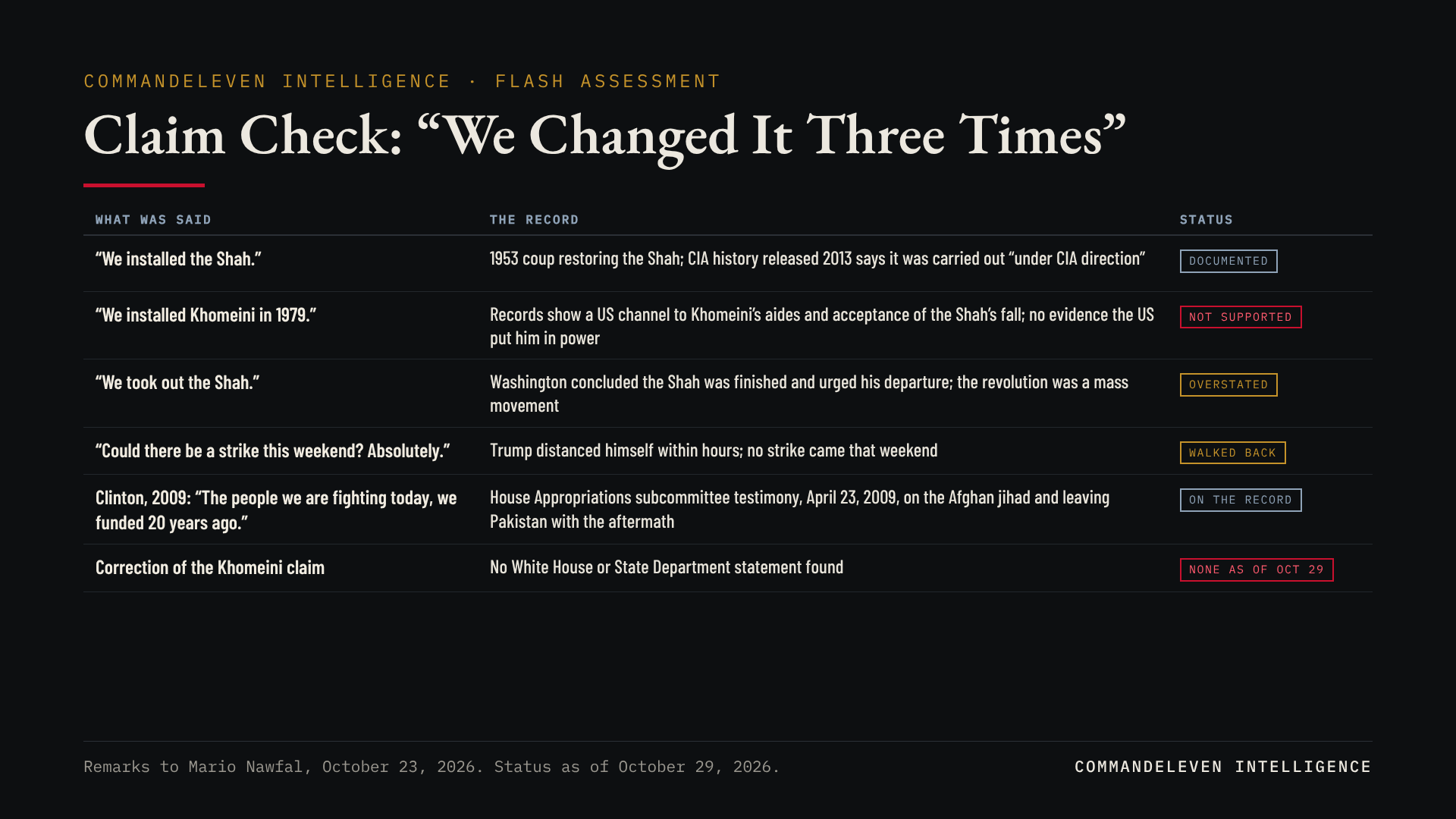
Half of what Barrack said is history and half is not. The United States did organize the 1953 coup that restored the Shah; the CIA acknowledged it in documents released in 2013. It did not install Khomeini. Declassified records show the Carter administration opening a channel to Khomeini’s circle and accepting the end of the Shah’s rule in January 1979, which is not the same thing.
The timing makes the claim matter more than its accuracy. A sitting US envoy has described regime change in Iran as something Washington has done three times, while the US weighs a week of strikes on Iran’s leadership after the November 3 midterms and Qatari mediators try to head them off. In Iran, that sentence serves the regime, its monarchist opponents and anyone who wants to paint the next Iranian government as America’s choice.
Key Judgments
KJ1: The quote is real. Barrack made the remarks on camera to Mario Nawfal on October 23; clips are circulating on X and the remarks were reported by Iranian and international outlets the same day. [CONFIRMED]
KJ2: The claim is half right. The 1953 coup was a US and British operation, which the CIA has acknowledged in writing. The claim that the US installed Khomeini is not supported by the declassified record. [CONFIRMED on 1953; ASSESSED on 1979]
KJ3: No one in Washington has walked it back. Trump distanced himself from Barrack’s strike remark on October 23 but has not addressed the Khomeini claim. CommandEleven Intelligence found no correction from the White House or the State Department as of October 29. [CONFIRMED as of publication; subject to change]
KJ4: Every faction in Iran can use it. For Tehran, it confirms a century of American interference. For monarchists, it confirms that the Islamic Republic was a foreign arrangement from the start. For the regime’s security services, it supplies a ready charge against any future opposition: that Washington is picking Iran’s leaders again. [ASSESSED, moderate confidence]
KJ5: It belongs to a longer ledger. In 2009, Secretary of State Hillary Clinton told Congress that “the people we are fighting today, we funded 20 years ago,” describing the US-backed Afghan jihad and the exit that left Pakistan with what followed. Senior US officials describing past interventions as American authorship, without accounting for the consequences, is a pattern, and the region’s governments and armed groups use each admission. [CONFIRMED on the Clinton testimony; ASSESSED on the pattern]
KJ6: Nothing here is registered on the Foresight Record. This is an information piece. [METHOD]
What Barrack Said
Barrack spoke to Mario Nawfal, the Lebanese-Australian entrepreneur and X broadcaster, in an interview released on October 23. [CONFIRMED]
- On Iran’s history: “We installed the Shah. We installed Khomeini in 1979. We took out the Shah.” He followed with: “We’ve changed it three times, right?”
- On a strike: asked whether there could be a US strike on Iran that weekend, he said: “Could there be a strike this weekend? Absolutely.” He also said the president remained open to a deal.
- On regime change: he said the administration is not pursuing direct regime change but wants the Islamic Republic to change its behavior, and that ordinary Iranians struggling under current conditions could change their own government once the pressure eases.
The reaction. Within hours, Trump was asked about the strike remark after landing in Florida. He questioned whether it had come from his ambassador, saying “He’s a pretty powerful man, I guess,” and later told a rally, “We may do another little Epic Fury, or they’ll agree.” Neither comment addressed what Barrack said about the Shah or Khomeini. Iran scholar Suzanne Maloney called the exchange “unbelievable” and “just surreal.” The Persian-language site Gooya News ran the remarks under the headline “We brought Khomeini to power.”
The speaker. Barrack is a close friend and longtime business associate of the president, not a career diplomat. His remarks have drawn fire before: in August 2025, he apologized after telling Lebanese journalists at the presidential palace in Beirut to stop behaving in an “animalistic” way, a remark he later called “inappropriate.”
What the Record Shows
1953: “We installed the Shah”
This part is on the record. In August 2013, documents released to the National Security Archive under the Freedom of Information Act included the CIA’s own internal history, which states that the military coup that overthrew Prime Minister Mohammad Mosaddegh “was carried out under CIA direction as an act of U.S. foreign policy.” Britain’s intelligence service was a partner in the operation. The coup restored the Shah, who had fled the country days earlier, and kept him in power for 26 years. [CONFIRMED]
1979: “We installed Khomeini”
This part is not supported. What the declassified record and published histories show: [CONFIRMED on the documents]
- November 9, 1978: US Ambassador William Sullivan cabled Washington that the Shah was finished and proposed that he and his senior generals leave, followed by an arrangement between younger commanders and Khomeini.
- Early January 1979: General Robert Huyser was sent to Tehran. According to the BBC’s 2016 reporting on declassified cables, his task was to prevent a military coup against Prime Minister Shapour Bakhtiar and to bring the army into contact with Khomeini’s camp. He was later accused of neutralizing the army; he denied it, and his reports have not been published.
- January 14–18, 1979: Secretary of State Cyrus Vance authorized a direct channel. US diplomat Warren Zimmermann met Khomeini’s aide Ebrahim Yazdi in Paris three times.
- January 16: The Shah left Iran.
- January 27: Khomeini sent Washington a message urging that the army not back Bakhtiar and offering reassurance on oil.
- February 1 and 11: Khomeini returned to Tehran; ten days later the military declared itself neutral and the old order collapsed.
[ASSESSED] This is a record of a superpower accepting an outcome it could no longer prevent and trying to manage it: keeping the army intact, avoiding a bloodbath and protecting oil and American lives. It is not a record of the United States choosing Khomeini or putting him in power. The revolution was a mass movement that had been building for more than a year. Iran’s leadership rejected even the 2016 documents, with Ayatollah Khamenei calling them fabricated.
“We took out the Shah”
[ASSESSED] The Carter administration did conclude in late 1978 and January 1979 that the Shah could not survive, and US officials encouraged his departure. That is closer to the truth than “we installed Khomeini,” but it compresses a revolution into a decision made in Washington.
Why It Lands Now
Barrack did not say this in a seminar. He said it as Washington and Tehran approach the most dangerous point since the summer.
- The strike window. Axios reported on October 28, citing US and Israeli officials, that renewed US bombing after the November 3 midterms could include “a week of massive strikes on Iranian leadership, energy, nuclear and infrastructure targets.” Our Strike Clock brief sets out the planning. [REPORTED]
- The mediation. Qatar-led mediators are pressing Iran to readmit International Atomic Energy Agency inspectors in exchange for some sanctions relief. Tehran is demanding an end to the US naval blockade and the release of frozen funds. [REPORTED]
- The regime-change question. The administration has never settled it. Trump called regime change “the best thing that could happen” in February, said in March that it had already happened because the leadership had been “decimated,” said in June that he “never cared” about it, and after the September 1 strikes urged Iranians to “rise up and fight.” Defense Secretary Pete Hegseth said it was “not a so-called regime change war … but the regime sure did change.” [CONFIRMED]
Into that ambiguity, a presidential envoy has said that changing Iran’s government is something the United States has done three times. Whatever Barrack intended, Tehran can now quote a serving US official on the record.
How It Plays Inside Iran
[ASSESSED, moderate confidence] The claim reaches three audiences, and each can use it.
- The regime. The Islamic Republic’s founding story is independence: “Neither East nor West.” Barrack’s claim attacks that story, which is why the regime will be careful with it. What it can use without risk is the rest: a US envoy boasting that Washington makes and unmakes Iranian governments. That fits the 1953 grievance the regime has taught for 47 years, and it lands while Iranians are living through a war that began with the killing of their supreme leader.
- The monarchists. In parts of the opposition and the diaspora, the belief that the West removed the Shah and delivered Khomeini is long-standing. A serving US ambassador has now said it. That claim will travel, and it will not come with the historical record attached.
- The next opposition. This is the most lasting damage. Any Iranian movement that rises after a renewed bombing campaign can now be tagged by the security services as America’s fourth installation, with an American envoy’s words as proof.
What we have not seen yet. As of this morning, CommandEleven Intelligence has not found a formal response from Iran’s Foreign Ministry or a sustained campaign in Iranian state media built on the remarks. If the remarks are not corrected, we expect both to come, most likely timed to the strike window.
The Bigger Story: The Blowback Ledger
Barrack’s remark is the latest entry in a ledger the region keeps better than Washington does.
Clinton, 2009. On April 23, 2009, Secretary of State Hillary Clinton testified before the House Appropriations Subcommittee on State, Foreign Operations, and Related Programs. Describing the US-backed war against the Soviet Union in Afghanistan, she said: “the people we are fighting today, we funded 20 years ago.” She described how Washington worked with Pakistan’s military and intelligence services to arm the Afghan resistance, then cut those ties once the Soviets left, leaving Pakistan with the consequences, and warned: “let’s be careful what we sow because we will harvest.” [CONFIRMED]
Her words are often misquoted as an admission that the United States “created al-Qaeda.” She did not say that, and the record is more complicated: the Taliban emerged in 1994 from a generation shaped by the Afghan jihad and the refugee camps, and al-Qaeda grew from the Arab volunteers who came to fight it. What she did admit is that Washington funded the war that produced them and then walked away from the country left to manage what followed. [CONFIRMED on the testimony; ASSESSED on the history]
The pattern. [ASSESSED]
- Washington intervenes to shape another country’s government or war.
- It leaves before the consequences arrive, or declares them someone else’s problem.
- Years later, a senior official describes the intervention as American authorship, without the accounting.
- The region’s governments and armed groups use the admission, and it outlives the official who made it.
Why it matters to Pakistan. Pakistan sits in both columns of this ledger. It absorbed the blowback from Afghanistan that Clinton described. It hosted the April talks between Washington and Tehran and gave its name to the June peace memorandum. Its forces are now in Saudi Arabia under the Makkah Pact. If strikes resume after November 3, Pakistan is again close to a war it did not start, between a partner in Washington and a neighbor in Tehran, while a US envoy describes regime change in Iran as routine American policy.
Why it matters to the region. Every capital that receives a US envoy now knows that one of them describes Iranian governments as American products. For Iran’s partners, and for the armed groups it backs from Iraq to Yemen, that is a gift. It turns a contested history into a quotable line, at the moment Washington needs Arab mediators to persuade Tehran that a deal is safer than a war.
What Would Change This Assessment
Toward lower impact:
- A correction or clarification from Barrack, the State Department or the White House.
- The remarks fading from Persian-language media and Iranian official statements within days.
- A deal through the Qatari mediation that takes the strike window off the table.
Toward higher impact:
- The Foreign Ministry, Iranian state media or the Revolutionary Guard citing the remarks formally, especially in the strike window.
- Opposition or monarchist figures adopting “we installed Khomeini” as an American admission.
- Renewed US strikes on Iran’s leadership after November 3 while the remark stands uncorrected.
What This Assessment Does and Doesn’t Establish
This assessment establishes that a serving US ambassador and presidential envoy said on camera that the United States installed the Shah, installed Khomeini and removed the Shah; that the 1953 claim is documented and the Khomeini claim is not; and that, as of October 29, no US official has corrected the Khomeini claim. It establishes what Hillary Clinton said to Congress in 2009.
It does not establish what Barrack intended, whether he was speaking for the administration, or how Iranian audiences will respond. It does not treat the 1979 contacts as evidence that the United States installed Khomeini. No dated calls are set, and nothing here is counted on the Foresight Record.
Frequently Asked Questions
What did Tom Barrack say about Khomeini?
On October 23, 2026, he told Mario Nawfal: “We installed the Shah. We installed Khomeini in 1979. We took out the Shah.” He added: “We’ve changed it three times, right?”
Did the United States install the Shah?
In 1953, yes. The CIA’s own history, released in 2013, says the coup that overthrew Mosaddegh and restored the Shah was carried out under CIA direction.
Did the United States install Khomeini?
The record does not support it. Declassified documents show the Carter administration opened a channel to Khomeini’s aides in January 1979 and accepted that the Shah’s rule was over, but the revolution was a mass movement, not an American operation.
Has the White House distanced itself from the remark?
From the strike remark, partly. From the Khomeini claim, not as of October 29.
Did Hillary Clinton say the US created al-Qaeda?
No. In 2009 she told a House subcommittee that “the people we are fighting today, we funded 20 years ago,” referring to the US-backed war in Afghanistan, and that the US had left Pakistan to deal with the aftermath.
Related Reading
- No Countdown: The November 17 Alert, the Stock-Up Warnings and the One Real Date
- Pakistan’s Iran Border Pause: A Trade Halt, Not a Sealed Border
- Iran Sanctions 2026: Trump’s Toolkit vs. China’s Defiance
- Iran Foresight Audit: July 2026 Doctrinal Series vs. the War Doctrine & Strategy Series
Sources
- Mario Nawfal interview, via X, Barrack: “We installed Khomeini” (clip)
- Mario Nawfal interview, via X, Barrack on Iran, extended clip
- Public TV English, After US envoy to Turkiye warns of possible Iran strike on weekend, Trump first feigns ignorance then warns of another “Epic Fury”
- Gooya News, “We brought Khomeini to power”: controversial remarks by Trump’s close friend and confidant (Persian)
- Suzanne Maloney on X, “Unbelievable exchange. Just surreal.”
- Al Jazeera, CIA admits organising 1953 Iran coup
- The World (PRI), CIA: We orchestrated the 1953 Iran coup
- Wikipedia, Jimmy Carter’s engagement with Ruhollah Khomeini (summarizing the BBC’s 2016 “Two Weeks in January” reporting and the Carter Library record)
- Snopes, Did Hillary Clinton Say “We Created Al-Qaeda”? (sourcing the April 23, 2009 House testimony)
- TASS, relaying Axios, Mediators propose that Iran allows UN inspectors to return to its nuke sites
- Axios, Iran pressed to make nuke concessions as massive post-midterms strikes loom
- Wikipedia, Regime change efforts in the 2026 Iran war
- Al Jazeera, US envoy says calling Lebanon reporters “animalistic” was “inappropriate”
Related CommandEleven Intelligence Reporting
- The Strike Clock
- Iran War Status Brief, October 2026
- Iran’s ‘Dead Hand’ Is a Chain of Command, Not a Machine
- Iran’s War Doctrine and Strategy: A CommandEleven Intelligence Series
- The Afghan Fracture: A CommandEleven Intelligence Series
- US Failures in Afghanistan
- The Makkah Pact: A CommandEleven Intelligence Series