

CommandEleven Intelligence // Middle East Desk. Status as of October 29, 2026.
Bottom Line Up Front
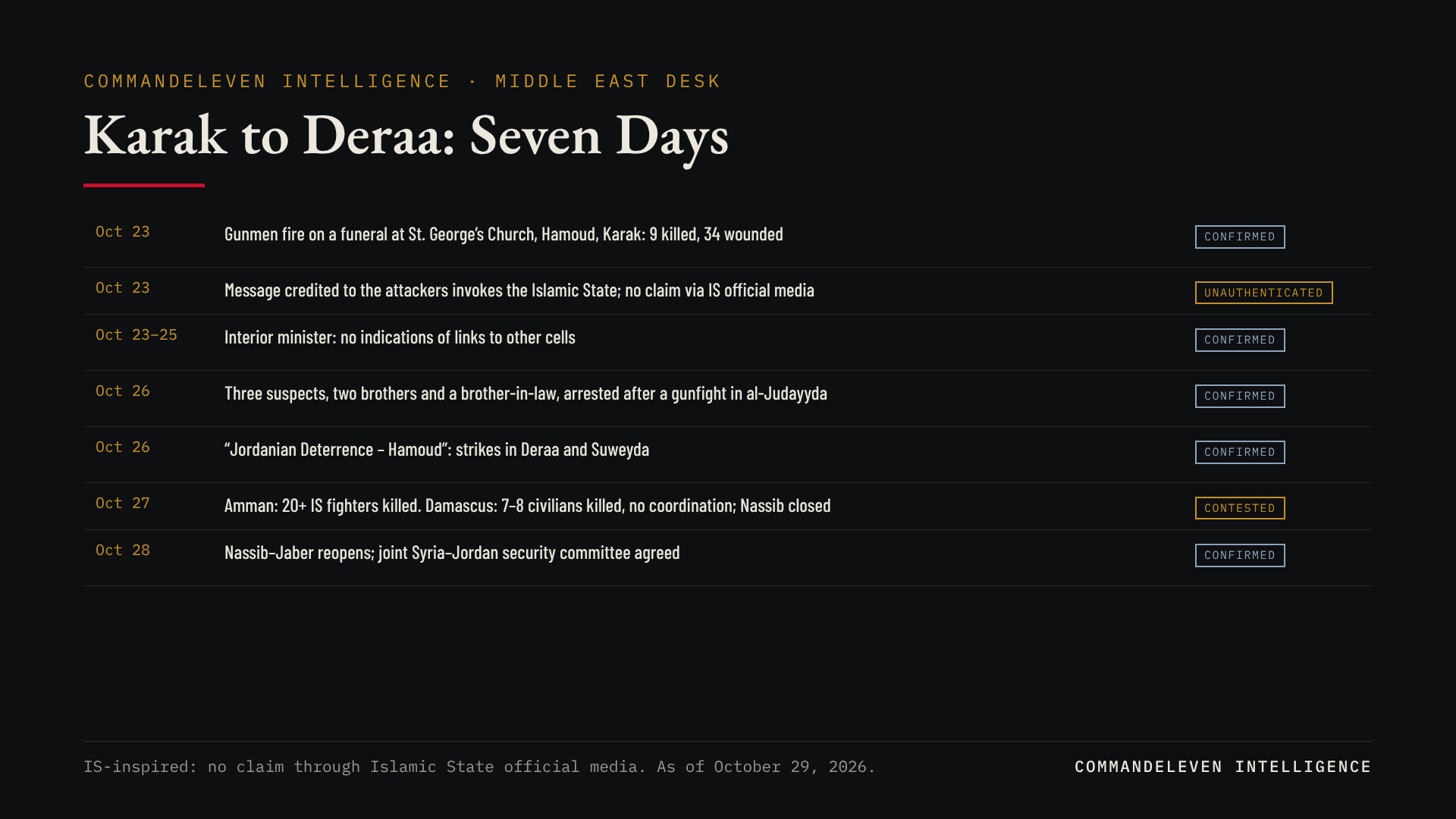
On October 23, three gunmen opened fire on a funeral at St. George’s Greek Orthodox Church in Hamoud, in Jordan’s Karak governorate, killing nine people and wounding 34. Jordanian police arrested three suspects, two brothers and their brother-in-law, after a gunfight in the nearby village of al-Judayyda three days later. On the evening of October 26, the Royal Jordanian Air Force struck what it called terrorist hideouts in southern Syria, in an operation named “Jordanian Deterrence – Hamoud.” Amman says more than 20 Islamic State fighters were killed. Damascus says at least seven civilians died, including three children, and that it was never consulted.
CommandEleven Intelligence assesses the attack as IS-inspired. A statement credited to the attackers invokes the Islamic State, and Jordan’s military now ties them to Islamic State groups in southern Syria. But the Islamic State has not claimed the attack through its own channels, and Jordan’s own account has shifted: on the first weekend, the interior minister said there was no sign of links to other cells.
The attack is a break in pattern. Jordan has faced the Islamic State before, at Karak’s castle in 2016 and at Fuheis and Salt in 2018, but those attacks targeted security forces. Gunmen firing into a Christian funeral is new for Jordan, and it comes as the Islamic State shows signs of regrouping in southern Syria.
Key Judgments
- [CONFIRMED] Nine people were killed and 34 wounded at a funeral at St. George’s Greek Orthodox Church in Hamoud on October 23. Three suspects from one family were arrested after a gunfight in al-Judayyda on October 26.
- [ASSESSED] The attack is IS-inspired. A message attributed to the attackers says they struck “in revenge for Islam and the Islamic State,” and Jordan’s military describes the groups it struck as the Islamic State. [DATA DEFICIT] No claim has appeared through the Islamic State’s official media, and the attackers’ message has not been authenticated.
- [CONFIRMED] Jordan’s account of outside links changed within three days. Interior Minister Mazen al-Faraya initially said there were no indications of links to other cells; by October 26 the armed forces said the attackers were tied to the groups it was bombing in Syria.
- [CONFIRMED on the claims; contested on the outcome] Jordan says its strikes killed more than 20 Islamic State fighters and destroyed a weapons depot. Syria says at least seven civilians were killed, including three children, and that the strikes were not coordinated with Damascus. Jordan has acknowledged civilian casualties.
- [REPORTED, unverified] Telegram channels monitored by CommandEleven Intelligence report that Jordanian intelligence traced the cell’s links to Deraa through communications intercepts. Amman has not said how it made the link.
- [ASSESSED, moderate confidence] The diplomatic damage was contained quickly. The Nassib–Jaber crossing, closed on October 27, reopened on October 28, and the two foreign ministers agreed to a joint security committee. Neither government wants the incident to undo a year of normalization.
The Attack
The funeral was under way at St. George’s Church in Hamoud, a village in Karak governorate about 90 kilometers south of Amman, when the shooting began. Between 150 and 200 people were in and around the church. Security-camera footage and witnesses describe three young men armed with pistols and at least one assault rifle, who fired on mourners in the courtyard before fleeing in a small blue pickup. Witnesses say the victims were men, many aged 50 to 70; women, children and older people were sheltering inside. [CONFIRMED]
The toll rose from seven to nine killed, with 34 wounded. Jordan declared three days of national mourning. King Abdullah II visited the wounded in uniform, said the attack “will be met with the harshest retaliation,” and ordered additional security for churches and Christian community centers across the country. Prime Minister Jafar Hassan blamed “terrorist takfiri ideology.” [CONFIRMED]
Christians make up about 3% of Jordan’s population, roughly 250,000 people, and Karak has one of the country’s oldest Christian communities. Vigils were held across Jordan over the weekend, with Muslims and Christians standing together in Amman. [CONFIRMED]
The Suspects
On the morning of October 26, security forces and special operations units surrounded an abandoned house in al-Judayyda, in Karak governorate. The suspects opened fire when ordered to surrender. After a gunfight of two to three hours, all three were wounded and taken into custody; no security personnel were hurt, and a cache of firearms and ammunition was recovered. [CONFIRMED]
Jordan’s Director of Public Security, Obeidallah al-Maaytah, said two brothers carried out the attack, with a relative by marriage as the third. The suspects have been named as Hazza Zaidan Mohammed, described as the planner, his brother Meshal Zaidan Mohammed, and Ahmad Sami Hussein. They are local men from the Hamoud area, not foreign fighters. [CONFIRMED on the arrests; REPORTED on the names and roles]
They have not been charged or tried, and they are presumed innocent.
Who Is Behind It
The message. Within hours, a statement credited to the attackers circulated online: “We have brutally punished the Christians of Karak in revenge for Islam and the Islamic State.” Some analysts treated it as a claim of responsibility. It did not appear through Amaq, al-Naba or the Islamic State’s other official outlets, and its origin has not been established. [REPORTED, unauthenticated]
Jordan’s shifting account. On the first weekend, the interior minister called the attackers “a group of extremists” and said there was no sign of links to other cells. On October 26, the armed forces said the attackers were linked to the organizations they had just bombed in southern Syria, and on October 27 Amman said those strikes had killed more than 20 Islamic State fighters. [CONFIRMED]
[ASSESSED] Both accounts can be true. Three relatives can act alone in the sense that no cell directed them, while still having been radicalized and supplied through contacts with Islamic State networks across the border. That is what “IS-inspired” means here: the attackers acted in the Islamic State’s name, and Jordan says they had ties to its groups in Syria, but there is no public evidence that the Islamic State directed the attack. CommandEleven Intelligence will revise the label if the group claims it through its official channels or if Jordanian prosecutors set out a direct link in court.
How the link was made. Telegram channels that CommandEleven Intelligence monitors report that Jordanian intelligence traced the cell’s contacts to Deraa through communications intercepts, which would explain how Amman moved from “no links” to airstrikes in three days. Jordan has not described its intelligence. [REPORTED, unverified]
Jordan Strikes Syria
On the evening of October 26, Jordanian jets struck several sites in rural Deraa and Suweyda. The armed forces said the operation, “Jordanian Deterrence – Hamoud,” was “revenge for our martyrs” at the Hamoud church funeral, destroyed terrorist sites and vehicles, and was carried out “in coordination with the Syrian government.” [CONFIRMED]
Damascus disputed every part of that. Syria’s Civil Defence recovered seven bodies, five of them members of one family killed in a tent in al-Tai in Deraa; Syrian officials later put the toll at seven to eight civilians, including three children. A strike on a residential building in al-Muzayrib caused no casualties because the family had left minutes earlier. Syria said there had been no prior coordination or notification, opened an investigation, and closed the Nassib–Jaber crossing, its only crossing with Jordan, on October 27. Government spokesman Mohammad al-Momani acknowledged that civilians had been killed. [CONFIRMED on the statements; DATA DEFICIT on fighter casualties]
The crisis ended almost as fast as it began. On October 28, Syria reopened Nassib–Jaber, and Foreign Ministers Asaad al-Shaibani and Ayman Safadi agreed by phone to set up a joint security committee and to coordinate directly against terrorism and cross-border arms and drug smuggling. Safadi expressed regret over the civilian deaths. [CONFIRMED]
[ASSESSED] Amman wanted to be seen striking back within days, and Damascus could not afford to be seen accepting strikes on its territory. Both got what they needed. The joint committee is the real outcome: it gives Jordan a channel to press Syria on the southern Islamic State networks it says the Karak attackers were tied to.
Why It Matters
A new target set in Jordan. The Islamic State’s previous attacks in Jordan, the 2016 Karak castle siege that killed 10 and the 2018 Fuheis and Salt attacks that killed five security personnel, were aimed at the state. A massacre at a Christian funeral is aimed at Jordanian society, and at the coexistence the monarchy treats as part of its identity. It is the template the Islamic State has used against churches in Egypt and Syria. [ASSESSED]
Southern Syria. Jordan says the attackers were tied to Islamic State groups in Deraa and Suweyda, the provinces on its border where the new Syrian government’s control is weakest. If that is right, the Islamic State has a working connection into Jordan from the south. Reports of Islamic State cells regrouping elsewhere in Syria and Iraq exist, but most rest on thin sourcing; Karak is the first case this autumn with an arrest, a death toll and a government willing to bomb on the strength of the link. [ASSESSED]
Recruitment at home. Analyst Waleed al-Oweimer told Alhurra that unemployment among young men in southern Jordan is open to exploitation, and estimated about 3,000 people are affiliated with Jordan’s Salafi-jihadi movement. The figure has not been independently verified. Hundreds of young Jordanians fought in Syria and Iraq during the civil war. [REPORTED]
The regional moment. The attack came as Jordan sits between a renewed US-Iran confrontation and Israel’s wars, after banning the Muslim Brotherhood in April 2025. Some Jordanian analysts read Karak as a message to the state over its regional positions. There is no public evidence of that, and CommandEleven Intelligence does not adopt it. [REPORTED; not adopted]
What to Watch
- A claim. Any claim through Amaq or al-Naba would move the attack from IS-inspired to IS-claimed.
- The case file. Charges at the State Security Court, and what prosecutors say about contacts in Syria.
- More arrests. Detentions beyond the three in Karak, or in Deraa or Suweyda through the joint committee, would show the network Amman describes.
- Further strikes. Another Jordanian strike in southern Syria would show the joint committee has not given Amman what it wants.
- Copycats. Threats or attacks on churches elsewhere in Jordan, or in Syria’s south, during the mourning period and after.
Dated Calls
These calls are registered on the Foresight Record.
- By December 31, 2026: Jordanian prosecutors formally charge the three Karak suspects under the country’s terrorism laws.
- By December 31, 2026: Jordan or Syria announces at least one further arrest outside the three suspects’ family in connection with the Karak attack.
- By January 31, 2027: The Islamic State does not claim the Karak attack through its official media.
What This Assessment Does and Doesn’t Establish
This assessment establishes the attack, the toll, the arrests, Jordan’s strikes and the competing Jordanian and Syrian accounts of them, and the reopening of the crossing. It establishes that a message invoking the Islamic State was circulated and that Jordan’s military ties the attackers to Islamic State groups in Syria.
It does not establish that the Islamic State directed or claimed the attack, how Jordan linked the suspects to Syria, or how many fighters, if any, Jordan’s strikes killed. The suspects have not been charged or convicted.
Frequently Asked Questions
What happened in Karak, Jordan?
On October 23, 2026, gunmen fired on a funeral at St. George’s Greek Orthodox Church in Hamoud, Karak governorate, killing nine people and wounding 34.
Did the Islamic State claim the attack?
Not through its official channels. A message credited to the attackers invoked the Islamic State, and Jordan’s military links them to Islamic State groups in Syria, so CommandEleven Intelligence describes the attack as IS-inspired.
Who were the attackers?
Jordanian authorities arrested two brothers and their brother-in-law, all from the area, after a gunfight on October 26. They have not yet been charged.
Why did Jordan bomb Syria?
Jordan says the attackers were tied to Islamic State groups in southern Syria and that its strikes on October 26 targeted their hideouts. Syria says civilians were killed and the strikes were not coordinated, though the two governments have since agreed to a joint security committee.
Sources
- Al Jazeera, Jordan strikes Syria after church attack, killing at least seven people
- Middle East Eye, Jordanians rally around Christian community after church attack
- Alhurra, Terrorist Attack on Karak Church Seen as a “Message” to Jordanian Leaders
- Fox News, Jordan church attack in Karak kills 9 at a Greek Orthodox funeral
- Arab News, Jordan strikes southern Syria after church funeral attack, Damascus says 8 civilians killed
- All Israel News, Jordanian strikes in Syria said to kill 20 ISIS terrorists after church attack
- The Media Line, Syria, Jordan Reopen Sole Border Crossing After Strikes, Agree to Joint Investigation
- The New Arab, Syria and Jordan reopen border crossing after deadly air strikes that killed seven civilians
- Daily Caller, Jordan Arrests Terrorists, Begins Strikes Against Those Behind Church Massacre
- Eurasia Review, A Wicked Attack: Islamic State Attacks A Church In Jordan (Rohan Gunaratna)
- LifeSite News, ISIS claims responsibility for deadly Greek Orthodox church attack in Jordan (relaying the attackers’ message)
- Jordanian Armed Forces on X, Statement on Operation “Jordanian Deterrence – Hamoud”