CommandEleven Intelligence · Middle East Desk. Hezbollah series, status as of October 27, 2026.
Bottom Line Up Front
Over six parts, this series has examined Hezbollah from every side: its leadership, its weapons, its disarmament, its money, its networks abroad and its media. The picture is of an organization that is weaker than at any time since the 1990s, but not collapsing, and more tightly bound to Iran than ever.
- At the top, it has lost two generations of commanders and has no publicly named military chief (Part 1).
- On the ground, it is rearming with cheaper, locally made weapons and less Iranian hardware (Part 2).
- Against the state, it has outlasted three disarmament deadlines because the Lebanese army will not fight it (Part 3).
- In its finances, it has been pushed out of the banks and into suitcases, with Al-Qard al-Hassan sanctioned, cut off and short of cash but still open (Part 4).
- Abroad, its networks went to war in 2026, from the Gulf to Michigan (Part 5).
- In its media, it has lost its regional voice but still controls the story inside its own community (Part 6).
[ASSESSED] The most likely path over the next six to twelve months is managed decline: Hezbollah stays armed north of the Litani, Israel stays in the south, Lebanon’s disarmament plan stalls at phase one, and Iran keeps paying enough to keep the organization alive but not enough to restore it. The main risk to that forecast is Iran. A new US or Israeli strike on Iran would test whether Hezbollah’s rebuilt drones, cells abroad and Iranian loyalty pull it into another war it cannot afford.
Key Judgments
KJ1: Hezbollah will not disarm voluntarily. Naim Qassem has said its weapons are “not part of negotiations,” and Hezbollah has called the June framework and its security annex “null and void.” [CONFIRMED on the statements; ASSESSED on intent]
KJ2: Iran remains the deciding factor. Hezbollah’s decision to go to war in March 2026 followed the strike on Iran, not events in Lebanon. Its next war, if there is one, will be decided the same way. [ASSESSED]
KJ3: Israel will keep its zone in southern Lebanon. The security annex ties any withdrawal to verified disarmament, and Israel’s defense minister has said Israel does not “need approval to stay in Lebanon.” [CONFIRMED on the statements]
KJ4: The end of UNIFIL will change the ground. The UN peacekeeping mission’s mandate ends on December 31, 2026, leaving the Lebanese army, Israel and a new US-backed coordination group to manage the south. [CONFIRMED on the mandate; ASSESSED on the effect]
KJ5: Hezbollah’s reach abroad will outlast its strength at home. Its overseas networks were the least damaged part of the organization and the most active in 2026. [ASSESSED]
The Scorecard
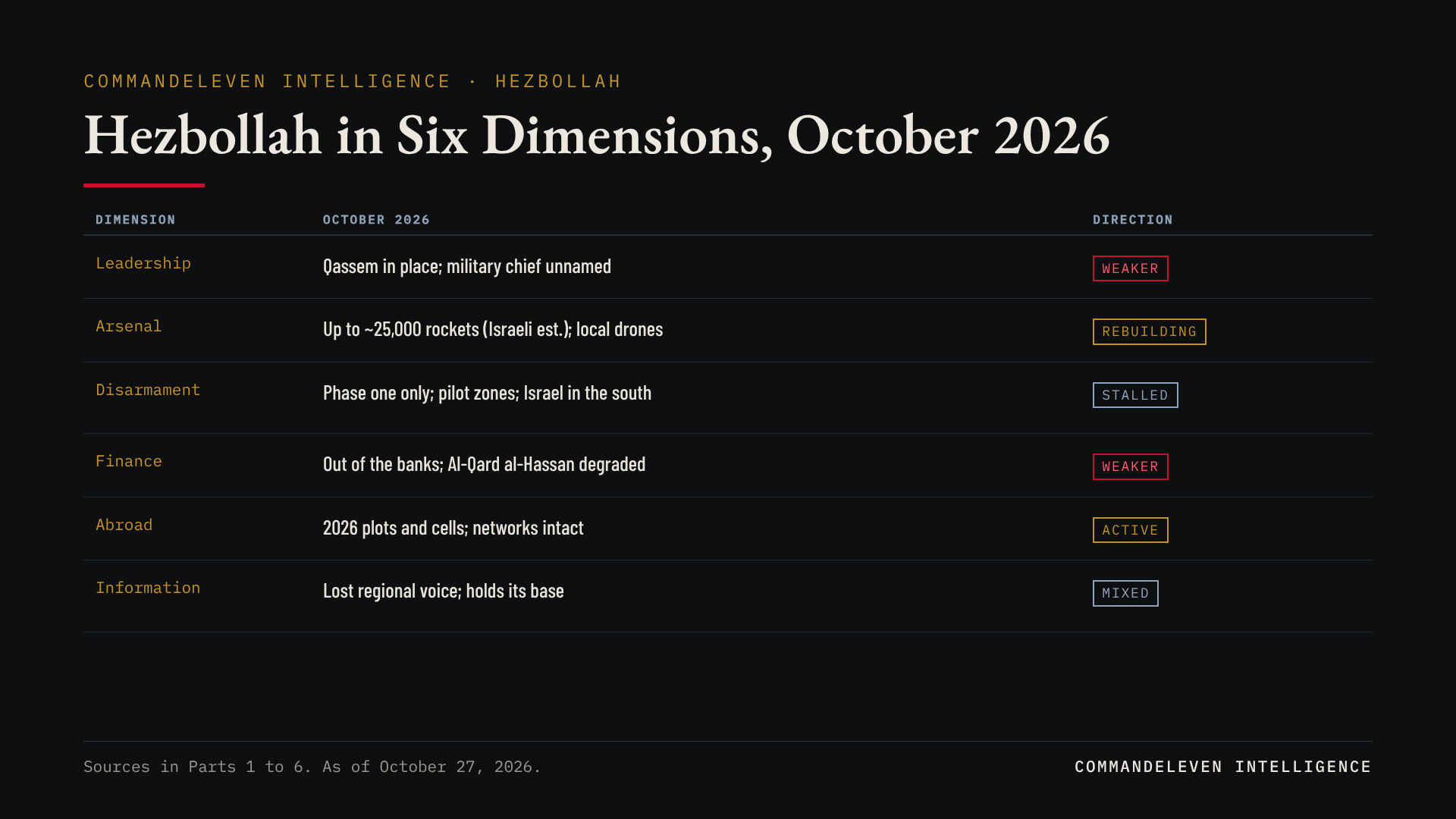
| Dimension | State in October 2026 | Direction |
|---|---|---|
| Leadership | Qassem secretary-general; military chief unnamed | Weaker |
| Arsenal | Up to ~25,000 rockets and missiles (Israeli estimate); local drone production | Rebuilding |
| Disarmament | Phase one only; pilot zones; Israel holds the south | Stalled |
| Finance | Shut out of banks; Al-Qard al-Hassan degraded; Iran short of cash | Weaker |
| Abroad | 2026 plots and cells in the Gulf, Syria and the US; networks intact | Active |
| Information | Lost its regional voice; holds its own community | Weaker abroad, firm at home |
Sources for each line are in Parts 1 to 6.
What Holds It Together
Three things keep Hezbollah going despite the damage.
- Iran. Tehran sent about $1 billion in 2025 and “tens of millions of dollars” for rearmament since June 2026, according to the US Treasury and Reuters (Parts 2 and 4). Qassem pledged loyalty to Iran’s new supreme leader nine days after he was chosen (Part 1). [CONFIRMED]
- The Lebanese state’s caution. The army will not use force, the cabinet will not revoke Al-Qard al-Hassan’s registration and prosecutors have not moved (Parts 3 and 4). [CONFIRMED]
- Its own community. Hezbollah still commands the loyalty of most of its base, pays salaries and aid to displaced families, and uses its media and supporters to make dissent costly (Parts 2 and 6). [ASSESSED]
[ASSESSED] Remove any one of these and Hezbollah’s decline speeds up. None is likely to disappear in the next year.
What Could Break It
- Iran runs out of money. The blockade and sanctions are squeezing Tehran’s ability to pay (Part 4). A sharp cut would hit salaries and aid first, then loyalty. [ASSESSED]
- The army changes its mind. A Lebanese decision to enter Beirut’s southern suburbs or the Bekaa would be the first real test of force. [ASSESSED, unlikely in the forecast period]
- Another decapitation. Israel has shown it can still find and kill senior figures in Beirut (Part 1). Losing a third generation of commanders would test whether the organization can keep functioning. [ASSESSED]
- A wider war. If Hezbollah joins a new war for Iran, Israel has signaled it would go further than in 2024 or 2026. [ASSESSED]
Three Scenarios
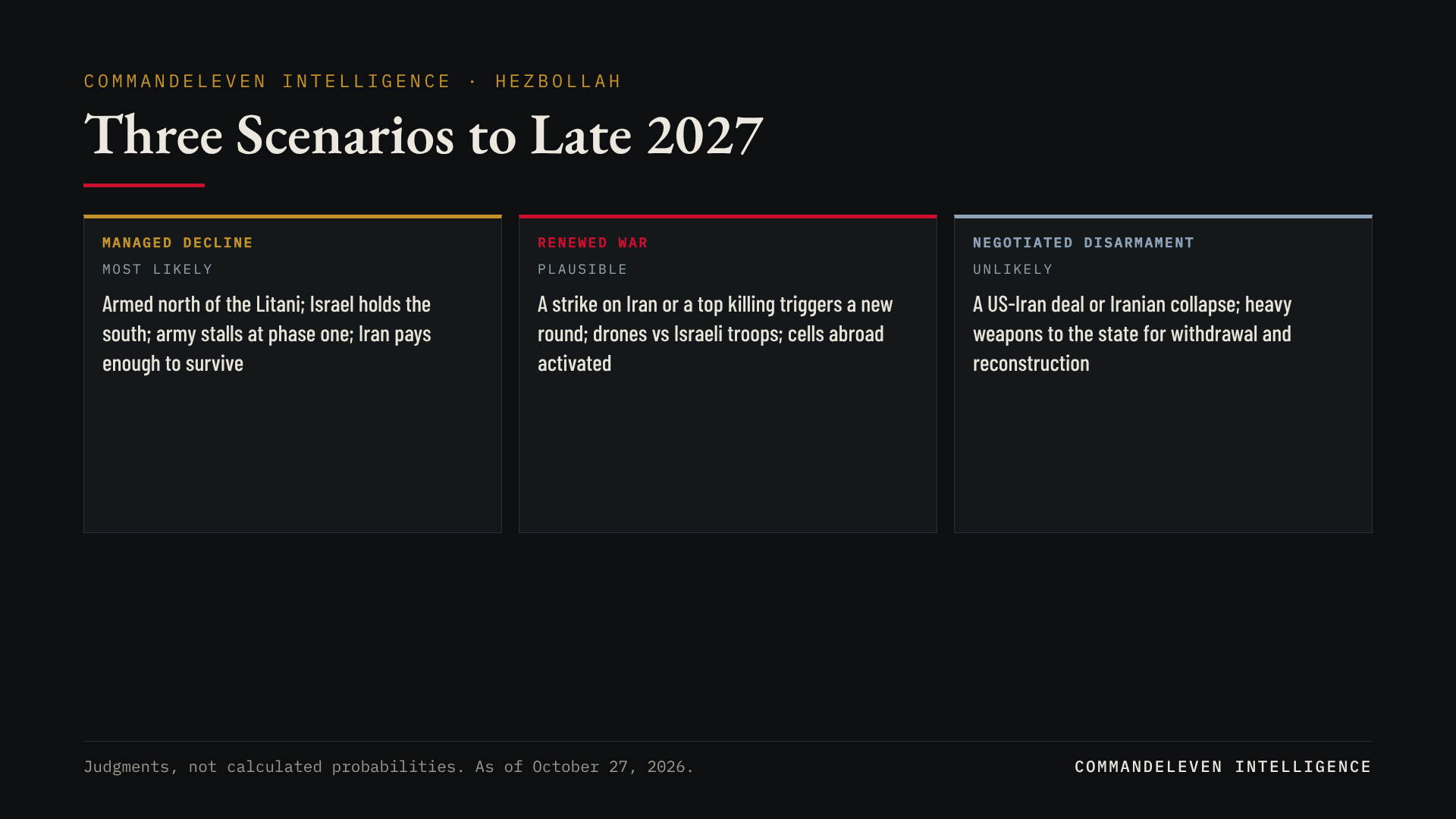
1. Managed decline (most likely). Hezbollah keeps its weapons north of the Litani and avoids open war. Israel keeps its zone and strikes at will. Lebanon’s army holds phase one and the pilot zones but goes no further. Iran pays enough to keep salaries flowing. The networks abroad stay quiet unless Iran needs them. Indicators: no phase two announcement; continued Israeli strikes without major Hezbollah retaliation; more Treasury designations; Qassem in place.
2. Renewed war (plausible). A US or Israeli strike on Iran, or the killing of a top Hezbollah figure, triggers a new round. Hezbollah uses its drones and short-range rockets against Israeli troops in Lebanon; Israel pushes north; cells abroad are activated. Indicators: a collapse of US-Iran talks; Hezbollah rhetoric shifting from “defending Lebanon” to defending Iran; new Gulf or European arrests.
3. Negotiated disarmament (unlikely). A US-Iran deal includes Hezbollah’s weapons, or Iran’s collapse removes its patron. Hezbollah agrees to hand heavy weapons to the state in return for Israeli withdrawal and reconstruction money. Indicators: a Hezbollah statement accepting weapons “under state control”; army deployment north of the Litani without clashes; Gulf reconstruction pledges.
[ASSESSED]
What to Watch
- December 31, 2026: the end of UNIFIL’s mandate and the start of the post-UNIFIL arrangements.
- The next round of Lebanon-Israel talks and whether the security annex’s pilot zones expand.
- Any strike on Iran and Hezbollah’s response within the first week.
- Treasury and Gulf designations of exchangers, couriers and front companies.
- Syrian and Gulf announcements of Hezbollah-linked arrests.
- Qassem’s speeches, especially any shift on weapons “under state control.”
Dated Calls
These calls are registered on the Foresight Record and will be scored on the dates given.
- By December 31, 2026. The UN Security Council does not extend UNIFIL’s mandate beyond December 31, 2026. [ASSESSED]
- By March 31, 2027. Hezbollah does not publicly agree to hand over its weapons to the Lebanese state. [ASSESSED]
- By June 30, 2027. The Lebanese army does not announce the start of phase two of its disarmament plan, north of the Litani to the Awali River. [ASSESSED]
What This Dossier Does Not Claim
- It does not claim Hezbollah is collapsing. It is weaker, not finished.
- It does not predict a date for any new war. Scenario two depends on decisions in Washington, Jerusalem and Tehran that have not been made.
- It does not assign numerical probabilities to the scenarios. “Most likely,” “plausible” and “unlikely” are judgments, not calculations.
Frequently Asked Questions
Is Hezbollah finished?
No. It has lost its leaders, much of its arsenal and its access to banks, but it remains armed, funded by Iran and active abroad.
Will Hezbollah disarm?
Not voluntarily in the next year, in our assessment. Its leader says its weapons are not negotiable, and the Lebanese army will not use force.
What happens when UNIFIL leaves?
The UN mission’s mandate ends on December 31, 2026. Security in the south will rest on the Lebanese army, Israel’s forces in its zone and a US-backed coordination group set up under the June framework.
Could Hezbollah go to war again?
Yes. The most likely trigger is a new strike on Iran, which is what brought Hezbollah into the 2026 war.
Sources
- Stimson Center, Lebanon-Israel Security Annex Adds New Problems Without Solving Old Ones
- An-Nahar, Naim Qassem calls for withdrawal from direct negotiations: “We will not return to before March 2”
- Shafaq News, October date set for next Lebanon-Israel talks
- TimesLIVE (Reuters), Hezbollah readies for new regional war with funds from Iran, sources say
- Al-Monitor (Reuters), Lebanon, Israel agree shortlist of countries that could send troops to verify Hezbollah disarmament
- United Nations, Security Council extends UNIFIL’s mandate for a final time: Resolution 2790 (2025)
- Sources for each finding summarized here are listed in Parts 1 to 6.