CommandEleven Intelligence · Middle East Desk. Hezbollah series, status as of October 27, 2026.
Bottom Line Up Front
Hezbollah is rearming again, for the third time in two years, and it is doing it differently. The fall of Bashar al-Assad in December 2024 cut the land bridge that carried Iranian missiles from Tehran to Lebanon by the truckload. Lebanon closed its airport to Iranian flights in February 2025. Syria’s new government has seized at least eight shipments bound for Hezbollah since December 2025.
Hezbollah has adapted in two ways. First, it still smuggles, but in smaller loads, through informal crossings, through Iraq and, according to Western and Israeli officials, by sea. Second, it now builds more of what it needs at home. Iran’s role has shifted from shipping finished weapons to supplying money, advisers and know-how. The result showed on the battlefield in 2026: cheap, locally made drones that Israel’s air defenses and jammers could not stop.
Reuters reported on October 26 that Iran has sent Hezbollah “tens of millions of dollars” for military rebuilding since the June ceasefire, and that the group is buying explosives and making attack drones for the next round.
[ASSESSED] Hezbollah will not rebuild the arsenal it had in 2023. It does not need to. A force of cheap drones, short-range rockets and anti-tank weapons, supplied from inside Lebanon, is harder to cut off and good enough to fight the war Hezbollah now expects: attrition against Israeli troops on Lebanese soil.
Key Judgments
KJ1: Hezbollah is rearming faster than it is being disarmed. Israeli, Lebanese and Western sources agree the group used every lull since 2024 to replenish rockets and drones. [ASSESSED, consistent across Alma, Reuters and Israeli officials]
KJ2: Iran remains the main backer, but its role has changed. Tehran now supplies cash, advisers and know-how more than finished weapons. [ASSESSED; Iranian cash transfers REPORTED by Reuters]
KJ3: Hezbollah has an indigenous weapons capability it did not have at scale before 2024. Its battlefield drones in 2026 were made in Lebanon, according to Israeli assessments. [REPORTED]
KJ4: Syria is no longer a corridor but a filter. The al-Sharaa government intercepts shipments at its borders. Some still get through by informal routes. [CONFIRMED on the seizures; ASSESSED on leakage]
KJ5: Money is the binding constraint. Iran is short of cash and ways to move it, according to the US Treasury, and Hezbollah must also pay for displaced supporters. [REPORTED]
Three Rebuilds in Two Years
After the November 2024 ceasefire. Hezbollah began repairing and replacing what it lost. By early 2026, Alma estimated it held up to 25,000 rockets and missiles, mostly short and medium range, and about 1,000 attack drones, against roughly 150,000 rockets before October 2023. Alma assessed that “Hezbollah’s pace of military rehabilitation exceeds the scope of thwarting activity carried out by the IDF.” [ASSESSED by Alma]
Before the March 2026 war. Reuters reported in early March that Hezbollah had spent months restocking rockets and drones, with Iranian support and its own manufacturing, on a budget of about $50 million a month, mostly from Iran, covering salaries and aid to displaced families. The group fired about 60 drones and rockets on March 2 and more than twice that by March 4. [REPORTED]
After the June 2026 ceasefire. Reuters reported on October 26 that Hezbollah has used the lull since June to rearm, is rebuilding command structures that broke down in fighting at Bint Jbeil and the Ali al-Taher ridge, and has not yet fully rebuilt its stockpiles or fighting force. Hezbollah denied that its command had broken down. [REPORTED]
The Routes In
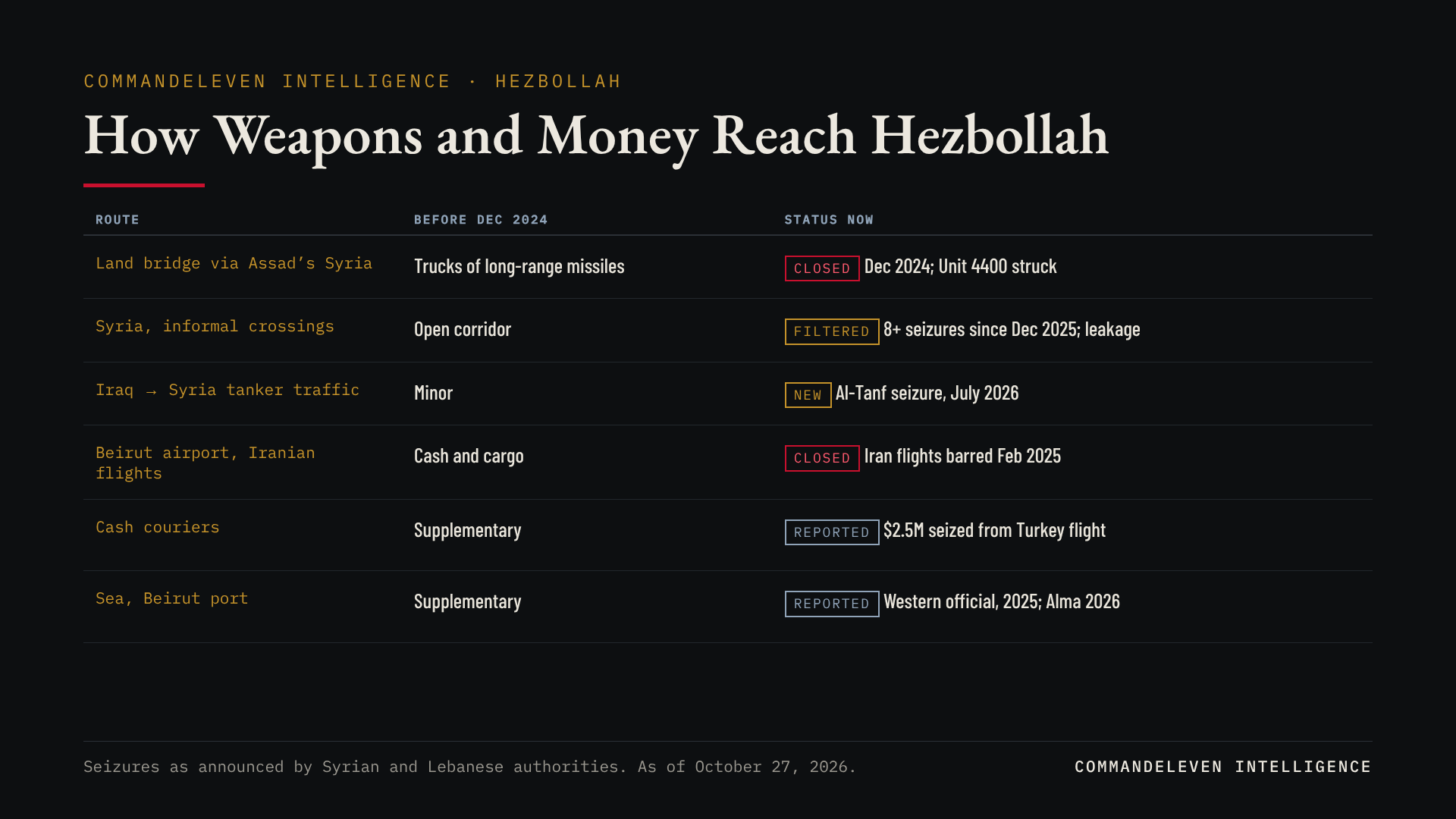
The land bridge, closed. Under Assad, Hezbollah and Iranian operatives moved long-range missiles through Syria in large trucks. That ended in December 2024. Israel has since struck Unit 4400, Hezbollah’s smuggling unit, and the border crossings it used. [CONFIRMED]
Syria, now a filter. The al-Sharaa government has committed to keep Hezbollah from rearming through Syrian territory. Its announced seizures since late 2025:
- December 2025. About 1,250 mines near Damascus, and 46 anti-tank guided missiles in the Daraa countryside.
- January 26, 2026. A vehicle in Homs province with anti-tank missiles, rocket-propelled grenade warheads and rockets.
- February 1, 2026. Drones seized in raids around Damascus.
- March 14, 2026. Five anti-tank missiles on the Lebanese border.
- March 20, 2026. Small arms, rocket-propelled grenades and explosives at Jroud Flita, with four arrests, two of them Lebanese.
- April 16, 2026. About 6,000 detonators for roadside bombs.
- July 2026. A tanker truck at the al-Tanf crossing from Iraq carrying drones, drone warheads, Iranian anti-tank missiles and cruise missile components, which Syria said was bound for Hezbollah. Hezbollah called the claim “fabricated.”
[CONFIRMED as Syrian government announcements]
[ASSESSED] The seizures show two things. Syria is trying, and Hezbollah is still trying. The mountainous Lebanon-Syria border, its tribal communities and smuggling networks that predate both governments mean some shipments get through.
Iraq, the new front door. The July seizure points to a route from Iraq into Syria, using the oil tanker traffic that has grown since the Strait of Hormuz was closed during the Iran war. The driver reportedly said staff at the Iraqi al-Waleed crossing helped. Baghdad set up a committee to investigate. [REPORTED]
The sea. In April 2025, a Western official told Saudi outlet al-Hadath that Hezbollah was reasserting control over Beirut port, using sympathetic dock and customs workers to bring in money and weapons unchecked. Alma’s 2026 assessment also emphasizes maritime smuggling. [SINGLE-SOURCE on the port claim; ASSESSED by Alma]
The air, closed. In February 2025, Lebanon barred Mahan Air and Iran Air from Beirut after Israel accused the Revolutionary Guards of flying cash to Hezbollah. Weeks later, customs seized $2.5 million from a passenger arriving from Turkey; three sources told Reuters it was bound for Hezbollah. [CONFIRMED on the ban and seizure; REPORTED on the destination]
Who Is Helping
Iran. Tehran remains the indispensable backer:
- Money. “Tens of millions of dollars” for military rebuilding since June, according to Lebanese sources cited by Reuters, plus about $200 million for displaced Shiite families. [REPORTED]
- People. Alma reports Revolutionary Guards and Quds Force personnel in Lebanon supervising and training. Israel said it killed five Quds Force commanders in a Beirut hotel strike on March 8, 2026. [REPORTED; Israeli military claim]
- Know-how. Alma assesses that Iran has moved from supplying complete weapons systems to “brokering” military-industrial knowledge, which costs it less and gives it more deniability. [ASSESSED by Alma]
Iraq’s networks. The al-Tanf seizure and the reported help at the al-Waleed crossing point to facilitators on the Iraqi side. No Iraqi armed group has been publicly named. [REPORTED; DATA DEFICIT on who]
Smuggling networks along the border. Long-standing cross-border criminal and tribal networks move goods regardless of who governs either side, according to Israeli officials and Alma. [ASSESSED]
Cash couriers. Israel complained to Washington in 2025 that Iran was using Turkish citizens to carry cash to Beirut, according to a US defense official. [SINGLE-SOURCE]
From Importer to Producer
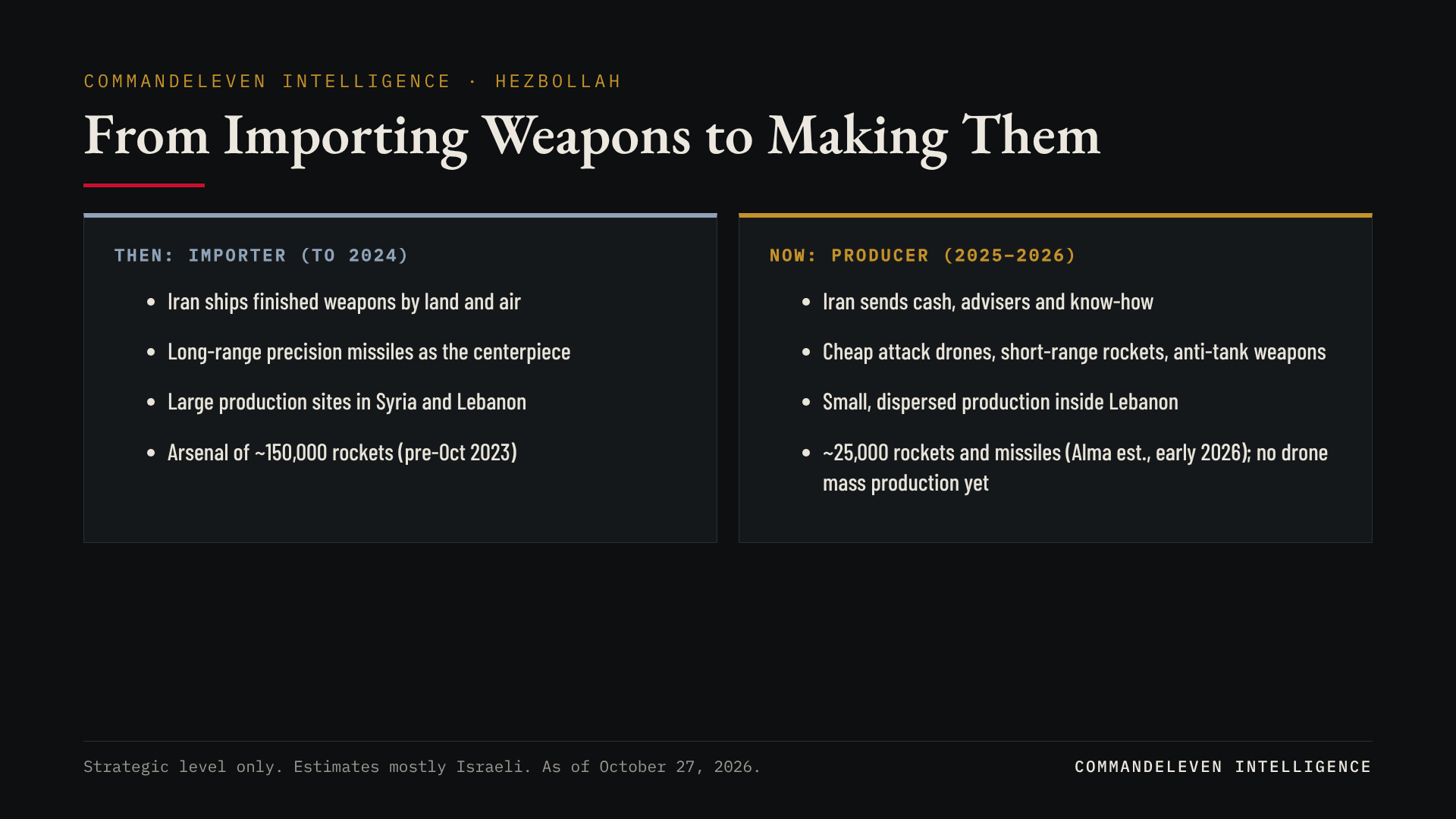
Hezbollah has gained significant technical capacity of its own. This section stays at the strategic level and gives no production detail.
The doctrine. Alma, an Israeli research center, describes Hezbollah’s approach as a “hybrid” one: dispersed, hidden, small-scale production of the kind Hamas used in Gaza, alongside continued efforts to make more advanced precision weapons. With the Syrian corridor cut, it calls local production “an existential strategic necessity.” [ASSESSED by Alma]
The proof. In the 2026 war, Hezbollah’s fiber-optic guided attack drones, the same type that has reshaped the Ukraine war, killed and wounded Israeli soldiers in southern Lebanon. Because they are wire-guided, they cannot be jammed. An Israeli commander told reporters, “There isn’t much to do about it.” Israeli assessments say the drones are made in Lebanon. In May, Israel’s army chief reportedly ordered strikes on their production and supply chain “deep inside Lebanon.” [CONFIRMED on use and casualties; REPORTED on local production]
The limits. The Jerusalem Post reports that Hezbollah lost much of its large-scale manufacturing in Syria and Lebanon and does not yet have the capacity to mass-produce these drones. Reuters reports that its production capacity overall has declined. [REPORTED]
[ASSESSED] The shift matters more than the numbers. An organization that can build its own drones, train its own operators and adapt tactics from other wars is far harder to disarm than one that waits for Iranian trucks. Interdiction now has to target workshops, people and money inside Lebanon, not just shipments at the border.
The Money Problem
Rebuilding costs money, and money is getting harder to move.
- The US Treasury says Iran is running low on cash and on ways to move it. [REPORTED]
- Lebanon has closed the air route and seized cash at the airport. [CONFIRMED]
- The United States imposed new sanctions on Hezbollah on August 20, 2026, and says it will keep “strangling” the group’s finances. [CONFIRMED]
- Hezbollah must also pay salaries and support supporters displaced by the war, its political base. [REPORTED]
Part 4 covers how Hezbollah moves and holds its money, and what sanctions have done to Al-Qard al-Hassan.
What It Means
[ASSESSED] Hezbollah’s rearmament is slower, cheaper and more local than before 2024. It is rebuilding for the war it expects, attrition against Israeli troops inside Lebanon, not the long-range missile war it once threatened. That makes the June framework’s verification harder: drones and small rockets can be made and hidden in garages, not just stored in bunkers.
Three things would slow it most: Syria keeping its border closed, Iraq closing the tanker route, and Iran running out of money. Only the first is under steady pressure today.
Dated Calls
These calls are registered on the Foresight Record and will be scored on the dates given.
- By March 31, 2027. Syrian authorities announce at least two more seizures of weapons they say were bound for Hezbollah. [ASSESSED]
- By March 31, 2027. Lebanese authorities announce at least one more seizure of weapons, explosives or cash linked to Hezbollah. [ASSESSED]
- By March 31, 2027. Hezbollah does not resume sustained fire on Israel (attacks claimed on three or more consecutive days). [ASSESSED]
What This Dossier Does Not Claim
- It does not give or claim any technical or production detail of Hezbollah’s weapons.
- It does not claim that any Syrian or Iraqi government official is complicit in smuggling to Hezbollah. The al-Waleed claim comes from a detained driver and is under investigation.
- It does not give a precise size for Hezbollah’s current arsenal. All public figures are estimates, most of them Israeli.
- It does not claim Hezbollah has mass-production capacity for drones.
Frequently Asked Questions
Is Hezbollah rearming?
Yes. Israeli, Lebanese and Western sources agree it has used each lull since 2024 to replenish rockets and drones, most recently since the June 2026 ceasefire.
Who is helping Hezbollah rearm?
Mainly Iran, through money, advisers and know-how. Smuggling networks on the Lebanon-Syria border and facilitators on routes from Iraq also play a role.
Can Hezbollah make its own weapons?
Increasingly, yes. Israeli assessments say the attack drones it used in 2026 were made in Lebanon, though it is not believed to have mass-production capacity.
Is Syria still a route for weapons to Hezbollah?
Less than before. The new Syrian government has seized at least eight shipments since December 2025, but some smuggling continues through informal crossings.
Sources
- TimesLIVE (Reuters), Hezbollah readies for new regional war with funds from Iran, sources say
- Modern Diplomacy (Reuters), How Hezbollah Spent Months Rearming for the War It Saw Coming
- Alma Research and Education Center, Key Points of Hezbollah’s Current Military Status, January 2026
- Alma Research and Education Center (Yaakov Lappin and Tal Beeri), Hezbollah: Independent Weapons Production, a Hybrid Doctrine in Light of a Strategic Need
- Alma Research and Education Center, Continuous Smuggling Attempts of Weapons from Syria to Lebanon, March 2026
- FDD’s Long War Journal, Syria intercepts advanced weapons bound for Hezbollah from Iraq
- Al Jazeera, Syria seizes advanced weapons it says were bound for Lebanon’s Hezbollah
- The Jerusalem Post, Why Israeli officials fear Iran-backed Hezbollah could still rearm despite Lebanon deal
- Al Jazeera, How Hezbollah’s fibre optic drones test Israel’s sophisticated radar system
- Naharnet, Report: Israel to strike Hezbollah drone production deep in Lebanon
- The Times of Israel, Hezbollah using maritime smuggling route for weapons, funds from Iran – report
- Al-Monitor (Reuters), Lebanon seizes $2.5m cash intended for Hezbollah at Beirut airport
- Iran International, Lebanon bars Iran airlines after Israel alleges Hezbollah cash smuggling
- L’Orient Today, Israel says killed 5 Iran Guards commanders in Beirut hotel strike
- News Tribune (AP), US hits Hezbollah with fresh sanctions emphasizing ties to Iranian government
The Hezbollah Series
- Hezbollah After Nasrallah: Series Introduction
- Part 1: Who Runs Hezbollah Now
- Part 2: Rearming North of the Litani (you are here)
- Part 3: The Disarmament Test
- Part 4: Following the Money
- Part 5: Hezbollah Abroad
- Part 6: The Information Front
- Part 7: What Comes Next