CommandEleven Intelligence · Middle East Desk. Hezbollah series, status as of October 27, 2026.
Bottom Line Up Front
Hezbollah has lost two generations of commanders in two years. Israel killed Hassan Nasrallah, his designated successor Hashem Safieddine and most of the Jihad Council in 2024. It killed the group’s military chief, Haytham Ali Tabatabai, in Beirut in November 2025. When Hezbollah joined the Iran war on March 2, 2026, Israel killed its intelligence chief, its southern front commander and at least two Radwan Force commanders within weeks.
What remains is a different organization at the top. Naim Qassem, a cleric who was never meant to lead, has been secretary-general since October 2024 and has rebuilt the leadership around politicians rather than clerics or commanders. On the military side, the public record no longer shows clearly who is in charge. And the decision that took Hezbollah back to war in March 2026 was made to support Iran, whose new supreme leader Qassem publicly swore loyalty to nine days later.
[ASSESSED] Hezbollah is politically weaker, militarily decapitated and more openly dependent on Tehran than at any point since the 1990s. That makes it more brittle, but not less dangerous: its decisions on war and peace now track Iran’s needs more closely than Lebanon’s.
Key Judgments
KJ1: Hezbollah’s senior military leadership has been destroyed twice. The 2024 campaign killed Nasrallah and most of the Jihad Council. The 2025-26 strikes killed the commanders who replaced them. [CONFIRMED]
KJ2: Qassem has rebuilt the top around politicians. Reported appointments in early 2026 put long-serving politicians, not clerics or commanders, in the deputy and executive posts, and dispersed the power of Wafiq Safa, the group’s longtime fixer. [REPORTED; appointments not all officially announced]
KJ3: The military command is now opaque. No successor to Tabatabai has been publicly confirmed. The most cited candidates are Mohammad Haydar and Talal Hamiyeh, head of the external operations unit. [DATA DEFICIT]
KJ4: Iran decides more, not less. Hezbollah entered the Iran war two days after the US-Israeli strikes that killed Ali Khamenei, and Qassem pledged “loyalty to [the] command” of Mojtaba Khamenei on March 11, 2026. [CONFIRMED on the statements; ASSESSED on the balance of decision-making]
KJ5: Israel’s intelligence penetration of Hezbollah has not been repaired. Israel continued to find and kill senior figures in Beirut through 2026. [ASSESSED]
Two Decapitations
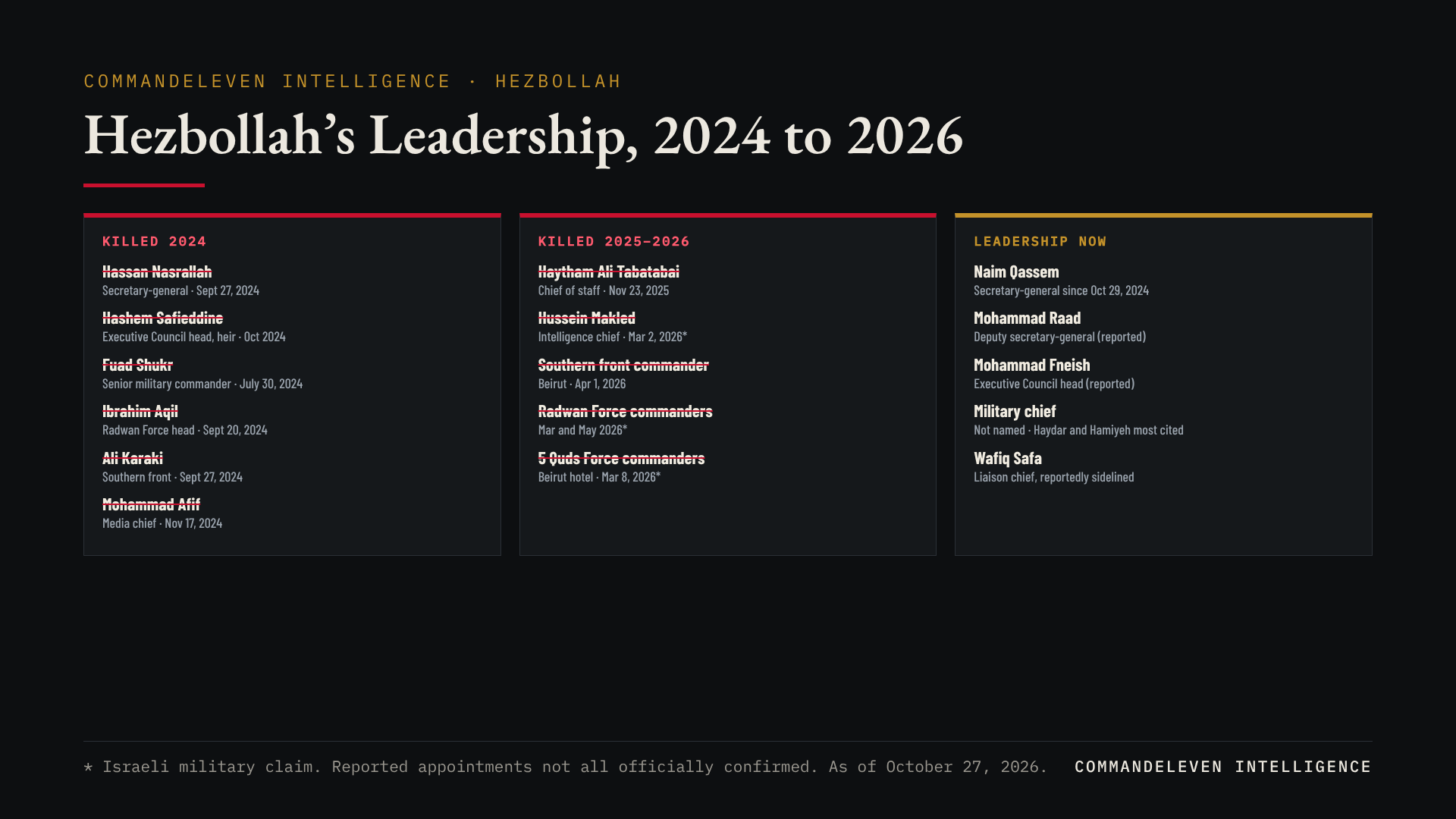
The first, in 2024. Israel’s campaign against Hezbollah in the second half of 2024 removed almost the entire senior tier:
- Fuad Shukr, the senior military commander, killed July 30.
- Ibrahim Aqil, head of the Radwan Force, killed September 20 with much of the Radwan command.
- Ali Karaki, southern front commander, killed September 27.
- Hassan Nasrallah, secretary-general for 32 years, killed September 27.
- Hashem Safieddine, head of the Executive Council and Nasrallah’s expected successor, killed in early October.
- Mohammad Afif, head of media relations, killed November 17.
[CONFIRMED]
The second, from 2025. The ceasefire of November 2024 did not stop the killing. On November 23, 2025, an Israeli strike in Beirut’s southern suburbs killed Haytham Ali Tabatabai, Hezbollah’s de facto chief of staff. He had commanded the Radwan Force, trained Houthi fighters in Yemen and was among the last senior commanders to survive 2024. [CONFIRMED]
The third wave, 2026. After Hezbollah joined the Iran war on March 2, 2026, Israel resumed strikes on the leadership:
- Hussein Makled, head of Hezbollah’s intelligence, killed on March 2 according to the Israeli military.
- The southern front commander, named in reports as Hajj Yusuf Ismail Hashem, killed in a strike on Beirut on April 1. Hezbollah confirmed the death of a top commander.
- Radwan Force commanders reported killed in March and May, according to Israeli military statements.
- Five commanders of Iran’s Quds Force killed in a strike on a Beirut hotel on March 8, according to the Israeli military.
[CONFIRMED on the April 1 death; Israeli military claims for the others]
Qassem’s Hezbollah
Naim Qassem became acting leader on Nasrallah’s death and was formally elected secretary-general on October 29, 2024. He had been deputy since 1991 but was never seen as Nasrallah’s heir. Alma, an Israeli research center, describes him as “a default choice” whose first impression was of “a pressured and unsettled leader lacking full control.” [CONFIRMED on the dates; ASSESSED by Alma on his standing]
The restructuring. According to reports compiled by Alma in February 2026, Qassem, with Iranian backing, began rebuilding the leadership around political figures:
- Mohammad Raad, head of Hezbollah’s parliamentary bloc since 1992 and a member of the Shura Council, reported as the new deputy secretary-general. If confirmed, he would be the first non-cleric in the post. Alma notes the deputy and secretary-general posts have historically gone to clerics.
- Mohammad Fneish, a former minister and member of parliament, reported as head of the Executive Council, which runs Hezbollah’s civilian institutions, with Sheikh Ali Damoush handling day-to-day reorganization.
- The media apparatus centralized under Ibrahim Mousawi, with tighter control of messaging.
- Wafiq Safa, for decades Hezbollah’s link to Lebanon’s army, ports and airport and, by Alma’s account, a key figure in its smuggling network, reportedly sidelined, with his unit cut back to a technical role.
[REPORTED; most appointments not officially announced]
[ASSESSED] The pattern points one way: a leadership that wants to look like a political party inside the Lebanese state while its military wing rebuilds out of sight. Alma itself cautions that Safa’s sidelining may be cover for a figure Israel has already tried to kill, and that he may still run the smuggling network from behind the scenes.
The political cost. Hezbollah’s position inside Lebanon has eroded:
- In August 2025 the cabinet ordered all weapons placed under state control. Hezbollah’s ministers walked out, and Qassem warned there would be “no life in Lebanon” if the government confronted the party.
- In March 2026, after Hezbollah reopened the war, the government declared all of its military activity illegal. Hezbollah calls the decision “null and void.”
- Parliament postponed the May 2026 elections to 2028 because of the war, removing Hezbollah’s chance to test its support at the ballot box.
- On September 27, 2026, no state or security officials attended the second-anniversary memorial for Nasrallah. Hezbollah blamed President Joseph Aoun for the boycott, and contacts between the group and the government were described as “virtually frozen.”
[CONFIRMED]
Who Runs the Military Side
This is where the public record runs thin.
- Mohammad Haydar (“Abu Ali”), Nasrallah’s former senior security adviser and a US-designated terrorist since 2019, is the most cited candidate to lead the military wing. He reportedly co-led it with Tabatabai after 2024 and survived an Israeli strike in Beirut in November 2024. [REPORTED]
- Talal Hamiyeh, a Jihad Council member since 2008 and head of the External Security Organization (Unit 910), which plans attacks abroad, has been floated as a successor at least three times. The United States offers up to $7 million for information on him. [REPORTED]
No successor to Tabatabai has been publicly confirmed. [DATA DEFICIT]
[ASSESSED] The opacity is deliberate. A leadership that has lost two chiefs of staff to Israeli intelligence in 16 months has every reason not to name a third. The cost is cohesion: a military command that cannot meet, communicate freely or be seen is slower and more dependent on Iranian advisers to coordinate it.
Iran’s Hand
The clearest change since 2024 is how openly Hezbollah’s decisions follow Tehran’s.
- On February 28, 2026, US and Israeli strikes on Iran killed Supreme Leader Ali Khamenei. Two days later, Hezbollah fired rockets at Israel for the first time since the 2024 ceasefire, saying it was acting to stop Israeli “aggression.” [CONFIRMED]
- On March 11, Qassem congratulated Mojtaba Khamenei on his selection as supreme leader and pledged: “We reaffirm our loyalty to your command.” [CONFIRMED]
- Alma assesses that Iran is “fully backing and actively driving” the leadership appointments and the military rebuilding. [ASSESSED by Alma]
[ASSESSED] In 2006, Hezbollah went to war with Israel over its own cross-border raid. In 2026, it went to war because Iran was attacked. That is the strongest evidence that the group’s strategic decisions are now made in Tehran first and Beirut second, and it is the main reason the Lebanese state’s efforts to disarm it, covered in Part 3, keep failing.
What It Means
[ASSESSED] A Hezbollah with a weak secretary-general, an unnamed military chief and an Iranian patron under siege is less able to fight a long war on its own terms. It is also less able to agree to disarm, because the decision does not rest with its leaders in Beirut. The next leadership test will come when Lebanon, Israel and the United States press the disarmament framework into Hezbollah’s heartland north of the Litani, in the Bekaa and in Beirut’s southern suburbs.
Dated Calls
These calls are registered on the Foresight Record and will be scored on the dates given.
- By March 31, 2027. Hezbollah does not publicly name a new military chief or chief of staff. [ASSESSED]
- By March 31, 2027. Naim Qassem remains secretary-general. [ASSESSED]
- By June 30, 2027. At least one more senior Hezbollah military commander (Jihad Council level or a named unit commander) is killed in an Israeli strike. [ASSESSED]
What This Dossier Does Not Claim
- It does not claim the reported appointments of Raad, Fneish and others are official. Most rest on Lebanese and Israeli reporting.
- It does not claim Wafiq Safa has left Hezbollah.
- It does not name a current Hezbollah military chief, because none has been confirmed.
- It does not treat Israeli military claims about individual deaths as independently confirmed where no other source exists.
Frequently Asked Questions
Who leads Hezbollah now?
Naim Qassem, secretary-general since October 29, 2024. Reports in 2026 put Mohammad Raad as his deputy, though Hezbollah has not formally confirmed it.
Who commands Hezbollah’s military?
No one has been publicly confirmed since Haytham Ali Tabatabai was killed in November 2025. Mohammad Haydar and Talal Hamiyeh are the most cited candidates.
Why did Hezbollah join the 2026 war?
It resumed attacks on Israel on March 2, 2026, two days after US and Israeli strikes on Iran killed Ali Khamenei. Its leader has since pledged loyalty to Iran’s new supreme leader.
Related Reading
- What Comes Next: Hezbollah’s Path to 2027 – Part 7
- Hezbollah After Nasrallah: A CommandEleven Intelligence Series
- Rearming North of the Litani: How Hezbollah Is Rebuilding, and Who Is Helping – Part 2
- Hezbollah Abroad: The Network Beyond Lebanon – Part 5
Sources
- Alma Research and Education Center (Dana Polak), Organizational Changes in Hezbollah: The Emerging Political Leadership and Mapping of Senior Officials’ Roles
- FDD’s Long War Journal, Israeli airstrike kills Hezbollah Chief of Staff Haytham Ali Tabatabai
- FDD’s Long War Journal, Histories of Hezbollah’s assassinated top military commander, likely candidates to replace him
- Alma Research and Education Center, Is There Tension in Hezbollah’s Current Military Leadership?
- L’Orient Today, Hezbollah’s Qassem pledges allegiance to Mojtaba Khamenei
- Jewish Telegraphic Agency, Hezbollah enters Iran war, firing on Israel’s north
- NPR, Hezbollah strikes Israel as American and Israeli planes pound Iran
- Agenzia Nova, Israeli raids on Lebanon killed the commander of Hezbollah intelligence
- Cyprus Mail (Reuters), Beirut strike killed top Hezbollah commander, group says
- L’Orient Today, Israel says killed 5 Iran Guards commanders in Beirut hotel strike
- Al-Monitor (Reuters), Lebanon parliament extends its own mandate two years as war intensifies
- FDD, Hezbollah leader threatens “no life” in Lebanon if government attempts to seize terror group’s weapons
- L’Orient Today, Nasrallah assassination commemoration highlights Hezbollah’s isolation