CommandEleven Intelligence · Middle East Desk. Hezbollah series, status as of October 27, 2026.
Bottom Line Up Front
For 30 years, Hezbollah’s media was as much a weapon as its rockets. In the late 1990s, Al-Manar’s repeated footage of Israeli retreats created the perception that Israel was leaving Lebanon before any official decision, as Al Jazeera’s Ali Hashem recounts. Hassan Nasrallah’s speeches set the narrative for the whole “Axis of Resistance.”
That front has been hit almost as hard as the military one. Nasrallah is dead, and his successor is an organizer, not a communicator. Mohammad Afif, Hezbollah’s media chief, was killed in 2024. In March 2026, Israel destroyed the headquarters of Al-Manar television and Al-Nour radio and killed Al-Manar staff, including a correspondent Israel accused of being an intelligence operative. Hezbollah’s own supporters now turn its online apparatus against Lebanese critics, including the prime minister and a Shiite woman who said on camera, “we want the state.”
Hezbollah has adapted. Its war footage now comes from cheap drones filming their own strikes on Israeli troops, distributed through Telegram and WhatsApp to a young audience. Its media is centralized under a single official. And it still reaches its core base, which is the audience it most needs to keep.
[ASSESSED] Hezbollah is losing the argument in Lebanon and abroad but holding it in its own community. Its information front has shrunk from a regional megaphone to a tool for keeping its base loyal and its critics quiet. That makes it less influential, and more aggressive at home.
Key Judgments
KJ1: Hezbollah has lost its most effective voice. No leader since Nasrallah has matched his reach, and its media chief was killed in 2024. [ASSESSED]
KJ2: Its broadcast infrastructure is under direct attack. Israel struck Al-Manar and Al-Nour in March 2026 and has killed Al-Manar staff, saying some were Hezbollah members. Both stations kept broadcasting. [CONFIRMED]
KJ3: Its messaging has turned inward. Since the 2024 ceasefire, its campaigns have targeted its own Shiite base, with themes of resilience and survival rather than victory. [ASSESSED by ICT, consistent with CommandEleven review]
KJ4: Its online supporters police dissent at home. Pro-Hezbollah accounts led campaigns against Prime Minister Nawaf Salam and against Shiite critics in 2026. Hezbollah distances itself from them. [CONFIRMED on the campaigns; Hezbollah’s role REPORTED]
KJ5: Israel is fighting on the same front. Leaflets, mass phone messages, platform takedowns and penetration of Hezbollah’s own circles are part of Israel’s campaign. [CONFIRMED]
The Machine
- Al-Manar. Hezbollah’s television station, on air in Lebanon since 1991 and by satellite since 2000. The United States designated it a terrorist entity in 2006. Its audience grows in every crisis. [CONFIRMED]
- Al-Nour. Hezbollah’s radio station. [CONFIRMED]
- Telegram. Hezbollah’s preferred platform because its rules are looser. The Hezbollah Military Media Arabic channel had nearly 400,000 followers in 2025, alongside official, unofficial and supporter channels. [CONFIRMED as ICT finding]
- WhatsApp groups and influencers. Used to push combat footage to young supporters and to relay content after takedowns. [REPORTED]
- Central control. Part 1 noted the reported centralization of Hezbollah’s media under Ibrahim Mousawi in 2026, with tighter control of messaging. [REPORTED]
The Messages
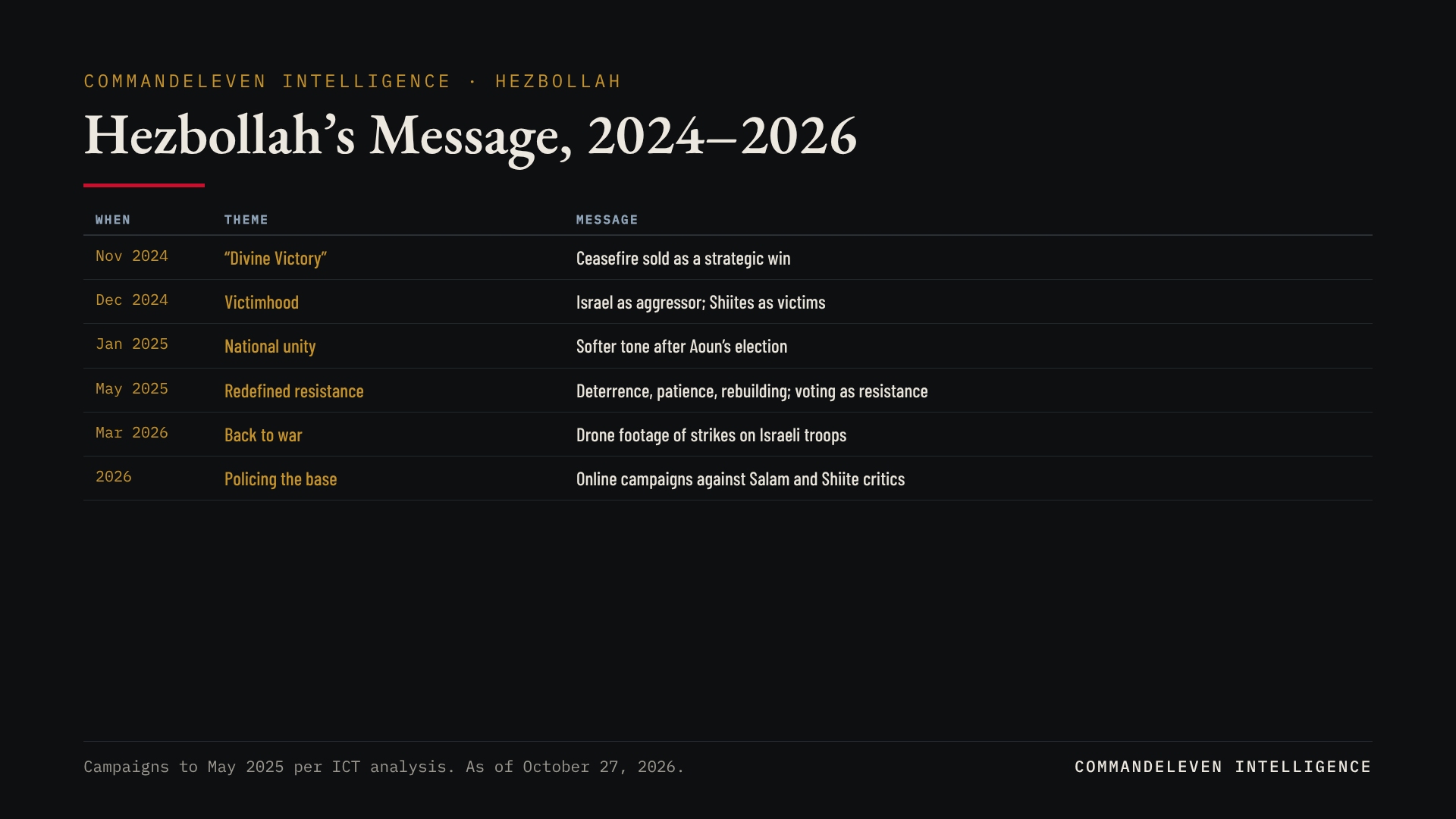
Hezbollah’s messaging has changed with its fortunes. An analysis of its Telegram campaigns after the 2024 ceasefire by the International Institute for Counter-Terrorism (ICT), an Israeli research center, found five main campaigns:
- “Divine Victory,” November 2024. The ceasefire presented as a strategic win.
- Ceasefire violations, December 2024. Israel as the aggressor, Shiites as victims.
- National unity, January 2025. A slow, then softer response to President Aoun’s election.
- Resistance and Liberation Day, May 2025. “Resistance” redefined as deterrence, patience and rebuilding.
- Municipal elections, May 2025. Voting presented as a continuation of resistance.
ICT concluded the campaigns were run from the top down, aimed mainly at the domestic Shiite base, and reflected a movement “in survival mode” that had lost coherence since Nasrallah’s death. [ASSESSED by ICT]
The 2026 war. When fighting resumed, Hezbollah’s most effective content was footage from its own fiber-optic attack drones striking Israeli positions, which Al Jazeera’s Ali Hashem describes as unedited and aimed both at supporters and at Israeli soldiers. One release, showing drones hitting an Israeli flag over a position in al-Bayada, was captioned “Flag lowering ceremony.” [CONFIRMED as published footage]
[ASSESSED] The drone videos replace Nasrallah’s speeches as Hezbollah’s main proof of life. They are cheap, constant and credible to the base, because they show something real. They also tell Israeli soldiers in Lebanon that they are being watched.
The Covert Front
Hezbollah also works online in ways it does not claim.
- Cyber espionage. From 2012 to 2015, a campaign researchers named Volatile Cedar used custom malware against targets in the United States, Canada, Israel and elsewhere. From 2019, a group researchers called Lebanese Cedar, linked to Hezbollah, breached about 250 servers in several countries. [CONFIRMED as security researchers’ findings, cited by CSIS]
- Social engineering. Operatives posed as women on Facebook to persuade targets to install a messaging app loaded with malware. [CONFIRMED as CSIS finding]
- Psychological operations. People who described themselves as Hezbollah “cyber fighters” told a researcher they ran fake accounts to swamp critics, spread false reports of attacks to cause panic in Israel and sent anonymous messages to Israeli soldiers’ families suggesting their relatives were in danger. [SINGLE-SOURCE; interviews not independently verified by the publisher]
The Front at Home
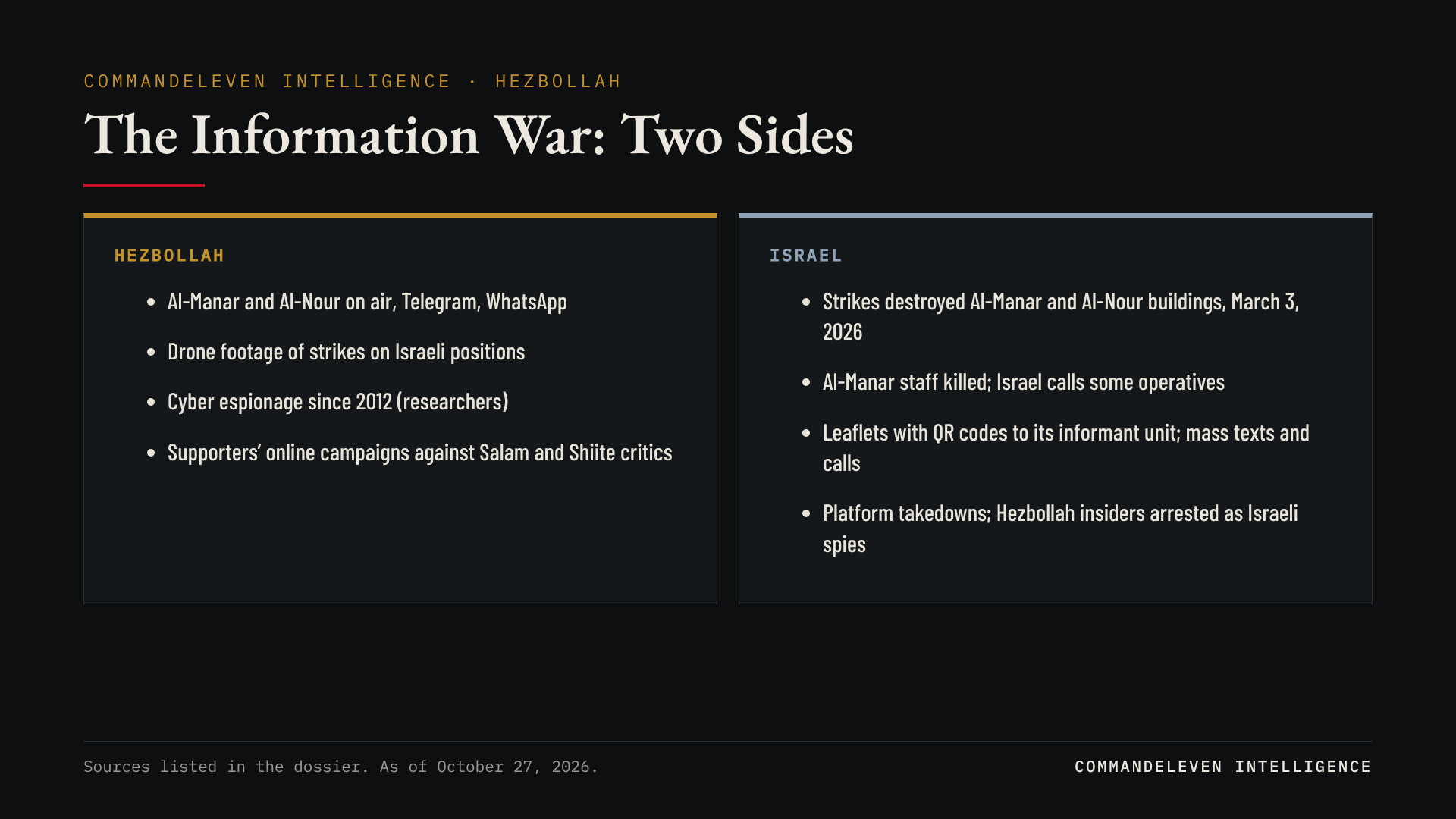
Hezbollah’s information war is increasingly aimed at Lebanese, not Israelis.
- Against the prime minister. In 2026, after Israel killed three journalists working for Hezbollah-affiliated media, Hezbollah supporters rallied outside the prime minister’s office calling Nawaf Salam a “Zionist,” and pro-Hezbollah accounts attacked him online. L’Orient Today compared the scene to Hezbollah’s 2008 takeover of parts of Beirut. Hezbollah kept its distance from the campaign. [CONFIRMED on the rally; Hezbollah’s role unclear]
- Against Shiite critics. On October 2, 2026, Abir Mroueh, a Shiite activist from a village near Nabatieh, told Salam on camera, “We are with you till the end, we want the state.” Pro-Hezbollah accounts then attacked her private life, including her marriage to a Christian, and she reported death threats, one of them against her young daughter. A Hezbollah source said the party was “not concerned” with the controversy. [CONFIRMED on the campaign; Hezbollah’s role unclear]
- Against the state’s decisions. Hezbollah calls the cabinet’s March 2026 ban on its military activity “null and void” (Part 1). [CONFIRMED]
[ASSESSED] The pattern is deniable intimidation. Hezbollah’s leadership stays silent while its online base does the work. The target is less the critic than the audience: other Shiites considering whether it is safe to say what Mroueh said.
Israel’s Information War
Israel fights on the same front, with more resources.
- Strikes on Hezbollah media. On March 3, 2026, Israeli strikes destroyed Al-Manar’s headquarters in Haret Hreik and Al-Nour’s building in Beirut’s southern suburbs. Both kept broadcasting, Al-Manar from an undisclosed location. [CONFIRMED]
- Strikes on staff. Israel killed Al-Manar presenter Ali Nour el-Din in January 2026, saying he was a Hezbollah member; Al-Manar political programming director Mohammad Sherri and his wife in a Beirut strike in March; and Al-Manar correspondent Ali Shoeib on March 28, with Al-Mayadeen reporter Fatima Ftouni and her brother Mohammed. Israel said Shoeib was a Hezbollah intelligence operative “exposing the locations” of its soldiers and gave no evidence. Lebanon’s president called it a “flagrant crime,” and Lebanon’s audiovisual workers’ union condemned the strikes on the stations as an attack on press freedom. [CONFIRMED on the deaths; Israel’s claims about the individuals unverified]
- Leaflets and phones. In March 2026, Israel dropped leaflets over Beirut urging people to demand Hezbollah’s disarmament, with QR codes the Lebanese army says lead to Israel’s human intelligence unit, Unit 504, which recruits informants. They came alongside mass calls and text messages to Lebanese phones. [CONFIRMED]
- Platforms. Israel has asked tech companies to remove Hezbollah accounts. Meta and X reportedly removed hundreds in January 2024. [REPORTED]
- Penetration. In July 2026, Lebanon arrested a man close to Hezbollah commanders who, a judicial official said, gave Israel “precise information that led to the assassination of Hezbollah officials.” [REPORTED]
[ASSESSED] Israel’s information campaign and its intelligence campaign are now the same campaign. Leaflets that invite informants, strikes on journalists Israel calls operatives and arrests of Hezbollah insiders as spies all serve one goal: making Hezbollah’s own community doubt whether it can trust the people around it.
What It Means
[ASSESSED] Hezbollah’s information front has contracted to its core. It no longer shapes the region’s narrative the way it did under Nasrallah, and its credibility outside its base has fallen with every lost commander and every war it brought to Lebanon. But inside its community, it still controls the story, and it is willing to make dissent costly.
That matters for everything in Parts 1 to 5. Disarmament, sanctions enforcement and the end of Hezbollah’s foreign operations all require Lebanese Shiites to accept a future without Hezbollah’s weapons. The information front is where Hezbollah fights to make sure they don’t.
Dated Calls
These calls are registered on the Foresight Record and will be scored on the dates given.
- By March 31, 2027. Al-Manar is still broadcasting. [ASSESSED]
- By March 31, 2027. Lebanese authorities announce at least one more arrest of a person accused of spying for Israel against Hezbollah. [ASSESSED]
- By June 30, 2027. Israel strikes Al-Manar or Al-Nour facilities or kills at least one more Al-Manar staff member. [ASSESSED]
What This Dossier Does Not Claim
- It does not claim Hezbollah’s leadership ordered the online campaigns against Salam or Mroueh. Hezbollah distanced itself from both.
- It does not accept or reject Israel’s claims that the Al-Manar staff it killed were Hezbollah operatives. Israel gave no public evidence.
- It does not confirm the claims of the self-described Hezbollah “cyber fighters.” They come from interviews the publisher did not verify.
- It does not attribute any specific 2026 cyberattack to Hezbollah. No public attribution exists.
Frequently Asked Questions
What is Al-Manar?
Hezbollah’s television station, on air since 1991 and designated by the United States as a terrorist entity in 2006. Israel destroyed its Beirut headquarters in March 2026, but it continues to broadcast.
How does Hezbollah spread its message now?
Mainly through Al-Manar, Telegram channels and WhatsApp groups, with drone footage of attacks on Israeli forces as its most widely shared content.
Does Hezbollah carry out cyberattacks?
Security researchers have linked Hezbollah to cyber-espionage campaigns since at least 2012. It relies heavily on Iran for advanced cyber capabilities.
How is Israel fighting Hezbollah’s information campaign?
With strikes on Hezbollah’s media, leaflets and phone messages aimed at Lebanese civilians, requests to platforms to remove accounts and recruitment of informants.
Sources
- Al Jazeera (Ali Hashem), The battle of perception: From Israel’s Fauda to Hezbollah’s FPV footage
- International Institute for Counter-Terrorism (ICT), Hezbollah on Telegram: Post-Ceasefire Media Campaigns and Narrative Shifts
- CSIS (Daniel Byman and Emma McCaleb), Understanding Hamas’s and Hezbollah’s Uses of Information Technology
- Irregular Warfare Initiative (Pierre-Yves Baillet), Hezbollah’s Information Warfare in the Post-October 7 Era
- L’Orient Today, Union condemns strikes on Al-Manar and Al-Nour; Hezbollah says broadcasting will continue
- Shafaq News, Hezbollah-linked Al-Manar TV mourns senior staff killed in Beirut airstrike
- Al Jazeera, Israeli air strike kills TV presenter in southern Lebanon
- WTOP (AP), Israeli airstrike in southern Lebanon kills 3 journalists covering the war
- L’Orient Today, Campaign against Salam: Hezbollah distances itself despite discontent
- L’Orient Today, “We want the state”: Shiite activist who supported Salam under fire from pro-Hezbollah accounts
- The New Arab, Why is Israel dropping leaflets with QR codes over Beirut?
- L’Orient Today (AFP), Lebanon detains man close to Hezbollah for allegedly spying for Israel: judicial official