CommandEleven Intelligence · Terrorism Finance Desk. Status as of October 27, 2026.
Bottom Line Up Front
Two signals landed in the same week. On October 21, Paraguay showed a visiting US deputy secretary of state a new army counterterrorism company in Ciudad del Este, the Paraguayan anchor of the Tri-Border Area with Brazil and Argentina. On October 26, Canada’s financial intelligence unit, FINTRAC, reported that it had revoked 82 money service business registrations in a year, up from 12, and imposed more than $198 million in penalties, citing money laundering and terrorist financing risk.
Both point at the same problem. Canada’s own 2025 risk assessment names Hezbollah as the second most frequent international terrorist recipient of funds leaving Canada, and describes the Port of Montréal as a known link for luxury vehicles shipped to Lebanon to support the group. In South America, the Tri-Border Area has been tied to Hezbollah finance since the 1990s, and the United States is still offering up to $10 million for information on the group’s money there.
The networks are not separate. The same trade-based schemes, used-car exports and money service businesses appear at both ends, and since its 2024 war with Israel, Hezbollah has leaned harder on criminal revenue and stablecoins to replace Iranian cash that is harder to deliver. [ASSESSED] That makes the Western Hemisphere more important to Hezbollah’s budget, not less.
Key Judgments
KJ1: Canada is a source country for Hezbollah money, by its own government’s account. The 2025 national risk assessment names Hezbollah as the second most frequent international terrorist recipient of outgoing Canadian funds, after Daesh, and links the Port of Montréal to vehicle exports that support the group. [CONFIRMED as the Government of Canada’s assessment]
KJ2: Canada’s weakness is enforcement, not detection. FINTRAC can analyze and disclose, but it cannot investigate, seize or charge. A Financial Crimes Agency with police powers was proposed in legislation on April 27, 2026, and is not yet operating. [CONFIRMED]
KJ3: The Tri-Border Area remains a priority for Washington and Asunción. The US reward offer of May 2025 and Paraguay’s new US-trained counterterrorism company show both governments treat the area as active. Public evidence on volumes is thin, and new research shows the activity spreading beyond the area into wider Brazilian networks shared with organized crime. [CONFIRMED on the measures; DATA DEFICIT on current volumes]
KJ4: Hezbollah’s post-war budget depends more on crime and crypto. With Iranian funding harder to deliver, Hezbollah is drawing more on drug trafficking, gold, money changers and stablecoins such as Tether. [ASSESSED, drawing on US and Israeli reporting]
KJ5: The trend matches our April 2026 financing forecasts. Our Global Counter-Terrorism Assessment called the hawala-crypto bridge a core channel, which was confirmed, and flagged Monero, which was not: stablecoins dominate. Hezbollah’s reported use of Tether fits that correction. [CONFIRMED against our Foresight Audit]
Two Signals in One Week
Paraguay, October 21. President Santiago Peña and US Deputy Secretary of State Christopher Landau toured a new Counterterrorism Company of the army’s Third Infantry Division in Ciudad del Este, across the river from Foz do Iguaçu in Brazil. Defence Minister Óscar González said the zone is “exposed to terrorist groups and organised crime.” Paraguayan media report that US training made the unit possible. Paraguay has not said which groups it will target first, and neither government has published the unit’s size. Peña then traveled to Washington, where he was due to meet CIA Director John Ratcliffe on October 22. [CONFIRMED]
Canada, October 26. FINTRAC’s annual report for 2025-26 says it revoked 82 money service business registrations, against 12 the year before, and imposed administrative penalties of more than $198 million on nine money service businesses. It said it directed significant resources to the sector because of money laundering and terrorist financing risks, including illicit cryptocurrency activity. [CONFIRMED]
[ASSESSED] Neither announcement names Hezbollah. Both target the channels that Canadian and US assessments say Hezbollah uses.
Canada: What Ottawa’s Own Assessment Says
The 2025 Assessment of Money Laundering and Terrorist Financing Risks in Canada finds that the overall volume of terrorist financing in Canada is low, mostly small transactions, and that there is little evidence of terrorist money flowing into Canada to fund attacks at home. Where there is a link, money leaves Canada for groups abroad. Within that picture, it singles out Hezbollah and Hamas as “established and well-resourced” groups that raise money in Canada. [CONFIRMED]
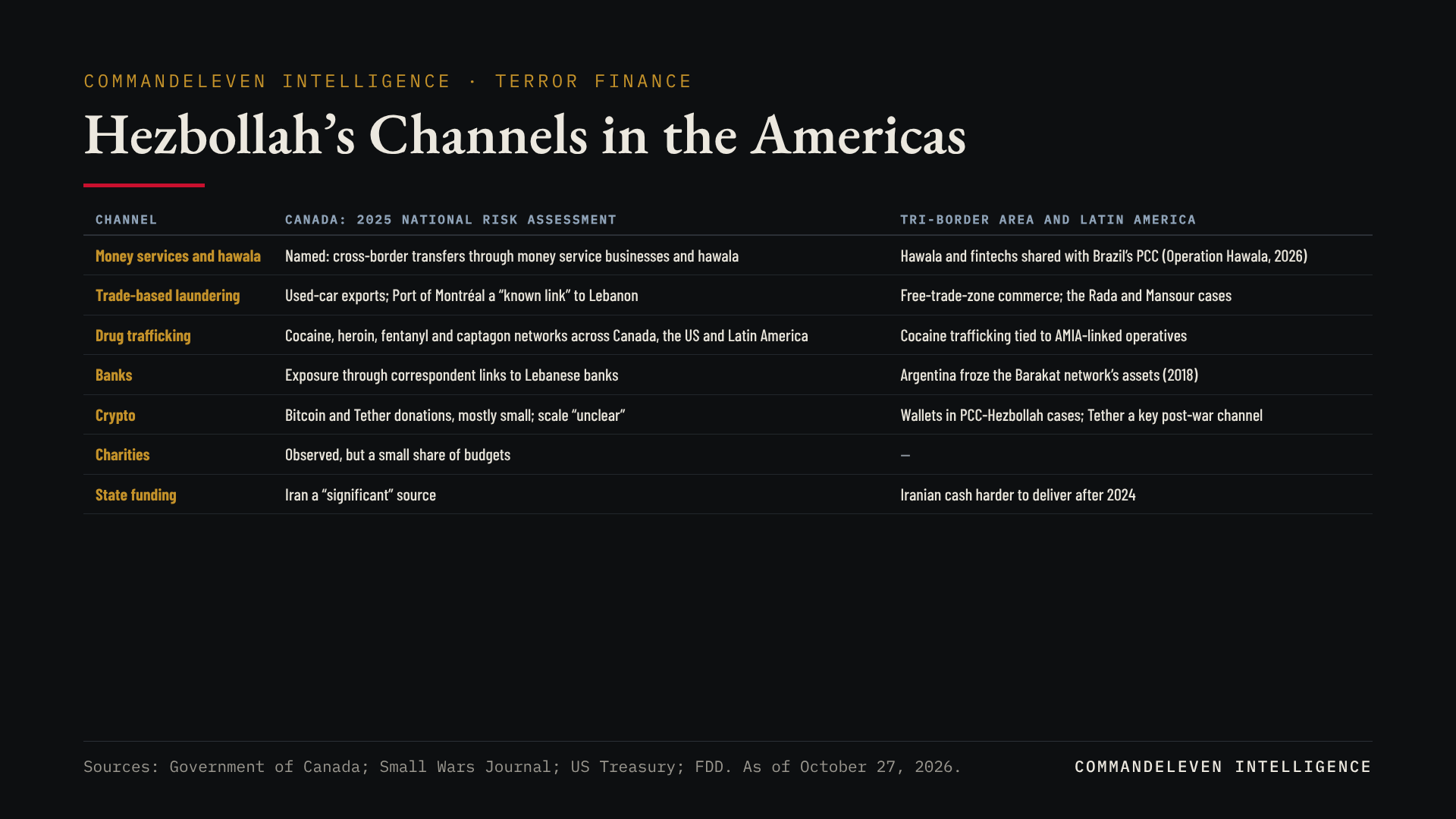
How Hezbollah moves money, according to the assessment:
- Money service businesses and hawala. Both Hezbollah and Hamas use money service businesses, especially informal value transfer systems such as hawala, to move money across borders.
- Lebanese banks. Hezbollah keeps accounts in Lebanon’s banking sector, and Canadian institutions may be exposed through correspondent banking relationships with Lebanese banks that serve the group.
- Crypto. Bitcoin and Tether appear in Hezbollah and Hamas fundraising, mostly as small donations. The report says the full scale “remains unclear.”
- Iran. State sponsorship from Iran is a significant source of revenue, and Canada has observed the same patterns the US Treasury described in 2024: oil and weapons sales, front companies, correspondent banking and crypto.
- Charities. Abuse of charities and non-profits has been observed, though the report estimates it is a small share of terrorist groups’ overall budgets.
- Crime. Hezbollah “remains a highly active global player in the cocaine, heroin, fentanyl, and captagon trades,” with networks spanning Latin America, Canada and the United States, and uses trade-based money laundering through the used-car trade. “The Port of Montréal is a known link where luxury vehicles are shipped to Lebanon, financially supporting Hezbollah.”
[CONFIRMED as the Government of Canada’s assessment]
What else is on the record.
- Canada listed Hezbollah in its entirety as a terrorist entity in December 2002, and the Islamic Revolutionary Guard Corps in June 2024. [CONFIRMED]
- In February 2025, Canada listed seven cartels and gangs as terrorist entities, including the Sinaloa and Jalisco New Generation cartels and Tren de Aragua, citing their alliances with terrorist groups. [CONFIRMED]
- In December 2025, Toronto police and the RCMP charged a 26-year-old Toronto man with seven terrorism offenses, including conspiring to commit murder for ISIS and providing cryptocurrency to the group. The charges have not been tested in court. [CONFIRMED that charges were laid]
- Vehicle seizures tied to Montréal exports are real and large: 598 vehicles worth $34.5 million recovered in a 2024 operation, for example. Those seizures were not publicly tied to Hezbollah. [CONFIRMED on the seizures; Hezbollah link not established in those cases]
The enforcement gap. FINTRAC analyzes reports and passes intelligence to police, but it cannot investigate, obtain warrants, seize funds or lay charges. Former Canada Border Services Agency officer Ken Chan called this an “intelligence-to-enforcement gap” in April 2026, pointing to the Cullen Commission’s criticism of slow, unusable intelligence and of the RCMP’s financial-crime capacity. Ottawa tabled legislation on April 27, 2026, to create a Financial Crimes Agency with police powers, with $352.7 million proposed over five years. It is not yet operating. [CONFIRMED]
The Tri-Border Area: Old Hub, Thin Evidence
The area where Argentina, Brazil and Paraguay meet, centered on Ciudad del Este, Foz do Iguaçu and Puerto Iguazú, has been tied to Hezbollah finance since before the 1992 and 1994 bombings in Buenos Aires. Its large Lebanese community, porous borders and free-trade commerce made it a center for smuggling, document fraud and money laundering. Argentina froze the assets of the Assad Barakat network in 2018 over alleged laundering through a casino in Puerto Iguazú. [CONFIRMED]
What has happened since 2023:
- September 2023. The US Treasury designated Amer Mohamed Akil Rada, a Hezbollah operative linked to the 1994 bombing of the AMIA Jewish center, who reportedly sent up to 80 percent of his commercial profits to the group, and his brother Samer, implicated in a 500-kilogram cocaine shipment. [CONFIRMED]
- December 2023. The US Justice Department charged Salman Raouf Salman, a senior Hezbollah operative tied to the AMIA bombing who reportedly still directs activity in the Western Hemisphere. [CONFIRMED]
- October 2024. The US Financial Crimes Enforcement Network (FinCEN) warned banks about Hezbollah’s ties to South American drug traffickers and its use of hawala, bulk cash and trade-based laundering. [CONFIRMED]
- May 2025. The State Department offered up to $10 million for information on Hezbollah’s finances in the Tri-Border Area, saying the group “generates about $1 billion annually.” [CONFIRMED]
- October 2026. Paraguay’s new counterterrorism company opened in Ciudad del Este. [CONFIRMED]
The caution. A March 2025 RAND study found that, given the lack of verifiable public reporting since the early 2000s, “it remains unclear” whether the Tri-Border Area is still one of Hezbollah’s primary hubs, or whether pressure from the “3+1” group of Argentina, Brazil, Paraguay and the United States displaced activity elsewhere. Brazil, home to the area’s largest city, still has not designated Hezbollah a terrorist group. [CONFIRMED]
The newest research. An October 16, 2026, study in Small Wars Journal by Sergio Altuna and Leonel Caraciki of George Washington University’s Program on Extremism argues that the Tri-Border Area is best understood “not as a self-contained Hezbollah hub, but as one node within a wider ecosystem.” The cases they trace:
- From Barakat to fintech. The Barakat network ran through identifiable family businesses. Later cases involve import-export firms, exchange houses, hawala operators, fintech services and crypto platforms that serve more than one client.
- Shared infrastructure with Brazilian organized crime. Brazilian investigations since 2017 have identified shell companies, financial institutions and crypto transactions allegedly serving both Hezbollah and the Primeiro Comando da Capital (PCC), Brazil’s largest criminal organization.
- Operation Hawala, 2026. Brazilian authorities uncovered a network allegedly moving more than 100 million reais through legitimate and shell companies in several states, including São Paulo and Rio de Janeiro, for both the PCC and Hezbollah.
- A hawala case in Argentina. Argentine authorities investigated a hawala operator allegedly serving Hezbollah and Hamas who reportedly moved more than $1.5 million to wallets in Brazil.
- Displacement south. Uruguay’s 2025-2030 national strategy cites intelligence that some illicit activity may be shifting from the Tri-Border Area to the Santana do Livramento-Rivera border with Brazil.
The authors stress that shared infrastructure does not prove organizational cooperation, and that most cases ended in financial or criminal charges, not terrorism charges, because a direct link to a terrorist group is hard to prove in court. [CONFIRMED as the authors’ findings; individual cases alleged]
[ASSESSED] Washington and Asunción are acting as if the area is active, and the newest research suggests the bigger problem is no longer the area itself but the networks it plugs into across Brazil. The public record still cannot show the volumes. That gap is exactly what the reward offer is trying to close.
Venezuela. Over the past decade, much of Hezbollah’s regional activity shifted toward Venezuela, as CommandEleven Intelligence set out in Venezuela’s Passport Pipeline. With Maduro removed in January 2026, that base is under pressure, which may push activity back toward older hubs, including the Tri-Border Area. [ASSESSED]
How the Money Moves Now
Hezbollah came out of its 2024 war with Israel short of cash. Israeli strikes hit Al-Qard al-Hassan, its quasi-bank, and Iranian funding became harder to deliver. Matthew Levitt of the Washington Institute told the US Senate in October 2025 that the group would turn to criminal enterprises, including laundering drug money, to fill the gap. [CONFIRMED as Levitt’s assessment]
A July 2026 memo for the Foundation for Defense of Democracies, by Israeli analyst Iftah Burman, describes what followed. Its main claims, which are drawn largely from Israeli and US reporting:
- Hezbollah has received more than $1 billion since early 2025, mostly from the IRGC, through Lebanese money changers, Turkish exchange houses and gold traders.
- Hawala networks settle balances between Africa, Latin America and Lebanon.
- Digital wallets tied to Hezbollah and the IRGC have moved more than $3 billion, with Tether (USDT) a key channel.
- After Al-Qard al-Hassan was hit, Hezbollah set up a replacement, Jood SARL, which the United States designated in February 2026.
[SINGLE-SOURCE: FDD memo; figures not independently verified]
[ASSESSED] The direction is consistent across Canadian, US and Israeli sources: less Iranian cash, more crime, more exchange houses and more stablecoins. Each of those runs through the Western Hemisphere.
Where the Two Ends Meet
The clearest link between Canada and South America runs through people, not maps.
- Hassan Mohsen Mansour, a Canadian-Lebanese citizen indicted in the United States and France for laundering drug proceeds, was linked to companies tied to the Rada family. He admitted using a Lebanese car-trading firm to disguise cocaine shipments as charcoal. [CONFIRMED, per US court records cited by Levitt]
- The used-car trade appears at both ends: Canada’s assessment names it, US officials have described Hezbollah buying used cars in North America and reselling them through Africa and the Gulf, and the 2011 US case against the Lebanese Canadian Bank alleged hundreds of millions of dollars moving through car purchases toward a Hezbollah-controlled cash network. [CONFIRMED on the assessments; the 2011 case allegations were not proven at trial]
[ASSESSED] For Canadian banks and money service businesses, the practical risk is not a Hezbollah account. It is a used-car exporter, a money service business or a correspondent bank relationship that sits two steps from one.
What It Means
For Canada. The country has a clear assessment and a growing enforcement push against money service businesses, but no agency yet able to turn financial intelligence into charges. Until the Financial Crimes Agency is running, the risk the assessment describes will be easier to document than to prosecute. [ASSESSED]
For the Tri-Border Area. Paraguay’s new unit is the most visible security step in the area in years. Its effect on Hezbollah finance depends on Brazil, which has not designated the group but whose own investigations are now finding Hezbollah-linked money in PCC networks, and on whether the unit is used against financial networks and not only armed groups. [ASSESSED]
For Hezbollah. A group short of Iranian cash needs its overseas networks more, not less. That makes the Western Hemisphere a growing part of its budget, and a growing target. [ASSESSED]
This follows on from our GCTA Foresight Audit on financing, the IRGC-QF and cartel logistics assessment and the Criminal-Terror Nexus. Our Hezbollah series, publishing this week, picks up the Lebanese end.
Dated Calls
These calls are registered on the Foresight Record and will be scored on the dates given.
- By March 31, 2027. The US Treasury or State Department designates, charges or names in a reward offer at least one person or company based in the Tri-Border Area for Hezbollah financing. [ASSESSED]
- By March 31, 2027. Canada’s Financial Crimes Agency has not yet laid its first criminal charges. [ASSESSED]
- By June 30, 2027. Brazil does not designate Hezbollah as a terrorist organization. [ASSESSED]
What This Assessment Does Not Claim
- It does not claim that the Paraguayan unit or FINTRAC’s enforcement actions were aimed at Hezbollah. Neither says so.
- It does not claim the Montréal vehicle seizures cited here were tied to Hezbollah.
- It does not claim the FDD memo’s crypto and funding figures are verified.
- It does not claim that remittances from Lebanese communities in Canada or South America support terrorism. Canada’s assessment warns explicitly against that conclusion, and so do we.
Frequently Asked Questions
Does Hezbollah raise money in Canada?
Yes, according to the Government of Canada. Its 2025 risk assessment says Hezbollah receives financial support originating from Canada and names it the second most frequent international terrorist recipient of outgoing Canadian funds.
What is the Tri-Border Area?
The region where Argentina, Brazil and Paraguay meet, centered on Ciudad del Este, Foz do Iguaçu and Puerto Iguazú. It has been linked to Hezbollah financing since the 1990s.
Is the Tri-Border Area still a Hezbollah hub?
The United States and Paraguay treat it as one. Public evidence on current volumes is limited. Recent research describes it as one node in a wider network across Brazil, shared with organized crime, rather than a self-contained hub.
How is Hezbollah funding itself after the 2024 war?
Reporting points to less Iranian cash and more criminal revenue, money changers, gold and stablecoins such as Tether.
Sources
- Government of Canada, 2025 Assessment of Money Laundering and Terrorist Financing Risks in Canada
- BNN Bloomberg, Financial transactions watchdog steps up action against money service businesses
- The Rio Times, Paraguay opens US-trained anti-terror unit
- Department of Finance Canada, Minister Champagne highlights Spring Economic Update measures to fight financial crimes
- Policy Options, Build a real financial crimes force to hit terrorist financing
- FDD’s Long War Journal, Hezbollah continues exploiting Canadian vehicular theft and money-laundering schemes
- Washington Institute (Matthew Levitt), Global Gangsters: Hezbollah’s Latin American Drug Trafficking Operations, Senate testimony, October 21, 2025
- The Algemeiner, US offers up to $10 million for information on Hezbollah’s financial networks in Latin America
- Foundation for Defense of Democracies (Iftah Burman), Hezbollah’s financing strategies: recovering from war with Israel
- Small Wars Journal (Sergio Altuna and Leonel Caraciki), Digital Hawala: Hezbollah’s Evolving Financial Infrastructure in the Tri-Border Area
- Global News, Toronto man arrested on ISIS terrorism charges
- RAND (Marzia Giambertoni), Hezbollah’s Networks in Latin America: Potential Implications for U.S. Policy and Research