CommandEleven Intelligence · Middle East Desk. Hezbollah series, status as of October 27, 2026.
Bottom Line Up Front
Lebanon has promised to disarm Hezbollah three times in two years, and each deadline has passed with Hezbollah still armed.
The November 2024 ceasefire made the Lebanese Armed Forces responsible for clearing Hezbollah from the south. In 2025, a US roadmap set December 31 as the date for full disarmament, the cabinet ordered weapons placed under state control and the army launched a five-phase plan. In January 2026 the army declared the first phase, south of the Litani River, complete. Eight weeks later Hezbollah went to war again, firing on Israel from the area the army said it had cleared.
The June 2026 framework signed in Washington tries again, this time with Israeli troops occupying a strip of southern Lebanon until disarmament is verified. Four months in, Israel blames the Lebanese army for failing to act, the United States is cutting and conditioning its aid, and in October Lebanese security forces stopped a truck carrying 780 kilograms of explosives that Hezbollah openly claimed and demanded back.
[ASSESSED] The Lebanese state wants Hezbollah disarmed but will not fight it to make that happen. Until that changes, every framework will measure progress by statements, while Israel measures it by what it finds on the ground.
Key Judgments
KJ1: Every disarmament deadline since 2024 has been missed. The 2024 ceasefire, the 2025 US roadmap’s December 31 deadline and the army’s own phase one all ended with Hezbollah still armed in the areas concerned. [CONFIRMED]
KJ2: The army’s phase-one claim did not survive contact. The army declared the area south of the Litani under its operational control on January 8, 2026. Hezbollah launched a war from southern Lebanon on March 2. [CONFIRMED]
KJ3: The army will not use force against Hezbollah. Its record, from 2008 to 2026, is to deconflict and in places coordinate with Hezbollah rather than confront it. Israel now accuses parts of the army of coordinating with the group. [CONFIRMED on the record; Israeli coordination claim is an allegation]
KJ4: Washington has moved from patience to conditions. Congress is capping and conditioning army aid on disarmament, and the Secretary of State is pressing Beirut directly over specific seizures. [CONFIRMED]
KJ5: Israel will hold southern Lebanon until disarmament is verified. Israeli leaders have said so repeatedly, and the June framework ties each withdrawal to verified progress. [CONFIRMED]
Three Promises, Three Deadlines
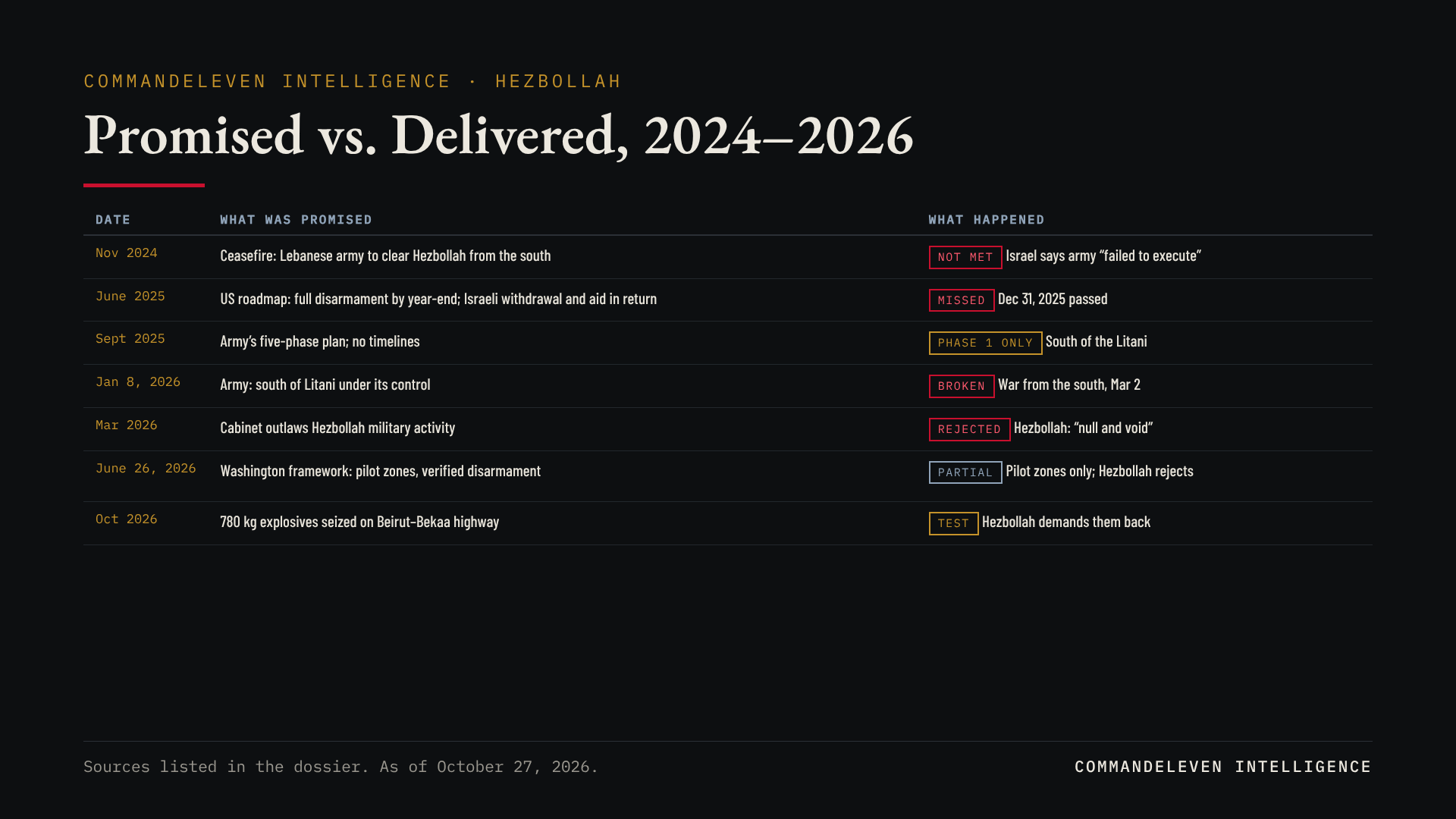
1. The November 2024 ceasefire. Lebanon tacitly agreed that the army would remove Hezbollah’s weapons and infrastructure from the south. Israel says the army “failed to execute this task as required.” [CONFIRMED on the commitment; Israel’s assessment]
2. The 2025 US roadmap. In June 2025, US envoy Tom Barrack delivered a six-page proposal: full disarmament by November or, at the latest, year-end, in exchange for Israeli withdrawal, an end to airstrikes and reconstruction money. A 120-day version had Lebanon commit to full disarmament by December 31, 2025, with US military aid frozen if Lebanon breached it. On August 7, 2025, the cabinet ordered all weapons placed under state control; Hezbollah’s ministers walked out. In September, the army presented its five-phase Homeland Shield plan: south of the Litani first, then north to the Awali River, Beirut and its southern suburbs, the Bekaa Valley and finally the rest of the country. No timeline was set for any phase. [CONFIRMED]
3. Phase one “complete.” On January 8, 2026, the army said it held operational control south of the Litani, except for five Israeli positions, but stopped short of declaring Hezbollah disarmed there: “work in the sector is still ongoing.” Israel called it an “encouraging start” that did not go far enough. The December 31 deadline had already passed. [CONFIRMED]
What happened next. On March 2, 2026, Hezbollah fired on Israel in support of Iran. Israel invaded, reached and crossed the Litani, and now holds a zone up to 10 kilometers deep behind what it calls the Yellow Line. About 50 frontline villages have been destroyed, and more than 1.2 million people were displaced. [CONFIRMED]
The June Framework
On June 26, 2026, Lebanon and Israel signed a US-brokered framework in Washington. Its core terms:
- Disarmament starts in two pilot zones agreed by the Israeli military and the Lebanese army. More zones can be added as disarmament advances.
- The army must verifiably disarm Hezbollah and other armed groups and dismantle their infrastructure, under a US-supported military coordination group.
- Israeli forces redeploy step by step as each stage is verified. A security annex was still to be written.
[CONFIRMED]
What has been delivered. In July, Israel withdrew from the pilot zones and handed sections of its buffer zone to Lebanese control, and the army deployed in Zawtar al-Gharbiyah. In August, the two sides agreed a shortlist of countries that could send forces to verify Hezbollah’s disarmament. [CONFIRMED]
What has not. Hezbollah rejected the framework. Qassem called it part of a “war of extermination,” and Hezbollah lawmaker Hassan Fadlallah said the state could not enforce it without triggering civil war. Defense Minister Israel Katz has said Israeli troops will not withdraw from the zone they hold, and Prime Minister Netanyahu has said Israel will keep its security zone as long as Hezbollah does not disarm. [CONFIRMED]
The Army’s Record
The Lebanese Armed Forces number about 85,000, far more than Hezbollah’s fighters. Size is not the problem. Will is.
- 2008. The army refused government orders to dismantle Hezbollah’s private communications network. Hezbollah then took to the streets, and the army largely stood aside. [CONFIRMED]
- 2025. Six soldiers were killed in August while dismantling Hezbollah infrastructure. The army pressed on in the south but did not move north of the Litani. [CONFIRMED]
- The Kfarra site, December 2025. At the request of the US-led monitoring mechanism, the army said it had taken “necessary measures” at a Hezbollah weapons site in Kfarra. Israel says Hezbollah kept using it and later moved equipment out. [Israeli claim]
- October 2026. The Israeli military said some army units “coordinated with Hezbollah” on security arrangements, helping the group prepare to move weapons, and that the army “bears responsibility” for its failures. [Israeli claim; denied in substance by the army, which says it is carrying out its duties]
The truck. In early October, Lebanese security forces stopped a truck on the Beirut-Bekaa highway carrying 780 kilograms of explosives, including 250 kilograms of TNT and 250 kilograms of C-4, and arrested two men. Hezbollah lawmaker Hassan Fadlallah acknowledged the shipment, said it was “intended exclusively for use against the Israeli occupation” and demanded the explosives back and the men released. Prime Minister Nawaf Salam called it a “criminal operation” and ordered an investigation. [CONFIRMED]
[ASSESSED] The seizure cuts both ways. It shows Lebanese security forces will stop a shipment when they find one. It also shows Hezbollah moving explosives through central Lebanon openly enough to demand them back, eight months after the government outlawed its military activity.
Israel’s Response
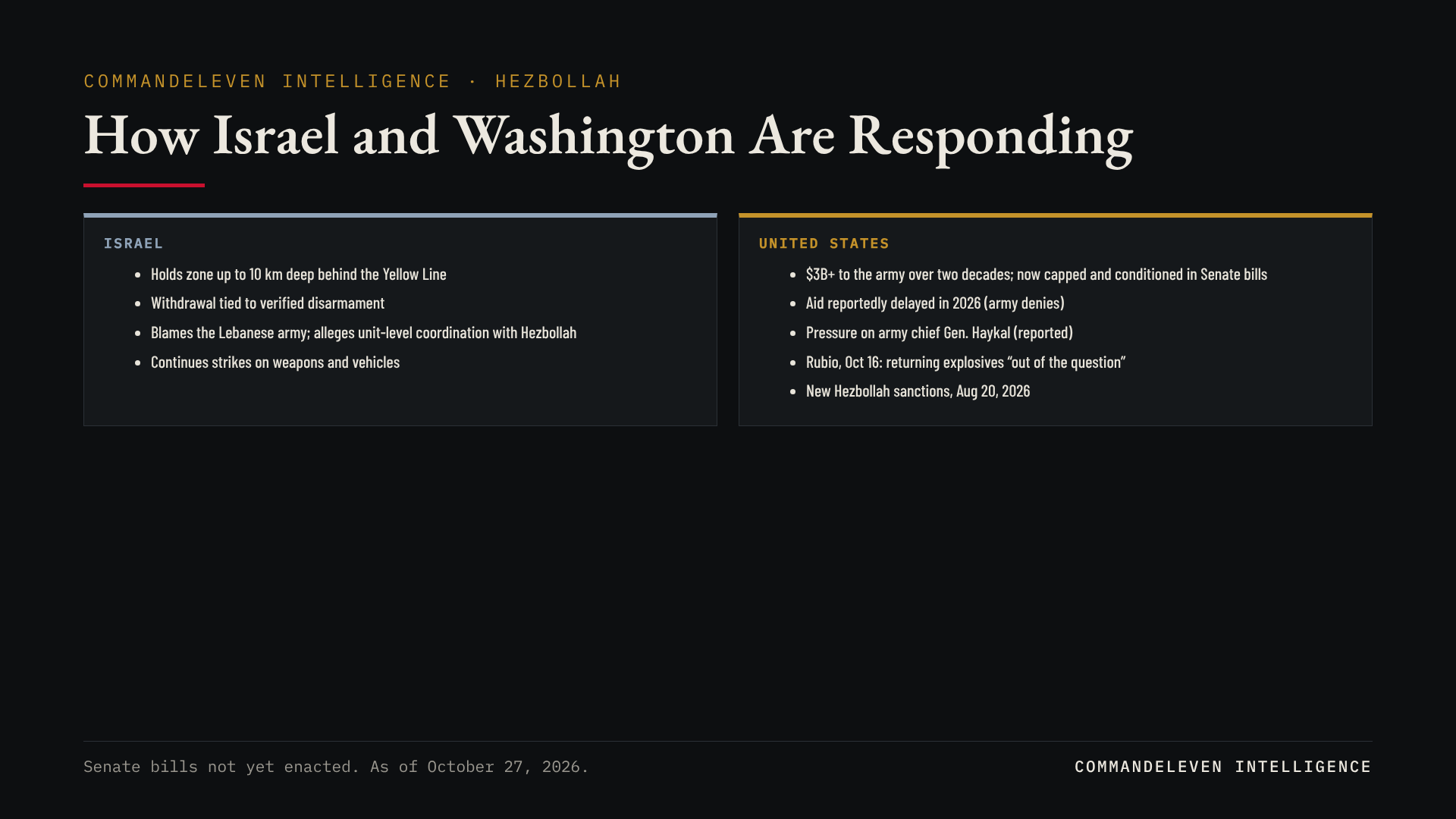
- Occupation as leverage. Israel holds the zone behind the Yellow Line and continues demolitions there, and has tied any further withdrawal to verified disarmament. [CONFIRMED]
- Blaming the army. Israel’s October 20 statement holds the Lebanese army responsible for Hezbollah’s continued armed activity and demands “more decisive and effective measures.” [CONFIRMED]
- Strikes. Israel continues to strike what it identifies as Hezbollah weapons and vehicles, including a truck it says was moving weapons out of a stored site. [CONFIRMED as Israeli statements]
Washington’s Response
- Aid conditioned. The United States has given the Lebanese army more than $3 billion over two decades. The Senate’s 2027 defense bill caps support at $36 million and releases only 5 percent until the administration certifies that Lebanon has outlawed Hezbollah’s activities and the army is actively disarming it, with recertification every 90 days. A separate bipartisan Senate bill offers $1.2 billion over five years, half of it held back until disarmament is certified. [CONFIRMED; neither bill has been enacted]
- Aid slowed. Lebanese military sources told The National in April that US security assistance had been suspended for weeks. The army denied it. [REPORTED; disputed]
- Pressure on the army chief. A senior Lebanese military source said Washington had called for the dismissal of army commander Gen. Rodolphe Haykal, whom Sen. Lindsey Graham criticized for not taking “bolder steps.” [REPORTED]
- Direct pressure. On October 16, Secretary of State Marco Rubio pressed President Joseph Aoun to hold accountable those behind the explosives shipment and said returning the explosives to Hezbollah “should be out of the question.” Aoun said Lebanese forces were “fully carrying out their duties.” [CONFIRMED]
- Sanctions. The United States imposed new sanctions on Hezbollah on August 20, 2026. [CONFIRMED]
What It Means
[ASSESSED] The pattern is fixed until one of three things changes: the army decides to use force, Hezbollah decides to hand over its weapons, or Israel decides to stay indefinitely. The first risks the army splitting along sectarian lines. The second depends on Tehran, as Part 1 set out. The third is already Israel’s stated policy.
The pilot zones are the one place where the framework is working, because they are small, agreed and verifiable. The hard tests are still ahead: north of the Litani, the Bekaa Valley and Beirut’s southern suburbs, phases two to four of the army’s own plan, where Hezbollah’s weapons and supporters are concentrated.
Dated Calls
These calls are registered on the Foresight Record and will be scored on the dates given.
- By March 31, 2027. The Lebanese army does not announce the start of disarmament operations in Beirut’s southern suburbs (phase three of its plan). [ASSESSED]
- By March 31, 2027. Israel has not withdrawn from the zone behind the Yellow Line, beyond the pilot zones and any agreed additions. [ASSESSED]
- By December 31, 2026. The US Congress enacts at least one law that ties assistance to the Lebanese army to Hezbollah’s disarmament. [ASSESSED]
What This Dossier Does Not Claim
- It does not claim the Lebanese army as an institution is allied with Hezbollah. Israel’s coordination claim is an allegation about some units.
- It does not claim the explosives seized in October were intended for assassinations. Hezbollah denies it, and no official has alleged it.
- It does not claim the June framework has failed. Its pilot zones are working; its harder phases have not started.
Frequently Asked Questions
Has the Lebanese army disarmed Hezbollah?
No. It declared the area south of the Litani under its control in January 2026, but Hezbollah went to war from southern Lebanon two months later. The harder phases of the army’s plan, north of the Litani, have not started.
What is the June 2026 framework?
A US-brokered agreement signed by Lebanon and Israel on June 26, 2026. It ties step-by-step Israeli withdrawal to verified disarmament of Hezbollah, starting in two pilot zones.
What is the Yellow Line?
The edge of the zone Israel occupies in southern Lebanon, up to 10 kilometers deep. Israel says it will stay until Hezbollah is disarmed.
Is the US still funding the Lebanese army?
Yes, but Congress is moving to cap and condition the aid on progress against Hezbollah, and some aid was reportedly delayed in 2026.
Sources
- Kataeb (citing the US proposal), U.S. proposes full Hezbollah disarmament by year-end to unlock reconstruction funds
- Washington Institute (David Schenker), Lebanon’s Moment of Truth
- Al Jazeera, Lebanon’s army says phase one of disarming non-state groups in south complete
- Yahoo News (AP), Lebanon says first phase of plan to disarm Hezbollah completed, but Netanyahu warns progress “far from sufficient”
- The Epoch Times, Israel-Lebanon peace framework lays out roadmap to end conflict, disarm Hezbollah
- Al-Monitor (Reuters), Israel says pilot safe zones begin in southern Lebanon
- Al Jazeera, Lebanese army enters “pilot zone” as villagers return amid Israel deal
- Al-Monitor (Reuters), Lebanon, Israel agree shortlist of countries that could send troops to verify Hezbollah disarmament
- News Tribune (AP), US hits Hezbollah with fresh sanctions emphasizing ties to Iranian government
- Al Jazeera, How Israel’s “Yellow Line” is reshaping southern Lebanon
- Daily Beirut, Israel blames Lebanese army for Hezbollah armed activity
- CP24 (AP), Hezbollah claims confiscated explosives and denies assassination plans
- Al Jazeera, Rubio presses Lebanon on confiscation of weapons from Hezbollah
- The National, US tightens grip on Lebanese army aid as delays bite in Beirut
- Jewish Insider, Senate defense bill calls for strict new conditions on funding for Lebanese Armed Forces
- L’Orient Today, US Congress introduces $1.2 billion Lebanon aid bill tied to Hezbollah disarmament