CommandEleven Intelligence · Middle East Desk. Hezbollah series, status as of October 27, 2026.

Bottom Line Up Front
Hezbollah has lost two generations of commanders, most of its long-range arsenal and much of its financial system inside Lebanon. Its network abroad is largely intact, and in 2026 it went to war.
Within four weeks of Hezbollah joining the Iran war on March 2, 2026:
- a Lebanese-born US citizen whose brother, a Hezbollah commander, had just been killed drove an explosives-laden truck into Temple Israel, a synagogue with a childcare center in Michigan;
- the UAE dismantled what it called a Hezbollah- and Iran-funded network operating under commercial cover;
- Kuwait arrested members of Hezbollah-linked cells, including one it says was trained by Hezbollah abroad to assassinate the country’s leaders.
Syria has since announced four more foiled Hezbollah-linked plots, from a bomb outside a rabbi’s home in Damascus to rocket launchers aimed at Israel. In Brazil, a court has reinstated the conviction of a man Hezbollah recruited, trained in Lebanon and sent home to scout synagogues.
Behind the plots sits a worldwide support network built over four decades: money and logistics in Latin America and West Africa, supporters and fundraising in Europe, business fronts in the Gulf and trainers who helped turn Yemen’s Houthis into a regional military power.
[ASSESSED] Hezbollah outside Lebanon is not a remnant. It is the part of the organization Israel has hurt least, and the 2026 war showed it can still be switched on, either by direct order or by inspiring supporters with nothing more than grief and a cause.
Key Judgments
KJ1: Hezbollah’s external operations survived the decapitation of its leadership. The 2026 plots in the Gulf, Syria and the United States came after Israel had killed most of the group’s senior command. [CONFIRMED on the plots as announced by governments; ASSESSED on capability]
KJ2: The Gulf is now a front line. The UAE and Kuwait both announced Hezbollah-linked networks in March 2026, and six Arab states jointly warned of “sleeper cells loyal to Iran.” [CONFIRMED as government statements]
KJ3: Hezbollah now uses outsiders. Brazilian prosecutors describe recruits with no prior ties to the group, including convicted criminals, flown to Lebanon for training. [REPORTED; one conviction reinstated]
KJ4: The support network matters more than the plots. Money, logistics and supporters in Latin America, West Africa, Europe and the Gulf keep Hezbollah funded and supplied when Lebanon is under pressure. [ASSESSED]
KJ5: Hezbollah exports expertise. UN experts credited Hezbollah, with Iran’s Quds Force and Iraqi specialists, for the Houthis’ transformation into a military force. [CONFIRMED as UN panel finding]
The Machinery
Hezbollah has three overseas arms, according to US government designations and court records:
- The External Security Organization (Unit 910). Also called the Islamic Jihad Organization, it plans attacks abroad. It is led by Talal Hamiyeh, a Jihad Council member since 2008 and one of the candidates to lead Hezbollah’s military wing (see Part 1). The United States offers up to $7 million for information on him. [CONFIRMED]
- The Foreign Relations Department. Designated by the United States in 2017, it handles outreach abroad. The State Department says it is also “involved in covert operations around the globe, which include recruiting, fundraising and gathering intelligence.” [CONFIRMED as US government finding]
- The Business Affairs Component. Founded by the late Imad Mughniyah, it runs the criminal and commercial side. The US Drug Enforcement Administration says it moved cocaine and laundered proceeds with South American cartels. [CONFIRMED as US government finding]
One Hezbollah operative was taught by his commander that the golden rule of the external operations unit was “the less you know, the better,” according to the Washington Institute’s Matthew Levitt. The structure reflects that: compartmented, deniable and built to operate for years without being activated. [REPORTED]
Four Decades of Attacks
Hezbollah’s external record before 2026 is long. A short selection:
- Buenos Aires, 1992 and 1994. The bombings of Israel’s embassy and the AMIA Jewish community center killed more than 114 people and wounded nearly 400.
- Burgas, Bulgaria, 2012. A bus bombing killed five Israeli tourists and their Bulgarian driver. Bulgaria convicted two Hezbollah operatives in absentia in 2020.
- Cyprus, Thailand and London, 2012–2015. Authorities found Hezbollah stockpiles of explosive precursors measured in tons in all three countries.
- United States, 2017–2022. Two operatives of the External Security Organization, Ali Kourani in New York and Alexei Saab in New Jersey, were convicted of surveilling potential targets including New York landmarks and airports.
[CONFIRMED]
2026: The War Goes Abroad
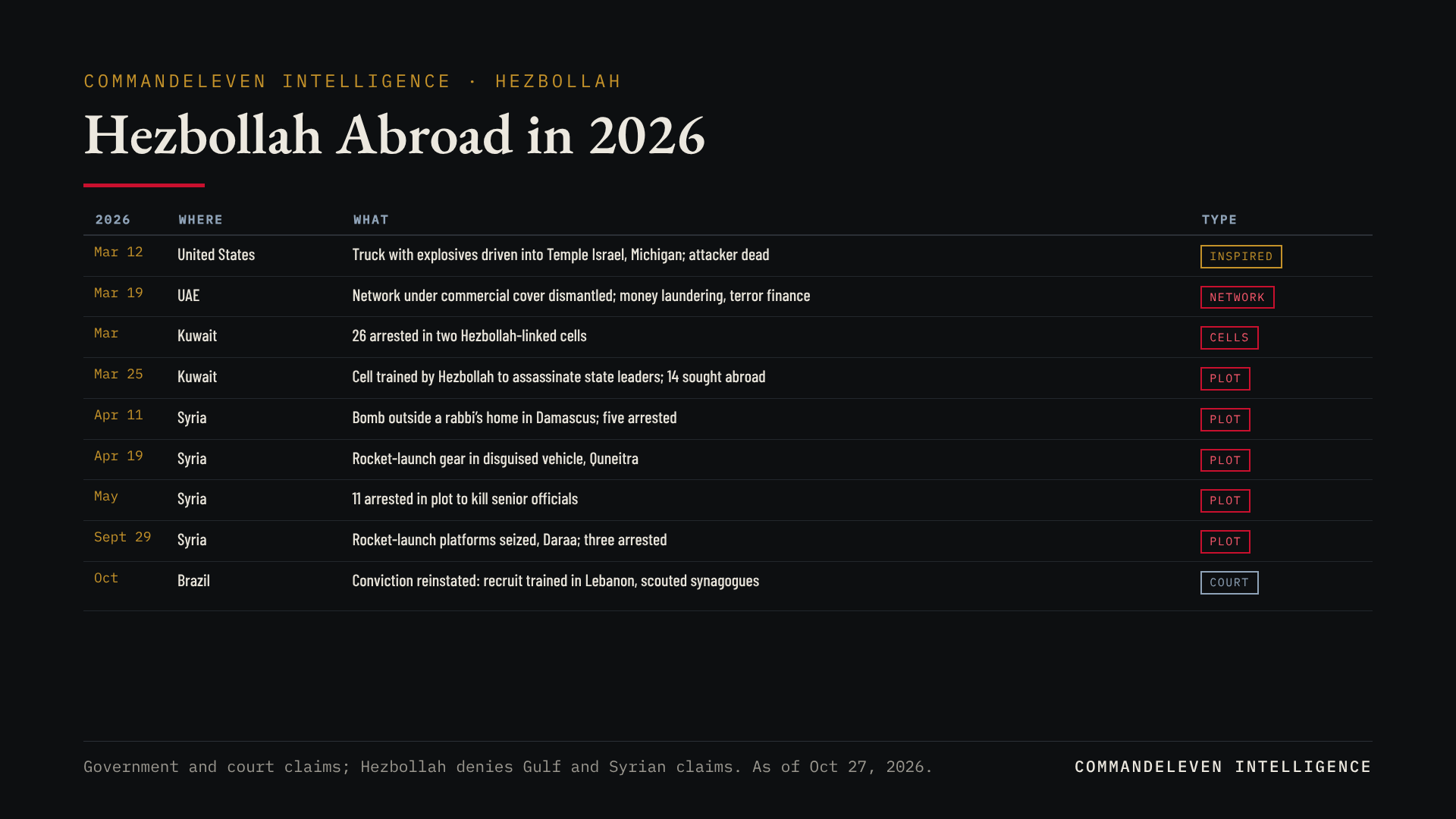
Michigan, March 12. Ayman Ghazali, a 41-year-old Lebanese-born US citizen, drove a truck loaded with explosives and weapons into Temple Israel in West Bloomfield, which houses an early childcare center. A security guard engaged him and he died of a self-inflicted gunshot wound. No one else was killed. Israel says his brother Ibrahim, killed in a strike in Lebanon a week earlier, was a Hezbollah commander. The FBI called it “a Hezbollah-inspired act of terrorism.” The US attorney later said Ghazali “acted under Hezbollah’s direction and control,” but the FBI said it had not verified that he was a member or that he worked with anyone. [CONFIRMED on the attack; direction by Hezbollah unverified]
UAE, March 19. The UAE’s State Security Apparatus said it dismantled a network “funded and operated” by Hezbollah and Iran under a “fictitious commercial cover,” involved in money laundering, terrorist financing and threats to national security. Hezbollah denied having any presence in the UAE. Lebanon’s president condemned the involvement of “Hezbollah elements.” [CONFIRMED as UAE government statement]
Kuwait, March. Kuwait announced the arrest of 26 people in two Hezbollah-linked cells. On March 25 it announced a separate cell whose members, it said, received “advanced military training abroad” from Hezbollah in weapons, explosives, surveillance and assassination, and planned to kill “symbols and leaders of the state.” Six suspects confessed, and 14 more are being sought abroad, including Iranians and Lebanese. [CONFIRMED as Kuwaiti government statements]
The joint warning, March 25. The UAE, Kuwait, Saudi Arabia, Qatar, Bahrain and Jordan jointly condemned “destabilising acts” planned by “sleeper cells loyal to Iran” and Hezbollah-linked groups. [CONFIRMED]
Syria, April to September. Syria’s government has announced four foiled Hezbollah-linked plots:
- April 11, Damascus. A five-member cell tried to plant a bomb outside the home of a religious figure, reported as Rabbi Michael Khoury. Syria said the members had “specialized military training abroad.”
- April 19, Quneitra. Rocket-launching equipment hidden in a disguised civilian vehicle, likely aimed at Israel.
- May. Eleven alleged Hezbollah-linked militants arrested across five provinces in a plot to assassinate senior Syrian officials.
- September 29, Daraa. Three arrested and rocket-launch platforms seized in the Yarmouk Basin.
[CONFIRMED as Syrian government statements; Hezbollah denies involvement]
Brazil, October. Brazil’s Superior Court of Justice reinstated the conviction of Lucas Passos Lima, who prosecutors say traveled to Lebanon twice in 2023 and filmed synagogues, a Jewish cemetery, the Israeli embassy and a rabbi near Brasília. A Brazilian federal prosecutor writing for the Washington Institute describes Hezbollah recruiting financially struggling convicted criminals, flying them to Lebanon for training and sending them home to scout targets. [CONFIRMED on the conviction; REPORTED on the wider pattern]
[ASSESSED] The 2026 pattern has three layers: cells trained in Lebanon and planted in target countries (Kuwait, Syria), business networks that can be turned to sabotage (UAE), and individuals radicalized by the war itself (Michigan). Only the first needs a working chain of command. That is why decapitating Hezbollah’s leadership did not switch off its reach.
The Network That Pays
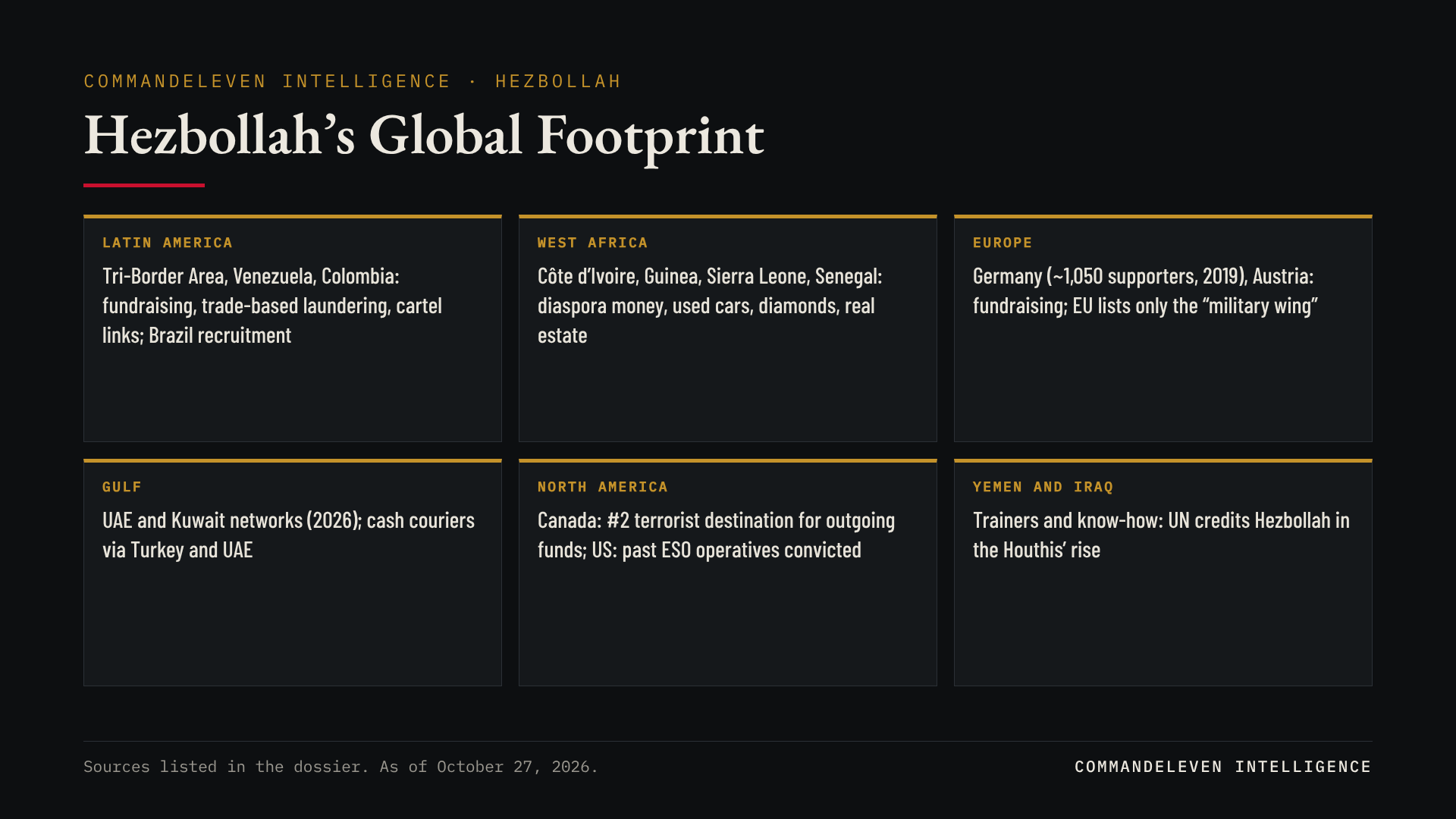
Hezbollah’s attacks abroad are rare. Its presence abroad is permanent, and it is mostly about money and supply.
- Latin America. The Tri-Border Area of Argentina, Brazil and Paraguay, Venezuela and Colombia host fundraising, trade-based money laundering and links to drug cartels. Almost one in ten of the more than 2,000 people and entities the US Treasury has named as foreign narcotics kingpins have ties to Hezbollah, according to the Washington Institute. We covered the Americas networks in From Montréal to the Triple Frontier and Venezuela’s Passport Pipeline. [CONFIRMED]
- West Africa. US authorities call Côte d’Ivoire’s Lebanese community of about 100,000 the “primary conduit for Hezbollah money transfers in Africa,” with networks also in Guinea, Sierra Leone and Senegal using used-car exports, diamonds, real estate and construction. FDD argues Hezbollah will lean harder on these networks as Iran’s money dries up. [CONFIRMED as US finding; ASSESSED by FDD]
- Europe. Germany banned Hezbollah outright in 2020 and its domestic intelligence service counted about 1,050 supporters in the country in 2019. Austria banned it in 2021 after trying a Hezbollah finance commander who had lived there for 13 years. The European Union still lists only the “military wing.” [CONFIRMED]
- The Gulf. Business fronts and exchange networks, now under direct attack: the UAE network in March and Treasury’s August sanctions on couriers flying cash through Turkey, the UAE and Iran (Part 4). [CONFIRMED]
- North America. Canada’s 2025 national risk assessment names Hezbollah the second most frequent international terrorist recipient of funds leaving Canada, as covered in our Americas report. [CONFIRMED]
Exporting the Model
Hezbollah also exports what it knows.
- A 2024 UN panel of experts credited “the assistance and training provided by IRGC-QF, Hezbollah, and Iraqi specialists and technicians” for the Houthis’ transformation into a regional military force. Houthi fighters traveled to Lebanon, Iran and Iraq for training on false passports. [CONFIRMED as UN panel finding]
- Haytham Ali Tabatabai, Hezbollah’s chief of staff until Israel killed him in November 2025, had trained Houthi fighters in Yemen (Part 1). [CONFIRMED]
[ASSESSED] The Houthis are the clearest proof that Hezbollah’s most dangerous export is not explosives but expertise. A group that can teach others to fight a state does not need a large presence abroad to extend its reach.
A Note on Names
Several 2026 plots against Jewish targets in the United States and Europe have been linked to Kataib Hezbollah, an Iraqi militia, not Lebanese Hezbollah. They include the case of Mohammad Baqer al-Saadi, an Iranian-Iraqi charged in New York in May with directing attacks and plots in London, North Macedonia and the United States. Both groups answer to Iran’s Quds Force, but they are separate organizations. This dossier counts only cases that governments or courts have linked to Lebanese Hezbollah. [CONFIRMED]
What It Means
[ASSESSED] Hezbollah inside Lebanon is weaker than at any time since the 1990s. Hezbollah outside Lebanon is not. Its overseas networks have three advantages its forces at home lack: they are spread across dozens of countries, most are commercial or communal rather than military, and few of the governments hosting them treat them as a priority.
The 2026 war showed what happens when Iran needs them. The next war will test whether the Gulf states’ crackdown, Syria’s interceptions and Treasury’s sanctions have closed the gaps, or only exposed them.
Dated Calls
These calls are registered on the Foresight Record and will be scored on the dates given.
- By March 31, 2027. At least one more government outside Lebanon, Israel and Syria publicly announces arrests in a plot or cell it links to Lebanese Hezbollah. [ASSESSED]
- By March 31, 2027. US federal prosecutors charge at least one more person with providing material support to Lebanese Hezbollah. [ASSESSED]
- By June 30, 2027. The European Union does not designate Hezbollah as a whole, including its political wing, as a terrorist organization. [ASSESSED]
What This Dossier Does Not Claim
- It does not claim the Michigan attacker was a Hezbollah member or acted on its orders. The FBI calls the attack Hezbollah-inspired and has not verified direction.
- It does not treat Kataib Hezbollah cases as Lebanese Hezbollah cases.
- It does not independently confirm the Gulf and Syrian government claims. Hezbollah denies them.
- It does not estimate the number of Hezbollah operatives abroad. No reliable public figure exists.
Frequently Asked Questions
Does Hezbollah operate outside Lebanon?
Yes. It has an external operations unit that plans attacks abroad and long-standing financial and logistics networks in Latin America, West Africa, Europe and the Gulf.
Was the 2026 Michigan synagogue attack carried out by Hezbollah?
The FBI called it a “Hezbollah-inspired act of terrorism.” The attacker’s brother was a Hezbollah commander killed in Lebanon a week earlier, but the FBI has not verified that the attacker was a member or worked with anyone.
Which countries have foiled Hezbollah plots in 2026?
Publicly, Kuwait, the UAE and Syria. Brazil reinstated a conviction in a Hezbollah recruitment case in October.
Is Hezbollah the same as Kataib Hezbollah?
No. Kataib Hezbollah is an Iraqi militia. Both are backed by Iran, but they are separate organizations.
Sources
- Washington Institute, Lebanese Hezbollah Select Worldwide Activities: Interactive Map and Timeline
- Washington Institute (Matthew Levitt), Breaking Hezbollah’s Golden Rule, Season 2
- US Drug Enforcement Administration, DEA and European Authorities Uncover Massive Hizballah Drug and Money Laundering Scheme
- Jewish Insider, FBI: Temple Israel attack was “Hezbollah-inspired”
- Michigan Public, FBI: Temple Israel attack was an act of terrorism
- The Times of Israel (AFP), UAE says it dismantled terrorist network funded by Iran and Hezbollah
- The National, Kuwait foils Hezbollah plot to assassinate leaders of the state
- Kuwait Times, Kuwait foils major terror plot linked to Hezbollah
- The Times of Israel, Five arrested as Syria says it foiled Hezbollah-linked plot to kill Damascus rabbi
- FDD’s Long War Journal, Syria says it thwarted Hezbollah plot; Israel likely target
- FDD’s Long War Journal, Syria reports neutralizing Hezbollah plot to assassinate senior officials
- The Jerusalem Post, Hezbollah sends Latin American recruits to Lebanon for training before targeting Jewish communities
- FDD (The National Interest), To Squeeze Hezbollah, Look to West Africa
- L’Orient Today (Reuters), Iran, Hezbollah enabled Houthis’ rise, says UN report
- The National, Iranian “terror mastermind” feared to be plotting attacks from behind bars
- FDD’s Long War Journal, Histories of Hezbollah’s assassinated top military commander, likely candidates to replace him